How can an OHS regulator get the management of its own staff so wrong?

How can an OHS regulator get the management of its own staff so wrong?

In June 2014, a NSW Parliamentary inquiry released its final report into Allegations of bullying in WorkCover NSW, that State’s occupational health and safety (OHS) regulator. The report found that

“…Workcover has a significant organisational problem with bullying.  This problem is a longstanding one and operates at a cultural level.” (page x)

The Committee Chairman Hon Fred Nile MLC, wrote that

“more effective leadership and governance is essential.” (page x)

Longstanding bullying problems?  Problems with leadership and governance?  Many companies and public sector organisations have had similar issues ambulances, police, fire services, research organisations, to name a few, and are working them through. What happened in New South Wales?
Subscribe to SafetyAtWorkBlog to continue reading.
Subscribe Help
Already a member? Log in here

Senator Abetz oversteps on workplace bullying claim

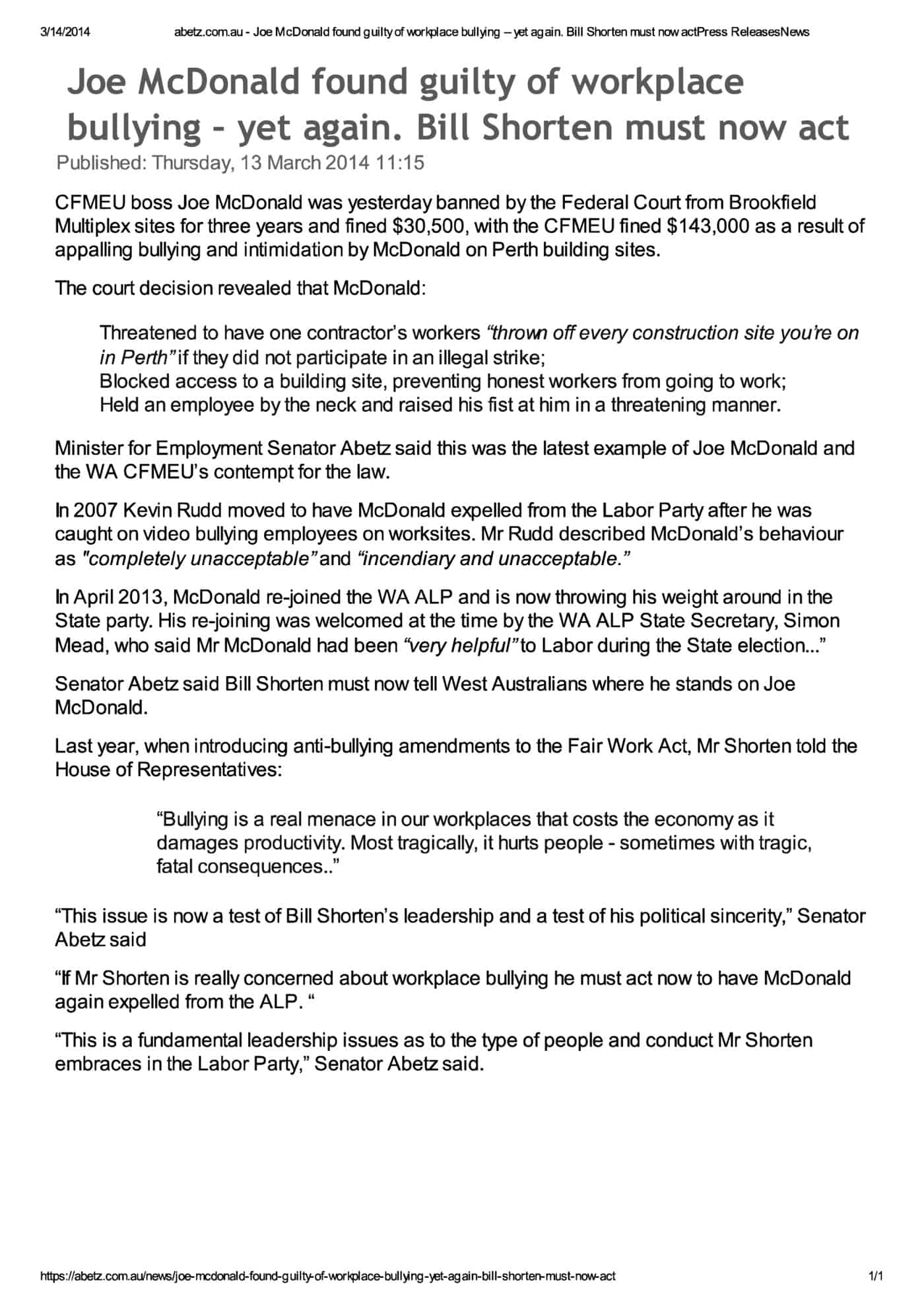
abetz.com.au - Joe McDonald 130314Anyone dealing with occupational health and safety (OHS), or in any profession, knows to be careful with one’s words in public.  This is particularly so when one is dealing with mental health issues or claims of workplace bullying.  This week Senator Eric Abetz, Australia’s Workplace Relations Minister, seems to have overstepped the mark by misrepresenting some Federal Court Orders as related to workplace bullying, when the Court made no such statement.  This could simply be dismissed as political hyperbole in the heat of the moment but this was no off-the-cuff remark.  He headlined his media release on 13 March 2014 as:

“Joe McDonald found guilty of workplace bullying – yet again. Bill Shorten must now act”.

According to Safe Work Australia, an organisation within Senator Abetz’s portfolio, workplace bullying is defined in the most recent national guide as

“repeated and unreasonable behaviour directed towards a worker or a group of workers that creates a risk to health and safety.” (page 2)

Nowhere in the Federal Court orders*  is workplace bullying, or any other bullying, mentioned and the Federal Court has not found Joe McDonald guilty of workplace bullying. The best that can be said is that Joe McDonald has a history of intimidation on construction sites and that this has created tense relations between the workforce and employers (perhaps a confused safety culture) and generated delays in construction.

Does this all matter? Yes

Subscribe to SafetyAtWorkBlog to continue reading.
Subscribe Help
Already a member? Log in here

New political challenges for OHS in Australia

This weekend the Australian people voted for the conservative Liberal Party to be the next Federal government.   Workplace safety has been largely absent from the pre-election campaign but when it has been mentioned it has almost always been couched in terms of productivity.  In the next few years, workplace safety issues must be couched in terms of productivity to have any hope of gaining the ear of the new government and, particularly, the ear of Senator Eric Abetz, the most likely candidate for the ministry of workplace relations.

Workplace Bullying

Recent changes to workplace bullying laws which provide a prominent role of the Fair Work Commission are unlikely to be rolled back but Abetz has promised Continue reading “New political challenges for OHS in Australia”

Safety change through rape?!

At many occupational health and safety seminars and conferences in Australia there is often an OHS professional in the audience who says that jail time is the only real and effective deterrent for those breaking safety laws, usually in the context of gross negligence, reckless endangerment or industrial manslaughter.  The threat of imprisonment is indeed a deterrent for some people.

But sometimes there is an OHS professional who colours their call for imprisonment by suggesting that, once in prison, offenders should be harmed or even raped.  An example appeared on an OHS discussion forum within the last week.  The comment, on an issue of fall prevention, included this phrase:

“Only need to send a few for a short holiday with “Bubba” and some soap on a rope, to get the message across to the masses.”

This person is suggesting that the deprivation of liberty is insufficient punishment for an OHS offence and that the offender should also be raped.  What does this say about the real values of a person whose profession is based on harm minimisation and the elimination of hazards?

If, as The Guardian newspaper says, the two main principles for jail are “in order to punish wrongdoers, and to remove the danger they would otherwise pose to the wider world”, where is the justification for abuse?

The “Bubba” comment above, and many similar comments I have heard over the years, may be an extension of the cynicism that many OHS professionals seem to acquire over their time in the profession.  But it is also offensive and shows an approach to humanity that I do not share and that I believe has no place in the OHS profession, or anywhere, for that matter.  It is lazy thinking, and these thoughts come from those who advise Australian businesses!  It is a shameful situation.

Kevin Jones

OHS would benefit from a historical perspective on workplace bullying

Every year, around this time, the mainstream media reports on the findings of employee surveys of the Victorian public service. Each year the statistics on workplace bullying are featured.  (The Age newspaper reported on the latest survey on 31 March 2013.)  But the approach to an understanding of workplace bullying has changed over the last fifteen years or so.  A brief look at the March 2001 Issues Paper on workplace bullying, released by the Victorian Workcover Authority (VWA), is useful to illustrate the degree of  change but also the origin of some of the contemporary hazard control themes.

Cover of Bullying Issues PaperThe VWA Issues Paper was always intended to lead to a formal Code of Practice but due to belligerence from various industry bodies, no code eventuated and Victoria had to make do with a guidance note.  This effectively banished workplace bullying to a nice-to-manage rather than an essential element of modern management.  Significantly, Safe Work Australia intends to release a model Code of Practice on workplace bullying shortly. Perhaps the employer associations’ attitudes have mellowed.  Perhaps it is the decline of trade union influence since 2001.

The Issues Paper roughly defines workplace bullying as:

“…aggressive behaviour that intimidates, humiliates and/or undermines a person or group.” Continue reading “OHS would benefit from a historical perspective on workplace bullying”

Australian Government shifts workplace bullying into the industrial relations system

Politicians are sufficiently media-savvy to release policies and information to gain the maximum exposure in the media cycle.  For some reason, Australia’s Workplace Relations Minister, Bill Shorten, missed the opportunity to have his changes on workplace bullying in the newspapers for 12 February 2013.  The news cycle is also being dominated by the resignation of Pope Benedict.  However Shorten’s response to the Parliamentary Inquiry into Workplace Bullying deserves detailed analysis.

??????????????????????????????????Shorten is bringing the investigation of workplace bullying cases under the Fair Work Commission.  There are likely to be complex consequences of this decision, a decision that is clearly the Minister’s as the Parliamentary Inquiry made no clear recommendation on the location of the “new national service”.

“The Committee did not receive evidence on where such a service [“a single, national service to provide advice to employers and workers alike on how to prevent, and respond to workplace bullying” 5.51, page 136] should be located.  It might be best situated within an existing government agency or department such as Safe Work Australia, the Fair Work Ombudsman or the Department of Education, Employment and Workplace Relations.  It may also be considered appropriate for the service to be an independent body that is funded by the Commonwealth. Consequently, the Committee does not have a clear recommendation as to where the new national service may sit.” (Section 5.58, page 138)

Clearly Shorten’s announcement could easily have been “Minister rejects independent body on workplace bullying”.  The Minister should be asked about his reasons for not establishing an independent body into this important issue. Continue reading “Australian Government shifts workplace bullying into the industrial relations system”

Considering organisational violence may provide a more effective path to controlling psychosocial issues at work

Vaughan Bowie is an Australian academic who has chosen workplace violence as his major area of interest. Bowie came to general prominence earlier this century with several books and his contribution to the WorkcoverNSW guidance on workplace violence.

Cover from Proceedings_3rd_Workplace_Violence_2012His research has taken him to look at “organisational violence” and in October 2012, he addressed the 3rd International Conference on Violence in Healthcare (the proceedings are available HERE) on the topic in a presentation called “Understanding organizational violence: The missing link in resolving workplace violence?”

Bowie writes, in the conference proceedings (Page 155), that

“Initially much of the workplace violence (WPV) prevention and management responses focused on criminal violence from outside organizations. At the same time there was also a growing concern about service user violence on staff especially in the human services area. A later stage of this development was a growing recognition of relational violence at work.  This includes staff-on-staff violence and aggression, bullying, horizontal violence, sexual harassment and domestic violence.

Models based on these areas of WPV have been developed by the International Labor Organisation (ILO), the World Health Organisation (WHO), the Injury Prevention Research Center (IPRC) and the California Occupational Safety and Health Administration (Cal/OSHA) and other regulatory bodies. This presentation will show that the current models and responses based on these types of WPV are inadequate and ineffective because they largely ignore the fact that organizational culture and management style have a direct contributory effect on the types of violence experienced by employees, third parties, and service users.  The findings demonstrate that what at first appears to be criminal, service user or relational violence at work may in fact be the outcome of a type of ‘upstream’ organizational violence trickling down in a toxic way triggering further violence.” (emphasis and links added) Continue reading “Considering organisational violence may provide a more effective path to controlling psychosocial issues at work”

Concatenate Web Development
© Designed and developed by Concatenate Aust Pty Ltd