
The bookshops I visit often have two sections of books marked Business and Management. These categories are interchangeable for occupational health and safety (OHS) purposes, but the shopowners and/or publishers differentiate. Both categories have self-help books – leadership varieties, how to be a better manager, how to make lots of money really quickly (without apparently anyone being exploited!!). Books discussing mental health are in both categories, and three, in particular, seem to show the potential for improvement in mental health and the self-imposed limitations to achieving this.
Category: wellness
Resilience training is not dead, but it is coughing up blood
[This article was submitted to The Age (and elsewhere) as a soft counter to so many workplace articles about health and safety that never include content from an occupational health and safety (OHS) specialist. It was never used, even though rewrites were requested.
So it gets used here and in support of this curious month of October where, in Australia, there are two separate monthly themes – Mental Health and Work Health and Safety. That these themes continue to be separate says heaps about the culture in each of these sectors]
Australian jurisdictions are amending their workplace health and safety (WHS) legislation to specify that the unavoidable duties and obligations of employers must now include the psychological health of their workers and not just physical health. These reasonable and long overdue moves are manifesting in new laws, and new guidances supported by new International Management Standards. The kicker in these changes is that, at least in Victoria, employers will no longer be able to rely solely on awareness training or resilience training to manage workplace mental health. This position could, and should, challenge traditional mental health trainers and lobbyists to recalibrate their workplace strategies.
Continue reading “Resilience training is not dead, but it is coughing up blood”
Plants, cake and mental health
On mental health, a clinical psychologist, Dr Sanah Ahsan wrote in The Guardian recently that:
“…. I’ve seen first hand how we are failing people by locating their problems within them as some kind of mental disorder or psychological issue, and thereby depoliticising their distress.”
The Guardian, 6 September 2022
This perspective, enlightened for psychologists, is an established position for the Occupational Health and Safety (OHS) advocates. But OHS advocates have been traditionally weak and sometimes timid outside of the trade union movement. Most employers will pay more attention to the OHS position on mental health when it is spoken by one of their own or by a more respected professional.

Traditional suicide prevention strategies struggle for relevance
September 10 is World Suicide Prevention Day. Many organisations are and will be, releasing information about suicides but not really the prevention of suicides, more the management of potential suicides. It is a curious international day as it is almost a warm-up to Mental Health Day (and, in some places, Month).
This week Suicide Prevention Australia (SPA) released a report based on a survey of 283 responses, the majority from members of SPA. It’s not a representative survey, but it gained a fair bit of media attention. It also raises consideration of the meaning of a “whole-of-government” approach and the role of Regulations in preventing suicides.
Regardless of the peculiar survey sample, the media release accompanying offered a statement that should have all mental health and suicide prevention professionals reassessing their strategies.
Webinar of insight and update
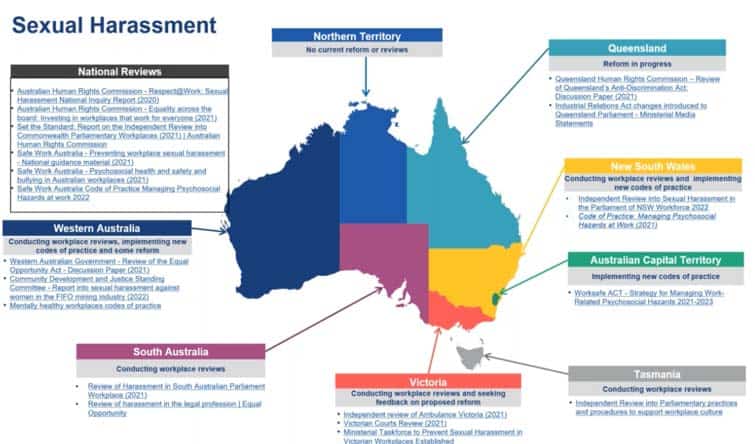
Recently 700 people registered for a webinar conducted by Herbert Smith Freehills on work health and safety reforms, primarily on psychosocial risks at work. These risks were presented in various inquiries into sexual harassment, fly-in fly-out work practices but also generated new regulations, guidances and codes.
Steve Bell spoke about the responses from occupational health and safety (OHS) regulators to these issues and said:
Evidence provided for structural change in construction safety management
In July 2022, RMIT University release a three-part series on physical and mental health in Australia’s construction industry consisting of Evidence, Exploration and Evaluation. By themselves, they make a strong case for structural reform of the construction sector to improve workers’ mental and physical health.
New book aims to spur the US to action on workplace mental health
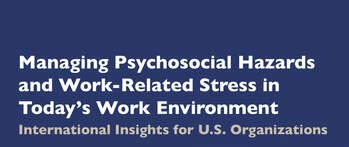
A new book on workplace psychological hazards and laws has been published. The book “Managing Psychosocial Hazards and Work-Related Stress in Today’s Work Environment – International Insights for US Organizations” written by Ellen Pinkos Cobb, has a similar format to her coverage of international sexual harassment laws in a previous publication. Many occupational health and safety-related books written in the United States suffer from American parochialism. Cobb’s book is written for US organisations to show what workplace health and safety achievements are possible. The book is a very good summary of international changes in workplace psychosocial hazards.