Two exemptions to Victoria’s Industrial Manslaughter laws

Every industry sector should have its own occupational health and safety (OHS) conference.  This allows for specific OHS topics to be presented but also provides for a broader context. The recent conference conducted by the Victorian Branch of the Australian Nursing and Midwifery Federation (ANMF) was a great example.

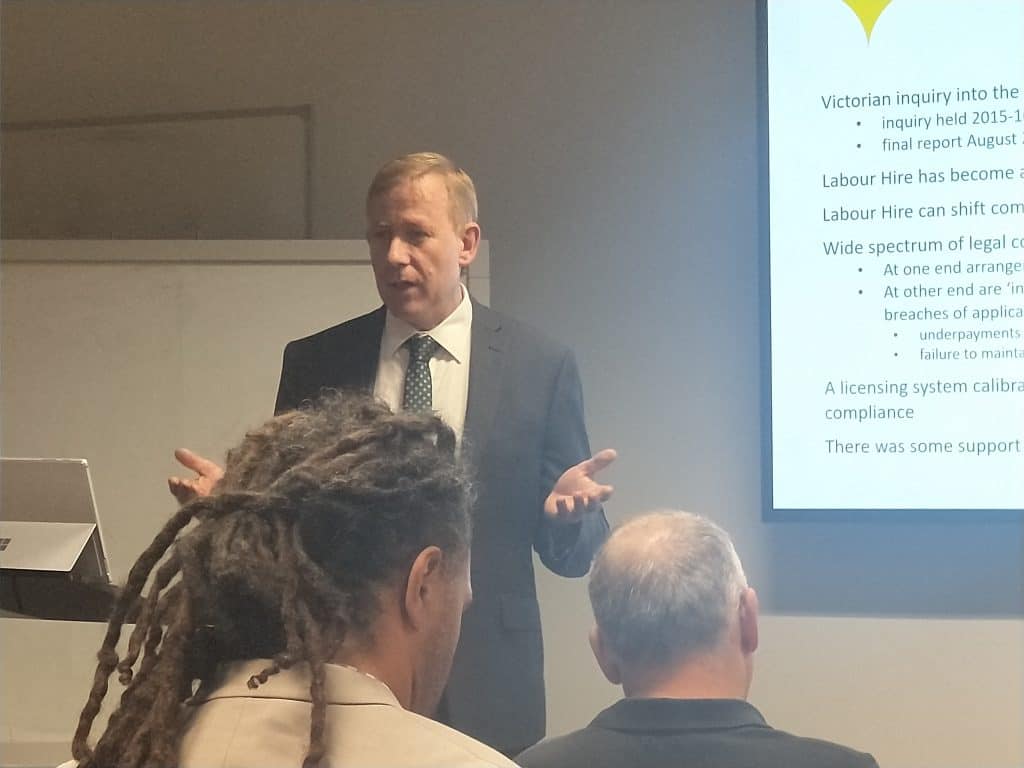
So close to a State election and in the lead-up to a Federal election it was not surprising that the trade union movement’s Change The Rules campaign gained attention, as did the push for the introduction of Industrial Manslaughter laws, in the presentation by Dr Paul Sutton.

The main points of his presentation are familiar and have been reported on previously but this presentation included news about two exemptions to the laws which may raise uncomfortable questions. 

Subscribe to SafetyAtWorkBlog to continue reading.
Subscribe Help
Already a member? Log in here

AI Group responds to media report on apprentice’s death

The Australian Industry Group and its Chief Executive Innes Willox have been criticised on social media in Australia today as a result of an ABC report into a workplace fatality that occurred during the AI Group’s apprenticeship program.  The criticism has come as the AI Group is very active on matters of occupational health and safety policy to its members and government

The AI Group provided SafetyAtWorkBlog with this statement concerning the report: Continue reading “AI Group responds to media report on apprentice’s death”

A deep look at sleep and mental health in the workplace needed

In September 2018 Australia commenced an inquiry into sleep health awareness.  At the time:

“The Committee Chair, Mr Trent Zimmerman MP, stated that ‘the Committee will examine the causes, economic and social costs, and treatment of inadequate sleep and sleep disorders.” (link added)

Although there is no timetable for the tabling of this Committee’s final report, many of the issues raised in the submissions relate directly to work and work-related mental health risks. Sadly there are hardly any solutions but this is a challenge to all public inquiries and which is particularly relevant to the current spate of Australian inquiries into OHS and mental health.

Subscribe to SafetyAtWorkBlog to continue reading.
Subscribe Help
Already a member? Log in here

The future of the worker

There have been many inquiries and investigation in Australia and elsewhere about the “future of work” but rarely about the “future of the worker”.  Research often looks at how work may be transformed by technology and new labour/employment structures with an assumption that the worker is a passive and static element in this change.  Those in occupational health and safety (OHS) and workers’ rehabilitation know that this is not the case.

This article looks at one aspect of the future of the worker.

Subscribe to SafetyAtWorkBlog to continue reading.
Subscribe Help
Already a member? Log in here

Advertorial over-simplifies workplace health and safety

On Sunday November 4 2018, The Herald-Sun newspaper’s regular Body & Soul supplement devoted several pages to an exclusive article about workplace wellbeing ($). It is clearly an advertorial as the supplement has several full page advertisement from Medibank Private and the article includes a text box labelling it as the

“b+s 2018 Worklife Survey in partnership with Medibank”.

The article and survey is less than helpful from an occupational health and safety (OHS) perspective as there is no mention of organisational control measures or even the recent campaign in National Safe Work Month by WorkSafe Victoria on wellness!

Subscribe to SafetyAtWorkBlog to continue reading.
Subscribe Help
Already a member? Log in here

Misunderstanding sleep – Part 2

Most non-transport industries do not look for the lack of sleep or fatigue as a factor in their investigations.  Unless a formal investigation is undertaken, fatigue is rarely mentioned and, if it is, it is categorised as a “contributory factor”, which often means it is given such a low priority that nothing will be done about it.  This is partly a legacy of silo thinking that sleep is a non-work personal activity, which it is, but is still one that can affect work and all the relationships and decisions made at work.  But it is also partly due to the enormous disruption that could result if the lack of sleep and fatigue were taken seriously and effective control measures were introduced.

The most effective control for fatigue may be human-friendly shifts and “reasonable” working hours but that might not fit the shift rosters which are required to satisfy clients.  We know that night shift has higher health and physical risks than day shift so logically, get rid of night shift ….

Subscribe to SafetyAtWorkBlog to continue reading.
Subscribe Help
Already a member? Log in here

Misunderstanding sleep – Part 1

On the corner of Lygon and Victoria Streets in Melbourne is a monument to the 8 Hour Day.  This represents a social structure of work that equates to

  • Eight hours of work,
  • Eight hours of recreation,
  • Eight hours of sleep,

The concept started in Australia in the mid-1800s and was intended to reduce exploitation and abuse of workers, many of whom were children.

The intent was to establish, what we would now call, a work/life balance structure with the recognition that work is required to earn a living, sleep is required to rejuvenate the body, preparing it for work, and recreation was social time, time with one’s family, exercise, all sorts of personal and social activities.

Today that structure is an “ideal” rather than a reality. 

Subscribe to SafetyAtWorkBlog to continue reading.
Subscribe Help
Already a member? Log in here
Concatenate Web Development
© Designed and developed by Concatenate Aust Pty Ltd