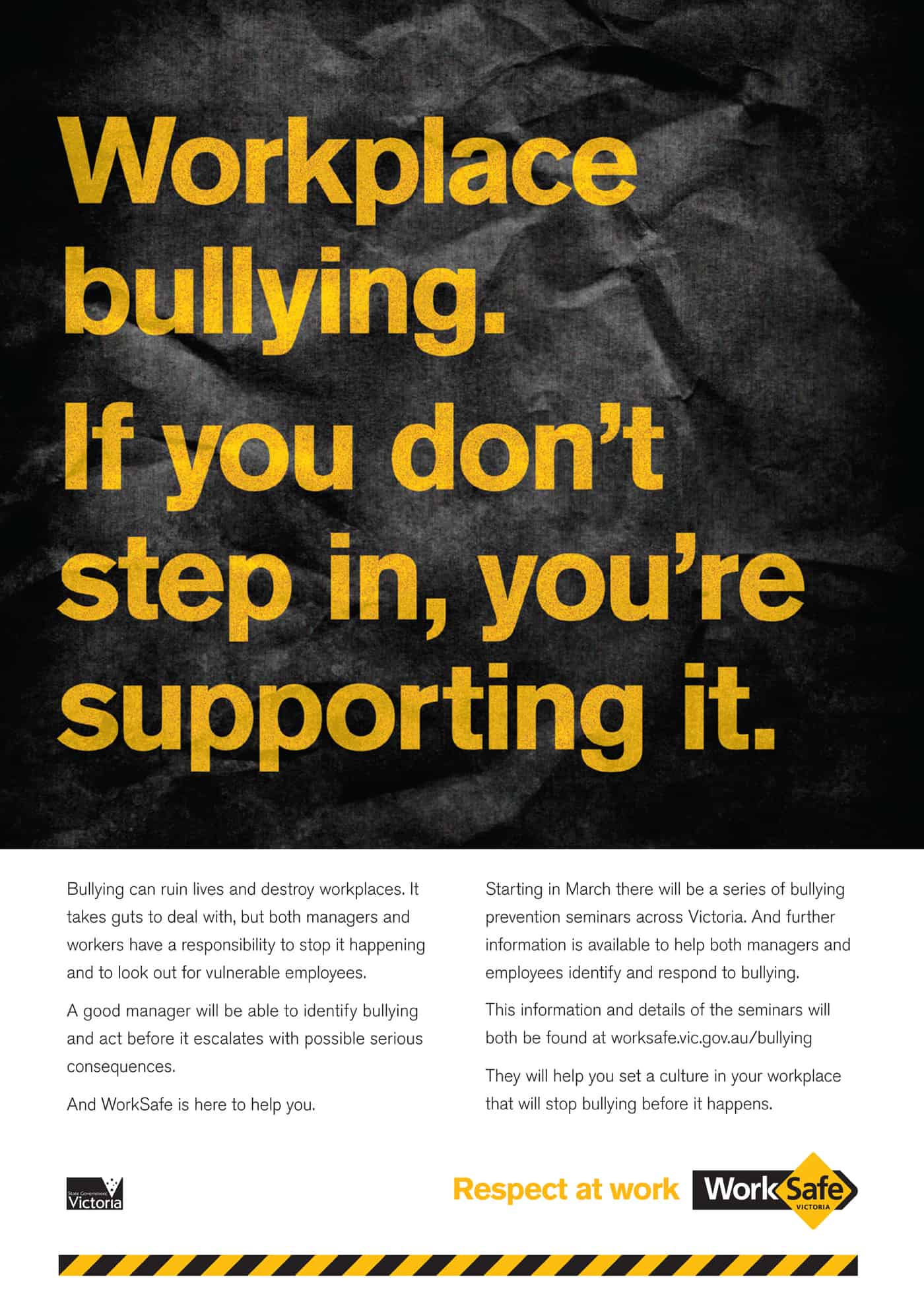
OHS would benefit from a historical perspective on workplace bullying

Every year, around this time, the mainstream media reports on the findings of employee surveys of the Victorian public service. Each year the statistics on workplace bullying are featured.  (The Age newspaper reported on the latest survey on 31 March 2013.)  But the approach to an understanding of workplace bullying has changed over the last fifteen years or so.  A brief look at the March 2001 Issues Paper on workplace bullying, released by the Victorian Workcover Authority (VWA), is useful to illustrate the degree of  change but also the origin of some of the contemporary hazard control themes.

Cover of Bullying Issues PaperThe VWA Issues Paper was always intended to lead to a formal Code of Practice but due to belligerence from various industry bodies, no code eventuated and Victoria had to make do with a guidance note.  This effectively banished workplace bullying to a nice-to-manage rather than an essential element of modern management.  Significantly, Safe Work Australia intends to release a model Code of Practice on workplace bullying shortly. Perhaps the employer associations’ attitudes have mellowed.  Perhaps it is the decline of trade union influence since 2001.

The Issues Paper roughly defines workplace bullying as:

“…aggressive behaviour that intimidates, humiliates and/or undermines a person or group.” Continue reading “OHS would benefit from a historical perspective on workplace bullying”

An OHS look at the Australian Labor Party’s National Platform

Cover of National Platform 2011 ALPThe leadership squabbles in the Australian Labor Party (ALP) have diminished  for the moment, and the next Federal election is set for September 2013.  Most everyone is tipping the ALP to lose the election.  The verb “lose” is specifically chosen, for the opposition Liberal/National coalition will probably win “by default”.  Whatever the electoral outcomes, the major political parties in Australia have current positions and policies on workplace safety.  Six months out from an election, it may be worth looking at those policies, as they currently stand. The first is that of the ALP.

The ALP has an extensive National Platform that was presented at its National Conference in 2012.  Below are some of the statements from that document as they pertain to occupational health and safety (OHS).  Some commentary is offered on these statements.

“The Labor Government places the highest priority on worker safety, particularly miner worker safety.” (page 42) Continue reading “An OHS look at the Australian Labor Party’s National Platform”

CSB pushes for a more effective discussion on fatigue management

Occupational health and safety has many examples of addressing small or short-term issues rather than  facing the difficult and hard, but more sustainable, control measures. I was reminded of this by a recent media statement from the United States Chemical Safety Board (CSB) in relation to fatigue management.

In 2007 the CSB recommended that, following the Texas City refinery fire,

“the American Petroleum Institute (API) and the United Steelworkers International Union (USW) jointly lead the development of an ANSI consensus standard with guidelines for fatigue prevention in the refinery and petrochemical industries.” [links added]

The progress of API and USW in developing the 2010 ANSI-approved Recommended Practice 755 (RP 755) has been reviewed by the CSB staff and they have found the following disturbing problems:

  • “The document was not the result of an effective consensus process, and therefore does not constitute a tool that multiple stakeholders in the industry can “own.” It was not balanced in terms of stakeholder interests and perspectives, and did not sufficiently incorporate or take into account the input of experts from other industry sectors that have addressed fatigue risks. Continue reading “CSB pushes for a more effective discussion on fatigue management”

First aid marketing exercise requires analysis

It is common to use a self-commissioned survey to market one’s services but sometimes the evidence does not support some of the marketing statements. The latest survey by St John Ambulance is a good example of this.

According to St John Ambulance’s media release on 13 March 2013:

“Only 13 per cent of Australian workplaces know how to keep their employees safe according to new research released … by … St John Ambulance Australia.”

Cover of First aid in the workplace - code 2012This is reworded in the report (page 2) as

“…only 13% of Australian businesses are compliant with the new [First Aid in the Workplace Code of Practice]’s requirements…”

The survey sample does not support the generalisations above. Continue reading “First aid marketing exercise requires analysis”

The Iceberg of Bullying

I’ve frequently observed a manner of bullying not easily described, a below the surface iceberg of bullying.  It can range from a parent relentlessly nagging a child with “You don’t love me”, to a manager at work asking a worker – with a fixed grin, “Don’t you love me anymore, matey?” whilst requesting (always with good humour) a dangerous task to be done, for the good of The Team.  It’s here that language and gestures are used as instruments of camouflage.

A permanent tone of obligation is present, constructed on illusions marketed locally as axioms of behaviour:  “We’re a team, Team, aren’t we Team?!”, “Our first concern is the H&S of our employees”, “They are our most important resource”, “We take their safety issues most seriously”, “Nothing comes before that”.  This is a hybrid form of insidious double bind, but much more subtle than ‘You‘re damned if you do and you’re damned if you don’t’.  It’s a single theme with regular pin pricks often generating permanent anxiety and learnt helplessness.

I have seen workers completely worn out by it.  They are silently humiliated and angry because the truth of the matter is never exposed.  I’ve seen them sitting quietly eating their lunch surrounded by fancy documents in thin frames or dutifully laminated for posterity: The Corporate OHS Policy, The Family Support Policy, The Anti-Discrimination Policy; The Anti-Bullying Policy; The Fatigue Policy. Continue reading “The Iceberg of Bullying”

Where are the Codes for establishing a safety culture?

Recently a safety professional told me he was investigating an incident on a work site and asked his first question “What do you think caused the incident?” The response was “safety culture”. Of course the next question will always be “what do you mean by safety culture?” and in most cases at this point the investigation will stall.

iStock_000023283219XSmallAll workplaces have a safety culture, it is just that most are dysfunctional or immature. In many workplaces, incident causes are handballed to this poorly understood concept of which most take as the latest iteration of “an act of God” or an SEP – “someone else’s problem”.

Safety regulators need to break the use of safety culture as an excuse by developing codes of practice on how to introduce and build an effective safety culture in Australian workplaces.

Continue reading “Where are the Codes for establishing a safety culture?”

New campaign indicates old-school thinking

IPC Athletics World Championship, Tuesday, 25 January 2011

Today WorkSafe Victoria launches a new return-to-work campaign which will use Paralympian Jack Swift as the “face” of the campaign.  The campaign is sure to be successful but the increasing focus of safety regulators on return-to-work (RTW)  may illustrate a growing trend where rehabilitation policy strategies are gaining priority over injury prevention. Yet innovative approaches to injury prevention provide the greatest potential for personal, economic and social savings.

In 2001 WorkCover NSW began its Paralympian Sponsorship Program, a program that continues.  The advantage of the New South Wales program is that it features a range of incident scenarios and, most importantly, the paralympians speak about “workplace safety, injury prevention and management and their personal road to recovery, return to work.” (emphasis added)  This broad, multi-category approach seems to be missing from the new Victorian campaign. Continue reading “New campaign indicates old-school thinking”

Concatenate Web Development
© Designed and developed by Concatenate Aust Pty Ltd