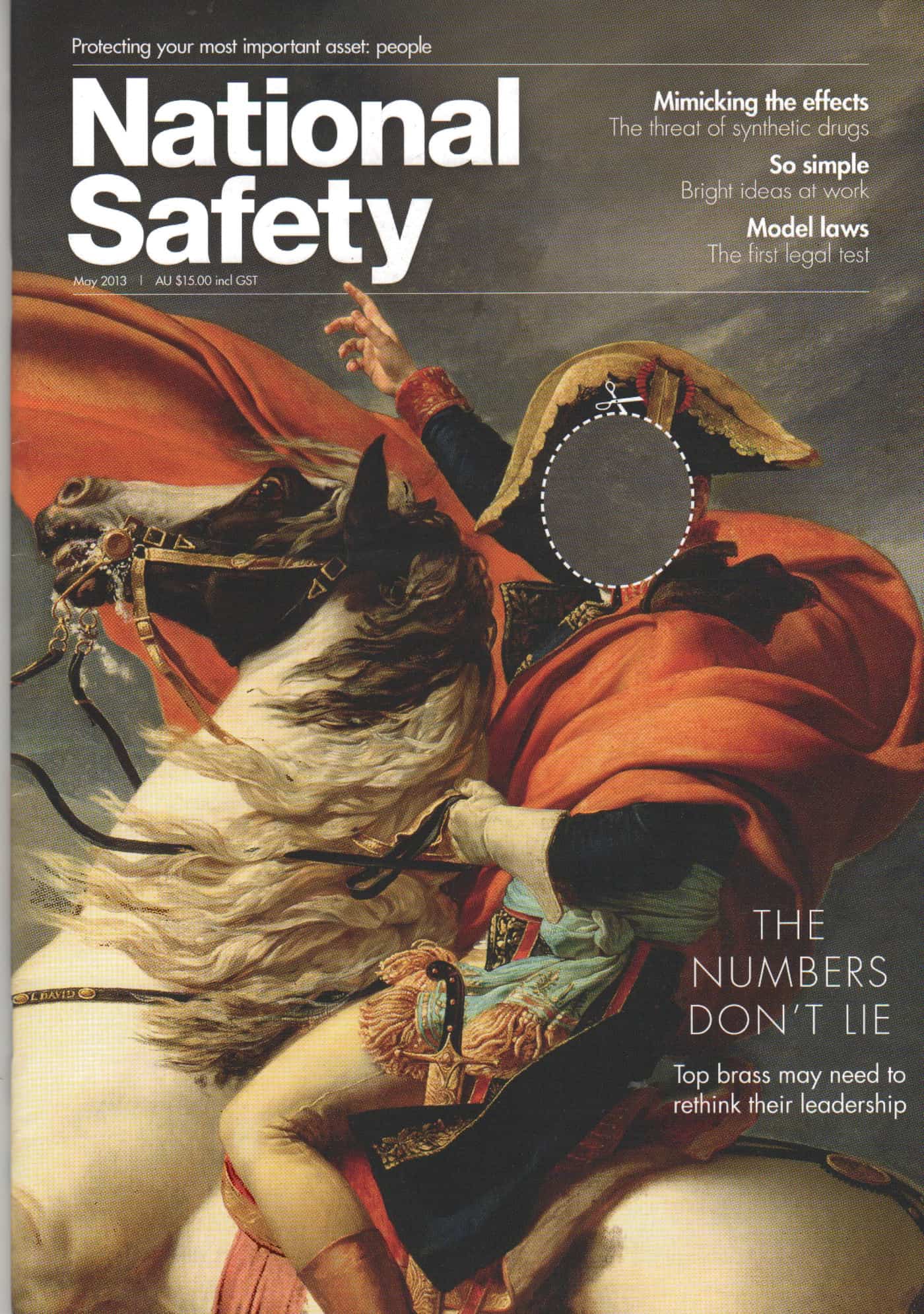
Double your money, invest in OHS

The corporate wellness advocates have been able to estimate the return-on-investment (ROI) for their programs but there has been little research on the return-on-prevention, until recently. In 2012 the International Social Security Association (ISSA) determined that, in microeconomic terms,

“…there are benefits resulting from investment in occupational safety and health… with the results offering a Return on Prevention [ROP] ratio of 2.2.”

This means that for every one dollar spent per employee per year the potential return is 2.2 dollars.

The report also found that OHS provides, amongst other benefits:

  • Better corporate image
  • Increased employee motivation and satisfaction, and
  • Prevention of disruptions.

But why bother costing harm prevention when there is already a legislative requirement to provide safe and healthy workplaces? Such a question usually comes from those whose understanding of OHS is principally compliance and who believe compliance equals safety.

The calculation of ROP, in the ISSA report at least, counters the belief that safety is always a cost with no economic benefit to the company. A positive ROP provides an opportunity to actively participate in the economic debate over productivity and, in some countries, austerity.

Kevin Jones

Australian Government shifts workplace bullying into the industrial relations system

Politicians are sufficiently media-savvy to release policies and information to gain the maximum exposure in the media cycle.  For some reason, Australia’s Workplace Relations Minister, Bill Shorten, missed the opportunity to have his changes on workplace bullying in the newspapers for 12 February 2013.  The news cycle is also being dominated by the resignation of Pope Benedict.  However Shorten’s response to the Parliamentary Inquiry into Workplace Bullying deserves detailed analysis.

??????????????????????????????????Shorten is bringing the investigation of workplace bullying cases under the Fair Work Commission.  There are likely to be complex consequences of this decision, a decision that is clearly the Minister’s as the Parliamentary Inquiry made no clear recommendation on the location of the “new national service”.

“The Committee did not receive evidence on where such a service [“a single, national service to provide advice to employers and workers alike on how to prevent, and respond to workplace bullying” 5.51, page 136] should be located.  It might be best situated within an existing government agency or department such as Safe Work Australia, the Fair Work Ombudsman or the Department of Education, Employment and Workplace Relations.  It may also be considered appropriate for the service to be an independent body that is funded by the Commonwealth. Consequently, the Committee does not have a clear recommendation as to where the new national service may sit.” (Section 5.58, page 138)

Clearly Shorten’s announcement could easily have been “Minister rejects independent body on workplace bullying”.  The Minister should be asked about his reasons for not establishing an independent body into this important issue. Continue reading “Australian Government shifts workplace bullying into the industrial relations system”

How safe is unsafe?

roofwork 01Across the street from an office in Melbourne, a pub is installing a roof area for entertaining.  The work has gone smoothly as far as one can see but the position of the platform ladder in the corner of the roof was curious. If someone was working from the ladder and wobbled, it would be possible to not only fall a couple of metres to the roof but perhaps over the roof’s edge to the pavement two storeys below.

The worker in the front of this picture was moving to erect another platform ladder towards the front of the roof.

roofwork 02The second picture shows the worker on that platform ladder.  Similar risks of wobbling and falling over the roof’s edge.

How safe is unsafe?  There is the potential for the worker to fall from the ladder to the street some distance below but he didn’t.   So was his positioning of the ladder and work undertaken safe?

Kevin Jones

Social media manipulation of OHS statistics

Recently SafetyatWorkBlog criticised the focus on fatality statistics as a measure of success. Workplace fatalities are a convenient measure but can seriously misrepresent the status of workplace safety by ignoring psychosocial hazards and occupational illnesses. An infographic came through the SafetyAtWorkBlog inbox this weekend which illustrates the unhelpful obsession with fatalities but, perhaps more importantly, the risks of social media.

OSHA-edited-v5This infographic from US firm Compliance and Safety (purposely unlinked) is slickly produced for social media and blogs but is fundamentally invalid. The title at the top is a ridiculous comparison. “Is OSHA a wasteful regulatory nightmare or common sense that saves lives?” The Occupational Safety and Health Administration (OSHA) may be wasteful but how can this be compared to the amorphous and self-serving concept of “common-sense”? The implication is that common sense equates to a free-market regulation of workplace safety. The failure of the free-market approach to occupational safety, and to the environment, many decades ago is exactly the reason why regulations were introduced. There were too many businesses exploiting workers and the environment by creating harm without accountability. Continue reading “Social media manipulation of OHS statistics”

It can take a long time to learn how to manage workplace safety

On 21 December 2012 in the South Australian Industrial Court, Amcor Packaging (Australia) was fined $A96,000 over a breach of the occupational health and safety (OHS) laws.  That type of sentence appears frequently in SafetyAtWorkBlog but the difference this time is that it is the third similar OHS prosecution and fine applied to Amcor in South Australia.  Amcor Packaging has had similar OHS problems in Queensland and Victoria.

According to a SafeWorkSA media release (not yet available online), the latest prosecution involved an incident in November 2010 where:

“Two workers were walking on conveyor rollers to guide an unstable stack of cardboard when one inadvertently stepped into a gap between the rollers. The female worker was then struck by the arm of an automated pallet sweeper, sustaining multiple fractures to her lower leg and ankle.”

Cover  from 2012_sairc_59In his judgment on the case, Industrial Magistrate Stephen Lieschke said there was no risk assessment at the plant and a lack of engineering controls.  The two previous Amcor offences in South Australia also related to inadequate engineering controls.

Recurrence

Magistrate Lieschke also said that

“The two prior offences are highly relevant to this sentencing process, as the court is left with a low level of confidence that Amcor will not commit any future offences…..,”

In June 2008 law firm Holding Redlich mentioned an increase in an OHS penalty against Amcor by the Court of Appeals: Continue reading “It can take a long time to learn how to manage workplace safety”

Safety and productivity links at risk from ill-informed ridicule and media beat-up

Yesterday Australia’s Fairfax Media reported on a “policy” supposedly being applied in the Western Australia resources sector by Chevron Australia that requires workers to stand, rather than sit, for the purposes of increasing productivity.  The initiative has been roundly ridiculed by various political and social commentators, including the Minister for Workplace Relations, Bill Shorten. However few have mentioned that the actions by the “policy” may be in line with recent OHS guidance issued by an Australian government safety authority, Comcare, or that the Victorian Government has granted $A600,000 for research into the use of standing workstations.

SafetyAtWorkBlog has been informed that Chevron has had no role in the production of the “leaked memo” and that this memo is likely to be notes and verbal advice provided at a low-level on a worksite and even simply as part of a regular toolbox meeting.  Fairfax Media is unfairly linking two disparate issues, dragging in Chevron who is not involved with the information and potential damaging valid safety information through unjustified ridicule. Continue reading “Safety and productivity links at risk from ill-informed ridicule and media beat-up”

Political ideologies on show over workplace bullying

In Australia, Parliamentary inquiries are usually required to provide the Parliament with a copy of their findings. In the last week of November 2012, the Chair of the Australia’s Parliamentary Inquiry into Workplace Bullying, Amanda Rishworth, presented its report which included a dissenting report from the Conservative (Liberal Party) committee members. On 28 November both Alan Tudge MP, one of the dissenting committee members, and Deborah O’Neill (Labor Party), spoke to the House of Representatives about the report. Their speeches say much on the issue of workplace bullying and the politics of workplace health and safety (WHS) in Australia.

Statistics and Costs

Tudge acknowledges the importance of preventing workplace bullying but provides an important fact to remember when reading the full report. According to Hansard, Tudge says

“The prevalence of workplace bullying is not known – there is no statistical data to assess exactly how prevalent it is. Regardless of the precise number, we know that it is too prevalent.” (emphasis added)

This may sound a little contradictory but it summarises a problem when investigating workplace bullying, there are no useful statistics on it. Continue reading “Political ideologies on show over workplace bullying”

Concatenate Web Development
© Designed and developed by Concatenate Aust Pty Ltd