
Evidence of the need to change how and why we work

Last week Professor Rod McClure of the Monash Injury Research Institute urged Australian safety professionals to look at the ecology of safety and injury prevention.  By using the term “ecology” outside of the colloquial, he was advocating that we search for a universal theory of injury prevention.  In short, he urged us to broaden our understanding of safety to embrace new perspectives.  It could also be argued that he wanted to break the safety profession out of its malaise and generate some social activism on injury prevention – a philosophical kick in the pants.

Before discussing the latest research Australia’s Barbara Pocock has undertaken, with her colleagues Natalie Skinner and Philippa Williams, the challenge of achieving some degree of balance between the two social activities of work and non-work can be indicated by a graph provided by Dick Bryan and Mike Rafferty in a recent DISSENT magazine article about financial risk.
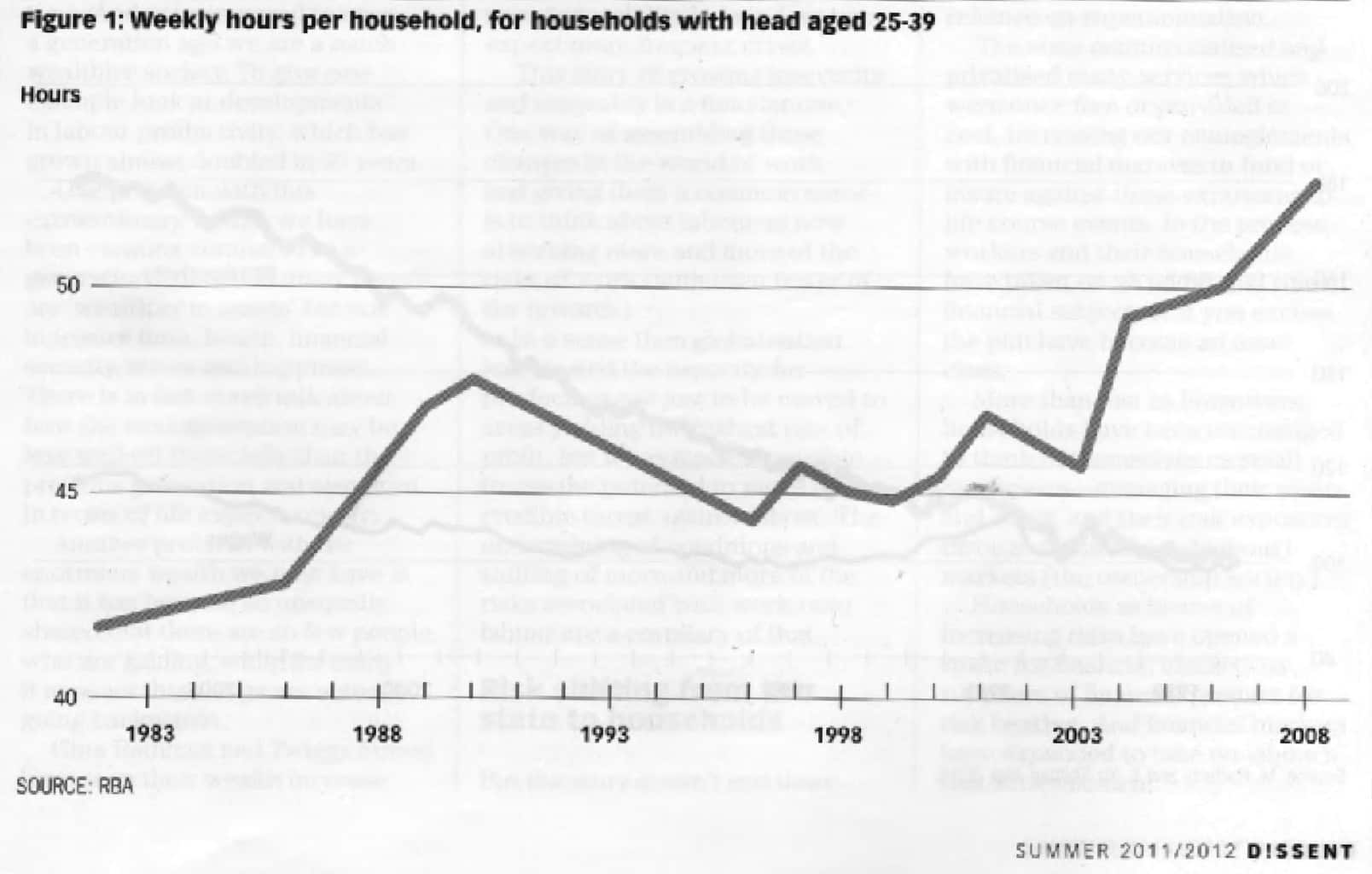
In 2008 people in Australian households were working over 50 hours per week.  The reasons for this are of less relevance than the fact that Australian workers are well beyond the 40-hour work week, not including any travel time.  Work has a social cost as well as a social benefit and any discussion (debate?) over productivity, as is currently occurring in Australia, must also consider the social cost of this productivity.  The graph above is a symptom of the challenge of achieving a decent quality of life and a functional level of productivity – the challenge that Pocock, Skinner and Williams have undertaken. Continue reading “Evidence of the need to change how and why we work”

Just workplace hardship

Yossi Berger writes:

We’re all familiar with the notions of focus and attention, and selective attention.  We’ve all experienced how difficult it can be to attend to target information when background noise is distracting.  The issue can be referred to as the signal-to-noise ratio.

I often find its effects in discussions with managers and workers during workplace inspections.  That is, I hear animated discussions of hazards, of risks, of risk assessments and risk management and various systems and theories.  The conversations over flow with these concepts whilst most of workers’ daily problems aren’t even raised, they don’t reach the level of a signal.

Thankfully in most workplaces, most managers and most workers have not experienced any fatalities.  By far most of them will not have experienced or witnessed a serious injury or serious disease.  Nor have most experienced their local hazards actually seriously hurting anyone.

But most workers will have experienced some dangerous working conditions, mostly not mortally dangerous, but dangerous.  Continue reading “Just workplace hardship”

OHS is Dead. Long Live WHS.

Media reports on the 13 April 2012 Council of Australian Governments (COAG) meeting say that harmonisation of occupational health and safety laws in Australia has died.  Some say this is the fault of the Victorian Government with its economic justification for inaction but the process was struggling as soon as the West Australian Government flagged its major concerns, principally, with increased union powers, as reiterated in the Australian Financial Review on 14 April 2012 (not available on-line).

WA Premier Colin Barnett is quoted as saying that:

“There are three or four sections we don’t agree with and the principle one of those relates to right of entry [for trade unions]… We see that as an industrial issue.  Right of entry, it is was applied to OH&S, in all probability would be used by the unions to shut down the Pilbara iron ore operations…”

This is further evidence of the political dominance of the mining sector in Western Australia, if it was ever needed.

Victoria does not have the same excuse as the right of entry has existed for many years and almost totally without any industrial relations problems. Continue reading “OHS is Dead. Long Live WHS.”

Substantial change in OHS needs clever politics

According to the UK Department of Work and Pensions (DWP), from 6 April 2012 businesses will no longer be obliged to notify the Health & Safety Executive of those injuries that result in a worker’s absence of up to seven days.  The DWP’s media statement about these changes estimates:

“The change to the Reporting of Injuries, Diseases and Dangerous Occurrences Regulations (RIDDOR) 1995 will see a fall of around 30 per cent in the number of incidents that must be reported by law – an average of around 30,000 fewer reports a year. The move is estimated to save businesses 10,000 hours a year.”

The business saving claim is very dubious (see below) as companies will still need to process any workers’ compensation claim or medical costs generated by the incident.  OHS professionals and safety managers will still need to investigate the incident and identify measures to prevent a recurrence.  These costs will continue. Continue reading “Substantial change in OHS needs clever politics”

Is OHS harmonisation a dead parrot or is it just pining?

In The Australian newspaper on 3 April 2012, Judith Sloan presents a useful summary of the status of the OHS harmonisation process.  Many of her criticisms are valid but she has not realised that the new Work Health and Safety laws stopped being occupational health and safety laws some time ago.  It is easier to understand the proposed changes if one accepts that these laws have broadened beyond the workplace to operate more as public health and safety laws.

It is possible to accept Sloan’s assertion of the “demise”of OHS harmonisation but if seen in the light of an integrated public/workplace health and safety law, the harmonisation process may be a welcome beginning to a broader application of safety in public and occupational lives.

The acceptance of this interpretation provides very different comparisons and linkages.  For instance, the shopper tripping on a mat in the vegetable section of a supermarket was likely, in the past, to receive recompense through public liability insurance. Now it could equally be under OHS laws.  The regulation of potential legionella sources was through the Health Department, even though many of these are in workplaces and often affect workers first.  Should cooling towers have been assessed by hygienists or occupational hygienists?  Should these be managed under an employer’s OHS management system or through the facilities manager or landlord?
Continue reading “Is OHS harmonisation a dead parrot or is it just pining?”

One industry sector continues to struggle with new OHS obligations

Some companies and industry sectors are struggling to cope with a major change to Australia’s occupational health and safety laws – the removal of the employer/employee relationship.  One example of an industry struggling with the change is the sex industry, more specifically, the licensed brothels.

In many industries, and in the safety profession itself, people confuse the OHS laws of injury prevention with the Compensation laws of rehabilitation.  In Australia these are two separate sets of laws, administered, often, by different government agencies and through different mechanisms, even though to effectively manage workers business needs to operate as if the demarcation does not exist. Many industries and professionals also make the common mistake of believing that a judgement in one area of law applies to other areas.

For many years the brothel industry* in Victoria, in particular, has believed that a ruling by the Australian Taxation Office (ATO) – that sex workers (or sexual service providers, the preferred term by the brothel industry) are not employees of the brothels – also relates to the OHS laws.  The argument goes that, as the ATO has said that no employment relationship exists for taxation purposes, there are no, or limited, OHS obligations on the brothel owners for the sexworkers.  This is bollocks, has always been bollocks and I have personally advised representatives of the brothel industry over many years that it is bollocks but the misunderstanding persists.  Sadly, this persistence could impede the progress of the brothel industry to comply with the new Work Health and Safety laws.

Continue reading “One industry sector continues to struggle with new OHS obligations”

The productivity debate in Australia misses the opportunities presented by wellbeing

At the moment Australian business is campaigning on the need to increase productivity rates in Australian workplaces.  It, with the recent support of some State governments and ideological colleagues, is seeking to achieve this by weakening the recent changes to the industrial relations structure encapsulated in the Fair Work Act.  Fair Work Australiatrade unions and industry associations are primarily focussed on the industrial relations elements of this ideological fight over productivity.
Evidence of the potential productivity and economic benefits of improved occupational health and safety has been missing in the debate yet it is this linkage that Dame Carol Black has been talking about recently in Australia.  It seems there is a keen audience for her perspective in Australia as she will be visiting the country four times in 2012.
At a recent OHS conference in Melbourne one speaker said some OHS positions in the United States are being renamed Occupational Health Productivity in recognition of the importance of wellbeing  in the OHS roles.  Renaming “wellbeing” as “productivity” provides a different context to OHS activities and should better gain senior executive attention as it would be easier to see how this activity fits with traditional operational thinking. Continue reading “The productivity debate in Australia misses the opportunities presented by wellbeing”
Concatenate Web Development
© Designed and developed by Concatenate Aust Pty Ltd