A sliver of hope on the farm safety horizon

Australian farm safety received several boosts last week. FarmSafe Australia released new report on agricultural injury and fatality trends. The Victorian Government gave the Victorian Farmers Federation more money to fund farm safety inspectors, again. And the Agriculture Minister established a Farm Safety Council of the usual agricultural groups. It is hard not to take many of these farm safety activities as indications of insanity by doing the same thing but expecting different results.


Subscribe to SafetyAtWorkBlog to continue reading.
Subscribe Help
Already a member? Log in here

Important gig economy report unlikely to affect change

Then current coronavirus pandemic has disrupted workplaces around the world with those most effected being low socioeconomic sectors, including those working on a casual basis or in precarious, gig occupations. Last week the Victorian Government received the final report from its Inquiry into the Victorian On-Demand Workforce. This report is likely to be crucial in assisting the government to develop a safe and healthy strategy for the post-pandemic world of work.


Subscribe to SafetyAtWorkBlog to continue reading.
Subscribe Help
Already a member? Log in here

What to do when someone “cracks the shits” over safety

It is established that several major manufacturers of quad bikes have “cracked the shits” (ie had a tantrum) and now refuse to sell their vehicles to the Australian market. How to respond to this type of action is to restate the facts and this is exactly what the Australian Competition and Consumer Commission (ACCC) did this month when it released its Quad Bike Safety Standard fact sheet.

Subscribe to SafetyAtWorkBlog to continue reading.
Subscribe Help
Already a member? Log in here

We’ve got Industrial Manslaughter laws, now what?

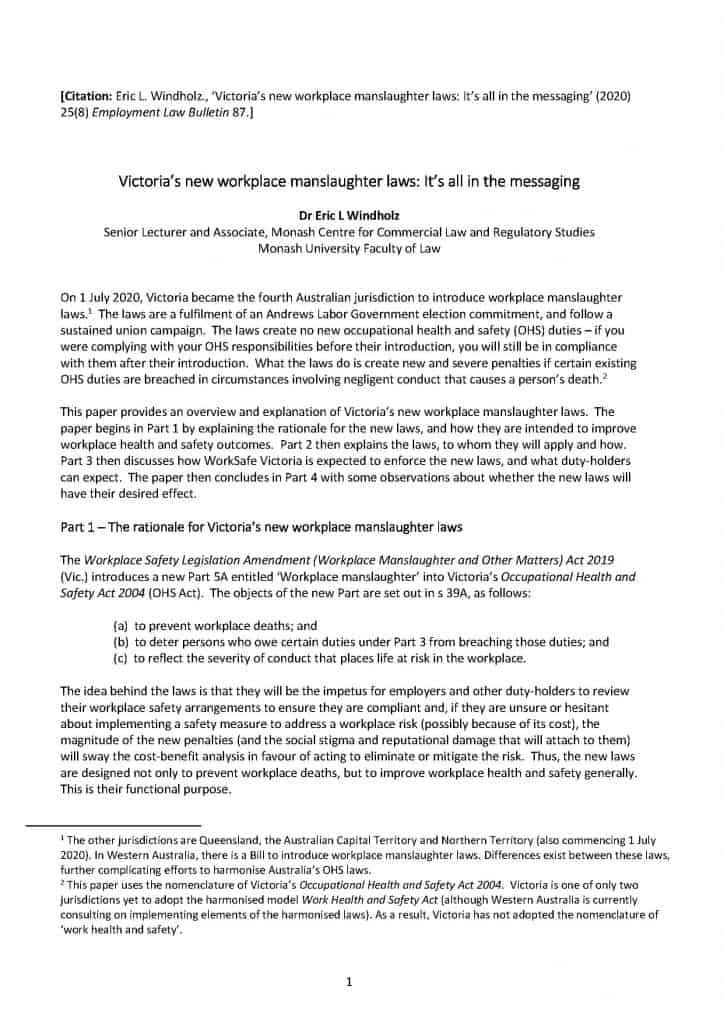
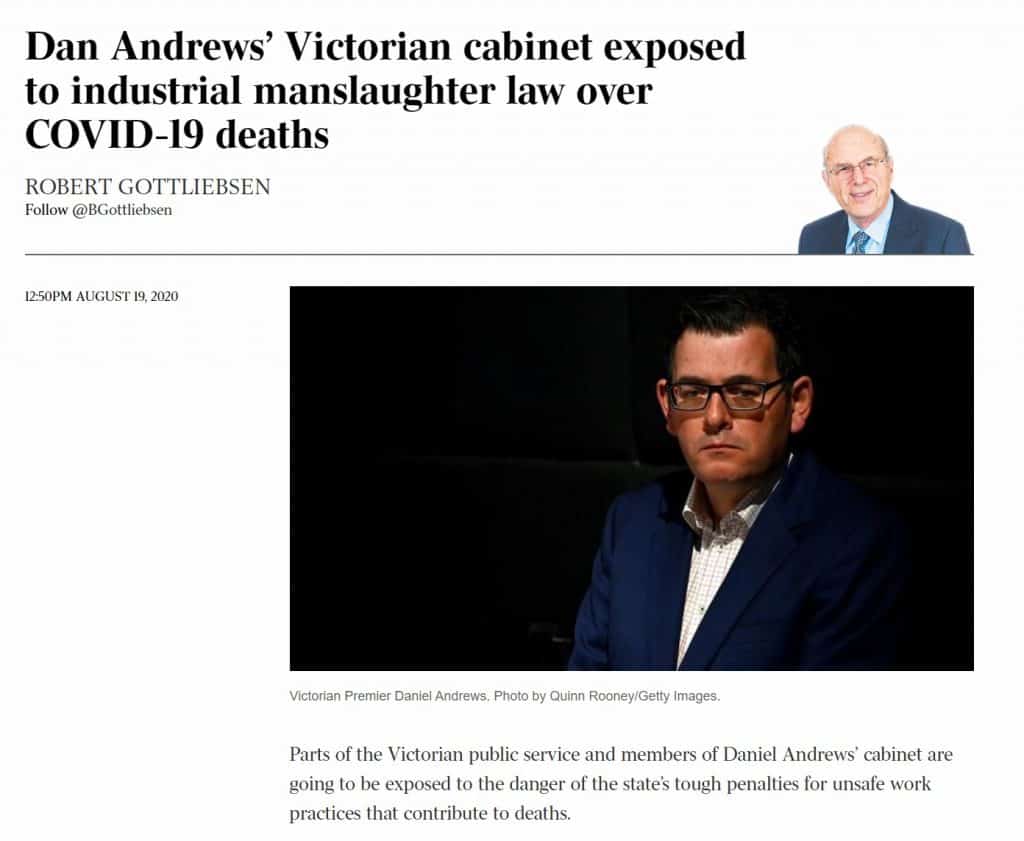
So, Victoria now has Industrial Manslaughter laws. Now what? Within days of the activation of these laws a worker died at the Thales worksite in Bendigo. This location is covered by the Federal Work Health and Safety laws, but this has not stopped social media from mentioning Industrial Manslaughter. It seems now that every work-related death will be assessed through the IM lens. It may be that the threat of jail should always have been the starting point for occupational health and safety (OHS) penalties and investigations but initial responses to the IM laws have been mixed, and some seem to be more interested in what, in the past, has been a sideline to the IM discussion – deaths, in work vehicles, suicides and industrial illness.

Subscribe to SafetyAtWorkBlog to continue reading.
Subscribe Help
Already a member? Log in here

Why isn’t workplace health and safety improving?

On Wednesday June 24 2020 at 1.30pm (AEST) I will be presenting my conference paper on the topic above. This is the first Australian Institute of Health and Safety conference to be conducted virtually and I am proud to be part of this year’s conference. As it is virtual, there is no limit on tickets so if you could not attend previous AIHS conferences, get to this one. Below is an extract from my paper:

The workplace fatality rates have been falling consistently for decades.  Occupational health and safety (OHS) professionals seem to be busier than ever.  So, the world must be safer than it has been in the past?  Maybe.  But this may not be the reality if we think a little deeper about the causes of harm and about the actions the OHS profession has applied.

Here is a typical graph showing the rate of workplace fatalities since 1985, when the modern OHS legislation was enacted in Victoria.

Subscribe to SafetyAtWorkBlog to continue reading.
Subscribe Help
Already a member? Log in here

Exclusive Interview with Dr Tom Doig

SafetyAtWorkBlog had the chance to put some questions to Dr Tom Doig in early 2019 prior to the book’s release. Below is that exclusive interview.

SAWB: “Hazelwood” is predominantly a book that describes the social and environmental impacts of the Hazelwood. What, if any, overlap did workplace health and safety (WHS) and WorkSafe Victoria have in the fire’s aftermath?

TD: In the aftermath of the mine fire, a number of WHS issues have come to the fore. Firstly, in the 2014 Hazelwood Mine Fire Inquiry, a number of criticisms were made of Hazelwood’s regulatory framework, with a suggestion that there was a ‘regulatory gap’, as expressed by Mr Leonard Neist, Executive Director of the Health and Safety Unit at the Victorian Workcover Authority (VWA), at that time:

‘If I identify that gap as, who is responsible for regulating for the protection of public safety, regardless of what the source of the hazard or the risk is, who’s responsible for public safety, that’s where the gap probably is and I can’t—if you were to ask me right now, I can’t tell you who is responsible for regulating public safety. I’m responsible for regulating workplace safety and responsible for public safety as a result of the conduct of that undertaking, but I couldn’t tell you who is directly responsible.’

In this case, while VWA focuses on the health and safety of mine employees, they aren’t explicitly concerned with the health and safety of the general public, if a hazard – like a 45-day plume of toxic smoke – is dispersed beyond a specific workplace.

Continue reading “Exclusive Interview with Dr Tom Doig”

Important safety, environmental, political and personal stories in book on the Morwell Mine fire

Dr Tom Doig has continued to build on his earlier work about the Morwell mine fire, expanding his “The Coal Face” from 2015 into his new book “Hazelwood” (after court-related injunctions, now available on 18 June 2020).

SPECIAL OFFER: The first four (4) new Annual subscribers in the month of June 2020 will receive a copy of Hazelwood.

The Morwell mine fire created great distress to residents in Victoria’s Latrobe Valley, ongoing health problems, and a parliamentary inquiry, but can also be seen as a major case study of occupational health and safety (OHS) laws, enforcement, role and the obligation on employers to provide a safe and healthy working environment that does not provide risks to workers and “protect other people from risks arising from employer’s business”.  The management of worker and public safety is present in almost every decision made in relation to the Morwell Mine fire. The overlay of an OHS perspective to Doig’s book is enlightening.

Subscribe to SafetyAtWorkBlog to continue reading.
Subscribe Help
Already a member? Log in here
Concatenate Web Development
© Designed and developed by Concatenate Aust Pty Ltd