Sex Work regulations review safety obligations

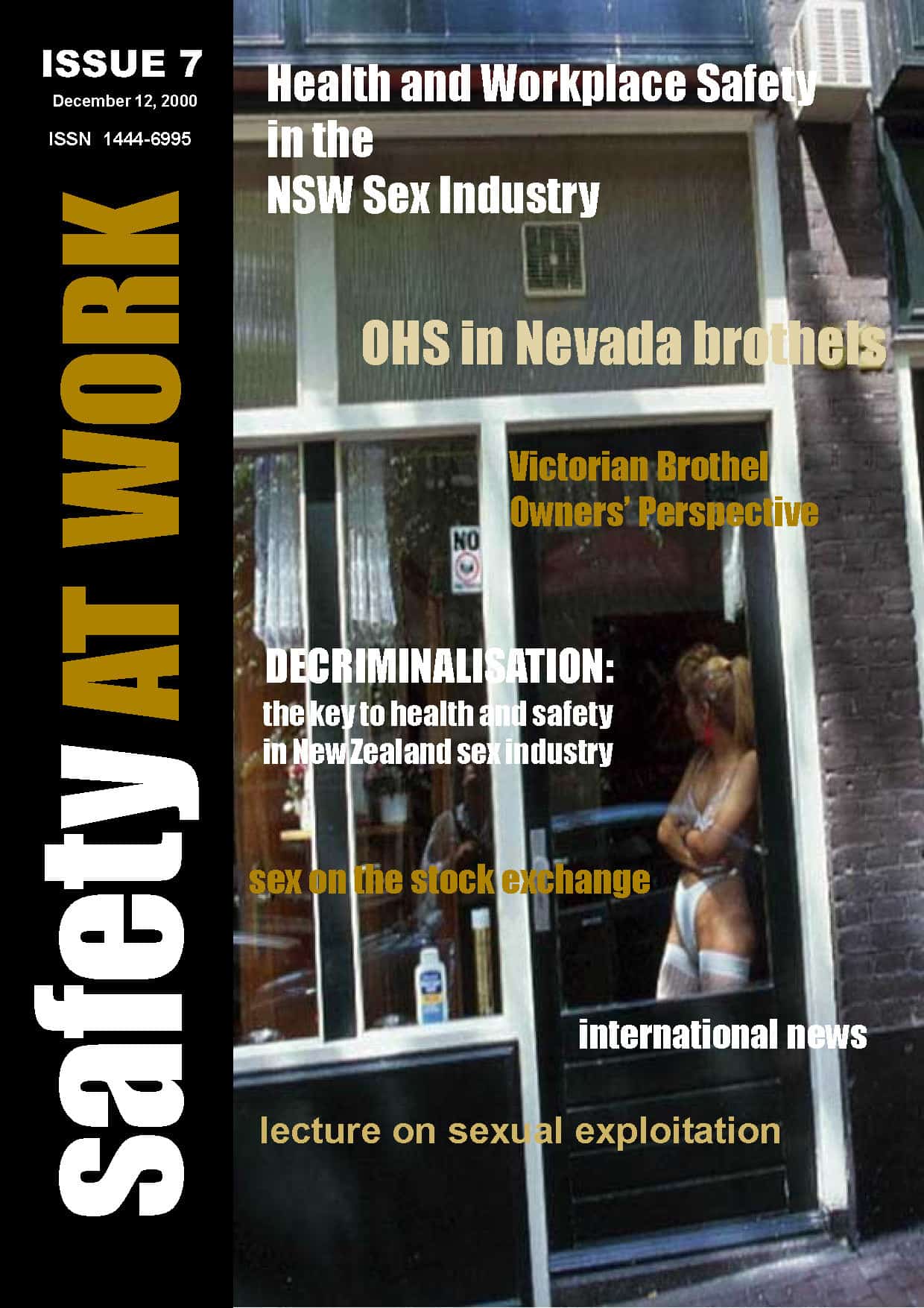
SafetyatworkV2I7-cover
2000 edition of SafetyATWORK magazine addressing some of the OHS issues in brothels

Consumer Affairs Victoria (CAV) is seeking public comment on some proposed revisions of the Sex Work Regulations.  Several revisions specifically address workplace safety issues but also indicate out-of-date thinking on worker safety and safety management.

Victoria licences its brothels and, as such, the occupational health and safety (OHS) laws apply as they do to all workplaces. However, the regulators of the sex industry seem to perceive OHS usually in terms of sexual health and hygiene even though statistics have shown that these issues are low risk hazards. This perception has lasted well over a decade as this 2000 article from National Safety magazine shows. Continue reading “Sex Work regulations review safety obligations”

Safety is the highest priority. Really?

Workplace safety can have a bizarre logic.  A recent example can be seen in the continuing controversy about the deaths of two workers on a construction site in Western Australia.

In November 2015 two workers Joe McDermott and Gerard Bradley were crushed to death by a concrete slab while on a break at a Jaxon Construction site in East Perth. The Construction Forestry Mining and Energy Union (CFMEU) concerns about the site have been discussed on ABC television last week and on the union’s social media. WorkSafe WA is investigating.

Some of the statements by Kim Richardson, the construction director of the Master Builders Association of Western Australia (MBAWA) seem ill-timed but reflect many of the perspectives held by employers towards occupational health and safety (OHS).

Shortly after the the incident Richardson stated that

“All workers have the right to go to work and have the expectation and the right to come home safely,…. That did not happen.

There’s been a move to have a tremendous amount of paperwork where people will tick boxes to say they have a safe system in place. But that doesn’t guarantee safe systems of work. The way the work is performed is where the focus needs to be.”

Richardson’s complaints seem to be that

  • occupational health and safety has too much paperwork
  • the paperwork misrepresents the level of safety at the workplace
  • greater attention should be given to how work is performed.

Few OHS professionals in Australia would argue these points but there are some uncomfortable implications in these complaints.

Subscribe to SafetyAtWorkBlog to continue reading.
Subscribe Help
Already a member? Log in here

SafetyAtWorkBlog’s most popular articles of 2015

SafetyAtWorkBlog has had a successful 2015, consolidating itself as a valid independent voice on workplace health and safety, particularly in Australia. But readers don’t get access to some of the statistics for the site and as a year in review exercise below are the top five most-read articles written in 2015, highest readership first:

Impairment argument fails to convince Fair Work Commission over unfair dismissal

WorkSafe Victoria heads roll

Research raises serious questions on SIA’s certification push

Some are losing faith in the Victorian Workcover Authority 

Safety learnings from construction Continue reading “SafetyAtWorkBlog’s most popular articles of 2015”

Submission on Labour Hire disappoints on OHS

cover of Ai_Group_LabourHireandInsecureWork__November 2015_Final2The public submission phase for the Victorian Government’s inquiry into labour hire and insecure work closed last week.  Public hearings have occurred this week and will continue in February 2016. One industry association, the Australian Industry Group has released its submission.  Its discussion  of occupational health and safety (OHS) of labour hire workers and suppliers is very disappointing.

Representing Members

The AiGroup says, in its submission that

“The interests of both groups [labour hire companies and users of labour hire], as well as the interests of the broader community, are best protected by ensuring that a competitive market is maintained for the provision of labour hire services, and that impediments to competition are removed.” (page 4)

It could be argued that the competitive market has allowed unscrupulous labour hire suppliers to succeed as they have been offering the cheapest labour.  These suppliers have succeeded, mostly, because there is a ready market for opportunities to maximise profit by reducing the legal rights of workers.  A competitive market may help fix the problem but it is also a problem that it helped create. Continue reading “Submission on Labour Hire disappoints on OHS”

Missed lessons from work-related traffic incidents

Cover of Work-related-fatalities-involving-trucksIn early 2014 a truck driver drove his vehicle into an intersection, collided with a car resulting in the death of four out of five members of one family. The truck driver, Jobandeep Gill, has been sentenced to 10 years jail.  Video of the incident site shows a company name on the side of the van.  It is not possible to determine who Gill was driving for or what his employment status was but, regardless of this, it seems a work vehicle was involved in the death of four people, and therefore occupational safety laws (OHS) may have been broken.

It is accepted by OHS regulators that a truck is a workplace for the driver and that OHS responsibilities of all workers include

“… take reasonable care for the health and safety of persons who may be affected by the employee’s acts or omissions at a workplace…” (Section 25 of the Victorian OHS Act 2004)

On 25 November 2015, Dr Rwth Stuckey stated at an ISCRR seminar that:

“WRR (work related road) crashes [are the] leading cause of traumatic work-related fatality & injury in most westernised countries.”

So why don’t OHS regulators follow-up WRR crashes by interviewing the truck owners or the employers of the drivers?  Perhaps statistics don’t support Dr Stuckey?

Subscribe to SafetyAtWorkBlog to continue reading.
Subscribe Help
Already a member? Log in here

OHS formally enters professional sports

On November 9 2015, WorkSafe Victoria charged the Essendon Football Club with breaches of the occupational health and safety (OHS) law over its controversial supplements program. This blog has watched how the Australian Football League (AFL), in particular, has acknowledged its OHS obligations and duties.  This interest has been shared by Dr Eric Windholz who wrote about the charges today.

Windholz acknowledges that WorkSafe Victoria has established a formal presence in professional sports with its decision to prosecute.  

Subscribe to SafetyAtWorkBlog to continue reading.
Subscribe Help
Already a member? Log in here
Concatenate Web Development
© Designed and developed by Concatenate Aust Pty Ltd