Authority in denial?

Polite or ignorant?

Coroners can be a polite lot, preferring what they would call ‘substance’ to emotion, accuracy to grand standing.  They also hope that their Findings make a difference and help to protect people against a range of lethal circumstances.  Ex-coroner Graeme Johnstone (Victoria) was an outstanding example in OHS.   So any comments in their Findings ought to be considered against this background.

However, the comments by the South Australian State Coroner Mark Frederick Johns in his Findings (9/2/2011) in the death of Daniel Nicholas Madeley who died (6/6/2004) as a result of an occupational incident are puzzling.  Either the man is being very polite or seriously ignorant of what really goes on in industry.  And it does matter because coroners carry a lot of authority.  Work by Johnstone, Olle and Tasmanian coroners (mining disasters) has been very helpful.

Poor guarding

To paraphrase: Daniel was 18 years old when he died of ‘horrific injuries sustained when he was caught in a horizontal boring machine’.  He became entangled in the machine Continue reading “Authority in denial?”

Graphic hazard video from WorkSafe BC

Graphic ads or videos from OHS regulators are not new but each has their own approach and WorkSafe BC has released one, in particular, that is of interest to the construction industry.

On first viewing, the conduct of the supervisor is annoying.  He provides inadequate information to the worker.  He approves of the wrong tool for the job.   Others may see nothing but a silly young worker. Continue reading “Graphic hazard video from WorkSafe BC”

Important OHS and legal issues in findings of South Australian Coroner into young man’s death

The debate on OHS laws will be passionate in the pre-election frenzy of New South Wales but the OHS law reform is a national strategy and the safety debate is not asleep in the other States.

On 11 February 2011, AAP ran an article about the long-lasting familial and social effects a horrible workplace incident in South Australia in 2004.  Diemould Tooling Services (fined in 2009) took its appeal against prosecution to the High Court of Australia in 2008 and on 10 February 2011, almost six years after the death of 18-year-old Daniel Madeley, South Australian Coroner Mark Johns has said, at Madeley’s inquest:

“A horizontal boring machine had been operated at Diemould for years in a condition which could only be described as deplorably unsafe. It could have been guarded, but was not. It could have had a braking system, but did not. It could have had an automated lubrication system, but did not.

“Many other things could have been done, but any one of these would have been sufficient to save Mr Madeley’s life….”

Coroner Johns was very critical of SafeWorkSA about its actions following the 2004 death.  The coroner’s findings make for disturbing reading on several issues. Continue reading “Important OHS and legal issues in findings of South Australian Coroner into young man’s death”

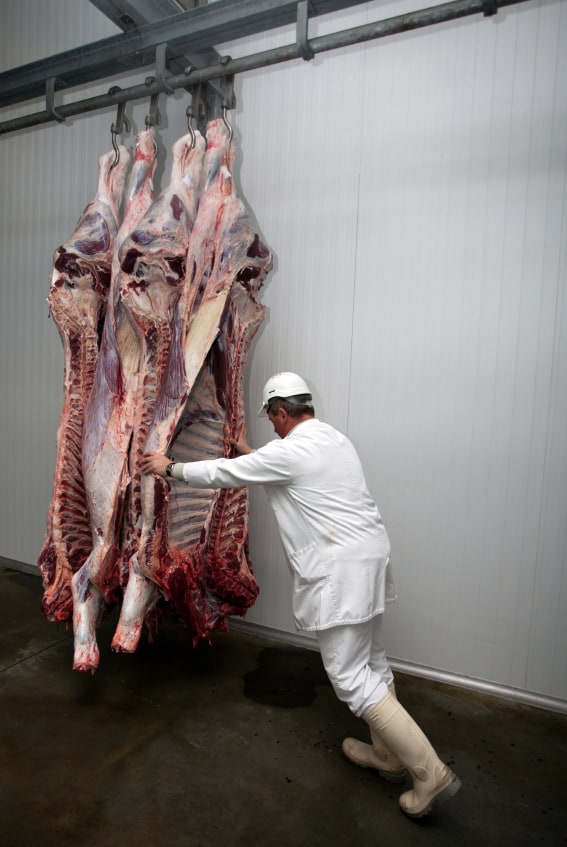
Only animals should die in abattoirs

The Sunday Age of 30 January 2011 ran an article about the status of workplace safety in some of Victoria’s abattoirs.  The article has some similarities to the landmark investigations by Eric Schlosser into work practices and compensation issues related to meatworks in the United States.

The Sunday Age says that

“(Last financial year [2009/2010], there were 355 workers’ compensation claims in Victoria’s meat industry that required at least 10 days off work, or cost more than $580 in treatment, or both – almost one a day. Nationally the industry’s injury and illness rate remains twice as high as that in the construction industry, and four times the average of all workplaces.”

Many would say that meat work is “inherently dangerous” but in the article lawyer Trevor Monti, contests the perception

”Yes, it’s a difficult industry and the work can be hard,” he says. ”But with proper consideration given to the system of work, the risk of injury can be significantly reduced.”

This is a position with which OHS professionals and regulators would agree.

It is significant that, if the comparative figures quoted above by the Sunday Age are accurate, abattoirs do not receive the enforcement attention that the construction industry receives.  Is it that the construction industry is largely unionised and the meat industry much less so?  Is it that abattoirs are rorting the immigration visa system as asserted by the Australian Meat Industry? Continue reading “Only animals should die in abattoirs”

How much significant information do workplace fatalities provide?

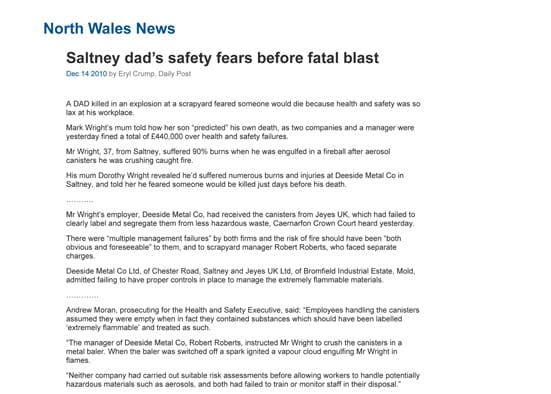
Workplace fatalities are terrible, lingering tragedies that generally don’t teach anything new about OHS failures.  I couldn’t find anything new in the frightening detail in the article below (dated 14th December 2010) or in scores of Google searches of industrial/occupational fatalities; though disease fatality epidemiology can be  informative.

If all workplace fatalities in Australia were stopped overnight, most workers wouldn’t notice a single improvement in their own workplace.  They’d still be working in the same cluster of hazards, useless risk assessments and a regular sprinkling of near misses and daily shortcuts.  Despite regulators’ and politicians’ shrieks of dismay at workplace deaths, such fatalities don’t represent the main OHS problem at work.

If any regulator was informed in advance – in some detail – that in a particular industry there would be three fatalities in the next three months (or even intolerable risk) they wouldn’t know how to prevent them.  Example?  Think of the insulation program, which still has some way to go and a few more surprises in store.  Example?  Over the next six months there are likely to be 3-6 quad bike-related fatalities in Australia, mostly as a result of rollovers.

Or think of the value of risk assessments:  example?  Consider the 60,000-80,000 barrels (10,000 tons) of the most dangerous hexachlorobenzene (HCB) waste stockpiled and being repackaged (ultimately, drum to drum) by workers in a primitive work process at Botany Bay Industrial Park, Sydney.  One of the world’s largest stockpiles of such dangerous wastes that no one around the world is prepared to handle.   This is the only place I’ve ever had to wear two layers of protection to inspect. What has the regulator done? Continue reading “How much significant information do workplace fatalities provide?”

Preparing for occupational violence in fast food outlets

On 17 December 2010, the parents of Luke Adams were abused outside a court in Melbourne, Australia.  The mother of the killer of Luke Adams berated the parents after her son received further time in jail.

SafetyAtWorkBlog touched on Luke Adams’ death in an article in 2009 in which we pointed out that several violent deaths had occurred in, and around, fast-food restaurants and yet there is little focus on the role of the restaurants in these incidents.

On 4 January 2011, the media is reporting that McDonalds has issued a security warning to its restaurants after a couple of violent robberies on its Victorian stores in the last few days.

Such acts in fast-food establishments are particularly worrying because of the young age of many workers in the sector.  Over this holiday period in Australia, many teenagers experience their first “real” work in fast-food outlets and other than working very long shifts (that’s a different story) the experience should present them with a positive approach to work. Continue reading “Preparing for occupational violence in fast food outlets”

Telling is better than being exposed

Many OHS laws place obligations on employers to notify regulators (   )  of any particularly serious (often defined) incidents.  In many jurisdictions regulators are sometimes informed of work-related hospital admissions, for instance, even if employers do not notify.  But there is substantial benefit in notifying the regulators early.

Anecdotal evidence shows that by facing up to the reality that an incident has occurred is less costly in the long term as this shows that one is aware of one’s OHS obligations and willing to apply them.

The wisdom of reporting incidents in a timely manner is perhaps illustrated by a 17 December 2010 article in The Age newspaper.  It is rumoured that incidents involving apprentice tiler Kane Ammerlaan may not have been reported to the OHS regulator in Victoria, WorkSafe.

Prompt reporting may not have been able to improve Ammerlaan’s situation relating to the fall but investigations into this possibly life-changing incident could have begun much earlier, and when evidence was easier to collate.

Ammerlaan also alleges that:

‘Through my six weeks I was constantly abused. There was a lot of verbal abuse; they’d throw stuff at me; I was shot with a nail gun on a few occasions.”

This may raise, yet again, the safety issue of the treatment of young workers and apprentices; an issue on which the community seems to require regular reminding.

Kevin Jones

Concatenate Web Development
© Designed and developed by Concatenate Aust Pty Ltd