SafeWorkSA responds to Gottliebsen OHS article

On 23 May 2011, prominent Australian business writer, Robert Gottliebsen published an article in BusinessSpectator entitled “Saying no to Canberra’s IR dopes“.  The article was uncharacteristically contained major errors on the application of new harmonised OHS laws.

The article generated considerable discussion on some Australian OHS discussion forums but the article’s website has attracted only one comment.  SafetyAtWorkBlog is in possession of a copy of the full reply sent to BusinessSpectator by SafeWorkSA, the OHS regulator in South Australia, a state that featured in Gottliebsen’s article.  SafeworkSA’s reply is reproduced below as it is yet to appear on the BusinessSpectator website, a week after it was sent.

“From:  Bryan Russell, Director of Strategic Interventions, SafeWork SA & SA Representative on the Strategic Issues Group – OHS with Safe Work Australia.

Robert Gottliebsen’s commentary of 23 May on South Australia’s actions regarding the Model Work Health and Safety Bill contains several serious errors that need to be addressed.

For the record, let me emphasise the following.

The Work Health and Safety Bill 2011 was reintroduced to the South Australian Parliament on 19 May 2011.

The Bill was tabled in the same form before the Legislative Assembly (Lower House), where the current Minister for Industrial Relations, Patrick Conlon, sits.

The SA Government is on the record as stating that the Bill was withdrawn from the Legislative Council (Upper House) on 3 May 2011 due to the recent change of Ministers.

Contrary to Mr. Gottliebsen’s assertions, we have observed no “community outrage” generated by radio talkback hosts. Continue reading “SafeWorkSA responds to Gottliebsen OHS article”

New South Wales gets a win-win on OHS laws

The Australian Government must be either issuing a sigh of relief or clapping their hands together following the passing of the model OHS laws by the New South Wales (NSW) government last week.

NSW was a belligerent signatory to the agreement for nationally harmonised OHS laws but the laws passed with sufficient tweaking to make the laws compatible with the national model laws.  Several days later, on 30 May 2011, everyone is claiming a win.  Unions retain some authority to prosecute over OHS breaches, although only “for the third and least serious category of offence”, according to the Australian Financial Review.

Unions NSW secretary Mark Lennon is reported as saying that the NSW upper house of Parliament has protected an important safeguard for workers.

On 27 May 2011 Lennon was bemoaning “that the Industrial Court has lost most of its occupational health and safety jurisdiction” and yet the Industrial Relations Commission will now retain an active OHS role even though it is dealing with lesser OHS offences, similar to the unions’ role above.

Overall the amendments in the NSW Parliament seem to be a face-saving exercise for the left-wing politicians and trade union movement.  They were provided with little wins but have given way on the major objections.  It is reasonable to describe this as a pragmatic solution given that the March 2011 NSW election effectively removed the union movement’s power base in that State. Continue reading “New South Wales gets a win-win on OHS laws”

New OHS info on Working Alone and Occupational Violence

One of the most difficult safety management challenges is the control of hazards associated with working alone.  The most effective control is to not work alone, but the difficulty comes because this option requires expenditure.

WorkSafe Victoria recently released an information sheet on this hazard and listed the following hazard control options:

  • Buddy system
  • Environmental design
  • Communication or location systems
  • Alarms
  • Movement records
  • Training
  • Knowledge sharing

WorkSafe wisely says that most workplaces will require a combination of these options to control the hazard of working alone.

Trying to reduce the hazards of working alone is a terrific indication of the economic health of a business, the level of safety commitment of a business owner or manager, and the state of safety knowledge in the company. Continue reading “New OHS info on Working Alone and Occupational Violence”

The Commercial Kitchens Campaign needs further examination

Why is a government workers’ compensation agency promoting first aid when a different agency has had that role for over twenty years?  And why do the program’s first aid kits contain commercial products that are no more effective in the first aid treatment of burns than water from the tap?

On May 12 2011, WorkCover SA launched, in conjunction with the Julian Burton Burns Trust, the Commercial Kitchens Campaign.  Burns are a major feature of this campaign with 500 Commercial Kitchens Burns Packs being distributed free to restaurants and cafes in South Australia.

SafetyAtWorkBlog has been told that these kits contain a Burns First Aid Kit developed by A/Prof John Greenwood, the Julian Burton Burns Trust and St John Ambulance Australia which includes the following items:

  • burnaid gel
  • burnaid dressing,
  • a plastic sheet,
  • sterile towel,
  • tape, and
  • step by step directions written by A/Prof John Greenwood.

The odd thing about this initiative is that medical research has shown that burnaid gels are less effective than cool running water for the first aid treatment of burns.  In the journal Wound Practice and Research (Vol 18 Number 1 – Feb 2010) Australian researchers Leila Cuttle and Roy M Kimble wrote in “First Aid treatment of burn injuries” that

“The widespread use of such dressings [Burnaid is specifically referenced] (which have now even penetrated the first aid market) is alarming considering the lack of studies which support their use.” Continue reading “The Commercial Kitchens Campaign needs further examination”

Compliance or Confidence?

A reader has been inspired by recent articles discussing OHS compliance to contribute their own article on some of the issues raised:

“Compliance”, while being a way forward in OHS, misses the mark. We should ask the question: Why do regulators want compliance anyway?

Compliance, or conformance as is alternatively used, is a means to an end. Not an end in itself. In haste to improve the world via compliance we sometimes forget that.

Compliance presumes that rules laid down by regulators are a “good enough” way to achieve safety. Compliance’s foundation is the minimum-standard. Foundations cannot be anything like the maximum-standard because best practice regulation knowledge backs up our common sense that maximum standards would be bad and expensive. But wouldn’t it be comforting to be able to encourage and get more than just the minimum?

Some who have felt the stick end of compliance might think some regulators believe their rules and guides are the only path to safety. But the fact is that even the best codes & regulations have flaws; they do change. Furthermore, exemptions get provided, position papers and codes of practice get written to fill the gaps. And they get re-written. Sometimes the reasons for a rule are lost in time. Shamefully, sometimes valid reasons never existed. Sometimes rules are written to serve the purposes of some over others or to empower authority. We can know this because COAG and the OBPR have to warn against it. Continue reading “Compliance or Confidence?”

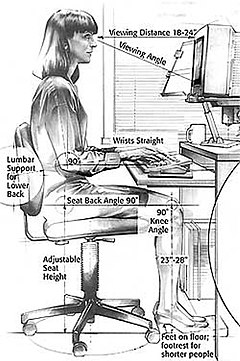
Ergonomics advice does not always reflect the reality

It is common for companies to invest in expensive office furniture in the belief that the furniture will encourage the worker to undertake tasks more safely.  In most circumstances, this is a waste of money and a major distraction from managing safety throughout workplaces.

The safety message is also being confused by some OHS regulators.  It is well-established that injured backs and other musculoskeletal injuries improve with movement rather than the traditional bed-rest.  However this encouragement to move is not reflected in most of the advice for configuring workstations.  Continue reading “Ergonomics advice does not always reflect the reality”

OHS news and content suggestions welcome

Recently, readers have been providing tip-offs to OHS issues that are not being covered by the traditional media.  SafetyAtWorkBlog has always inhabited this niche but is looking to expand its story source options.

I am encouraging readers to provide not only news tip-offs but to also suggest safety issues that could form the basis of a SafetyAtWorkBlog article.  For instance, do you know of an extraordinary safety person whose story requires a broader audience?  Is there a design fault with a safety product that the manufacturer is not attending to?  Is the application of a safety law having an unexpected effect at a workplace?

Tip-offs and suggestions can be anonymous but I reserve the right to reject any suggestions that I feel are not suitable for the SafetyAtWorkBlog.  The more specific and detailed your information for the article (contact details, photos, reference documents etc.), the higher the priority given.

But don’t forget that if you have the writing bug, you are welcome to send through articles for consideration.

Kevin Jones

Concatenate Web Development
© Designed and developed by Concatenate Aust Pty Ltd