
Conference videos provide optimism and nerves

Several years ago I assisted the Safety Institute of Australia in providing introductory video profiles for many of their conference speakers.  The intention was to provide a teaser for the content of conference presentations and to introduce more obscure speakers.  The strategy is continuing with several pre-conference videos being made available on-line.

Conference teasers in 2011 include Professor Niki Ellis and Australian lawyer, Andrew Douglas.

Andrew Douglas

Andrew Douglas says that safety professionals need to be careful of jargon as it can create an impenetrable elitism that may run counter to the aim of the profession.  Part of the risk of professional jargon is that it may support an inaccuracy that creates considerable damage.

Douglas identifies “zero harm” as an example of a phrase or concept that con become popular, perhaps dominant, even though it may  be unsupported by OHS laws.  Because the laws and the reality of workplace safety is that there will always be people who are hurt or injured at work, “zero harm” is unattainable and those who utter the “mantra of zero harm”, as Andrew Douglas describes it, lose any OHS credibility. Continue reading “Conference videos provide optimism and nerves”

Evidence on the need for safe job design

One reader has provided an example of recent research that supports the previous SafetyAtWorkBlog article on the importance of quality and safety in job creation.

In the March 2011 online edition of the Occupational & Environmental Medicine journal, Australian researchers have analysed data concerning “the psychosocial quality of work”.  According to an accompanying media release (not available online yet) they found that

“The impact on mental health of a badly paid, poorly supported, or short term job can be as harmful as no job at all…” Continue reading “Evidence on the need for safe job design”

Creating jobs is a waste unless those jobs are safe

Coming out of recession or, at least, a global financial crisis seems to mean that the creation of jobs is the only driver of economic growth.  Governments around the world seem obsessed with employment creation but rarely is the quality of the employment ever considered.

The drive for jobs at the cost of other employment conditions such as safety was illustrated on 11 March 2011 in an article in The Australian newspaper.  New South Wales’ election is only a short while away and, as it is widely considered to be an easy win for the conservative Liberal Party, government policies are already being discussed.

“Industrial relations spokesman Greg Pearce, a former partner at Freehills, said he was aware that concerns about the workplace safety system had emerged in the legal profession.

But the Coalition’s main goal was to minimise uncertainty to encourage job creation.”

The push for jobs is also indicative of short-term political thinking. Continue reading “Creating jobs is a waste unless those jobs are safe”

Australian Football’s corporate approach to OHS

Recently the CEO of the Australian Football League (AFL), Andrew Demetriou addressed a breakfast gathering in Melbourne on the issue of “OHS in the AFL”.  He spoke almost entirely about policy initiatives without specifically addressing occupational health and safety but after a while we came to understand he was speaking of OHS from his senior executive perspective rather than the level where traditional control measures are implemented.

This was a legitimate approach to OHS but one that is rarely heard, perhaps because the AFL is a unique sporting body.  There was no mention of concepts dear to the hearts of CEOs such as Zero Harm or Safety Culture.  In fact there was hardly even a mention of Leadership.

Continue reading “Australian Football’s corporate approach to OHS”

Rolling the sleeves up – a good OHS technique.

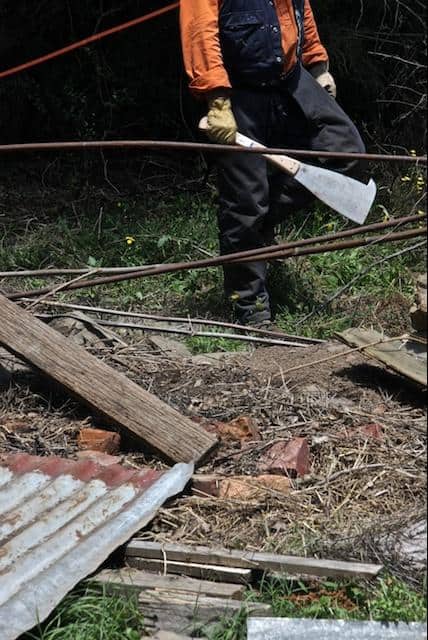
My father has a smallish block up in the bush, north-east Victoria in the Ovens Valley.  He can’t live there safely anymore, but since he built the place himself and with all the family history it has, it’s a place that has to be retained, and protected from bushfire as much as we reasonably can manage.

My partner and I, plus Dah (and a coupla friends) spent a few weeks there around Christmas and New Year doing lots of scrub clearing, garden things and general tidying up in readiness for the predicted return to hot dry summers after that naughty La Nina begins to fade.   These sort of work trips have been going on over quite a few summers.

The big range of jobs on these tidying-up trips range from trimming large branches, working up on roofs, scrub clearing, lots of load shifting, burn-offs, using lots of different powered equipment (chainsaw, scrub-cutters) and dragging out cut scrub with the ute etc etc.

Doing this work has me often giving lots of thought to doing the job efficiently and safely, and observing my own safety stuff-ups.  It gives me a chance to reflect on the safety system stuff we spend lots of time lecturing punters on and how practical it all is when there is limited time to get the job done, it’s 30 degrees Celsius, and the humidity is at a zillion; in other words, in work conditions lots of people have to deal with all the time. Continue reading “Rolling the sleeves up – a good OHS technique.”

Important OHS and legal issues in findings of South Australian Coroner into young man’s death

The debate on OHS laws will be passionate in the pre-election frenzy of New South Wales but the OHS law reform is a national strategy and the safety debate is not asleep in the other States.

On 11 February 2011, AAP ran an article about the long-lasting familial and social effects a horrible workplace incident in South Australia in 2004.  Diemould Tooling Services (fined in 2009) took its appeal against prosecution to the High Court of Australia in 2008 and on 10 February 2011, almost six years after the death of 18-year-old Daniel Madeley, South Australian Coroner Mark Johns has said, at Madeley’s inquest:

“A horizontal boring machine had been operated at Diemould for years in a condition which could only be described as deplorably unsafe. It could have been guarded, but was not. It could have had a braking system, but did not. It could have had an automated lubrication system, but did not.

“Many other things could have been done, but any one of these would have been sufficient to save Mr Madeley’s life….”

Coroner Johns was very critical of SafeWorkSA about its actions following the 2004 death.  The coroner’s findings make for disturbing reading on several issues. Continue reading “Important OHS and legal issues in findings of South Australian Coroner into young man’s death”

Death in the workplace guide could have been much more helpful

Workplace Health & Safety Queensland (WHSQ)has released an update of its guidance on how to handle the impacts of a death at work.  “A death in the workplace– a guide for families and friends” provides very useful information for a period when a family’s life will change forever and when thinking clearly will be difficult.

Like many guidances from OHS regulators, this one is very legalistic or procedural.  It explains the roles of police, coroners, OHS inspectors and others but it lacks a humanity that many would find reassuring in such a difficult time.

One of the issues that creates great anxiety is any delay in getting the body of their loved one back.  The Queensland guide discusses organising this through a funeral director but grieving people want a little more information.  The guide would have been improved by simply stating that there may be a delay in returning their loved ones and that a delay of a week is often the norm.

Often families choose not to know the details of the procedures because they are focussing on their loss.  Anyone who has had to organise a funeral after a sudden non-work related death knows how traumatic the process already is and how disruptive it can be to a family, without the involvement of government agencies, police and others.

If the readership of this guidance was families and friends it has the wrong tone.  It provides important information without understanding the context in which such a guide may be read.  WorkCover New South Wales’ guide for families recognises this context with “a word of introduction”. Continue reading “Death in the workplace guide could have been much more helpful”

Concatenate Web Development
© Designed and developed by Concatenate Aust Pty Ltd