Bullying Inquiry hears about psychopaths, enforcement and ‘hush money’

The latest set of transcripts from Australia’s Parliamentary Inquiry into Workplace Bullying has been released to the public.  Again, the public hearings provide important insights, not necessarily into the hazard of workplace bullying, but the perception of the hazard of workplace bullying.

The transcript of the public hearing in Hobart starts with a presentation from Kevin Harkins, the Secretary of Unions Tasmania. Harkins says

“… that the face of bullying in the workplace has changed. There used to be traditional initiation type processes that we are all aware of from media reports. I think it has all moved to a more complex state now: bullying in the workplace largely by workplace psychopaths. While companies have policies in place to combat bullying in the workplace, I think that in the main they are token attempts to do nothing or to cover what happens in the workplace.”

It may be that the initiation rituals where apprentices were set on fire or hung from a crane may have declined but it is concerning if the trade union movement relies on media reports for evidence of the decline in abuse. Continue reading “Bullying Inquiry hears about psychopaths, enforcement and ‘hush money’”

Bullying Hansard provides hope, despair and extraordinary claims

On 12 July 2012, SafetyAtWorkBlog described Moira Rayner as the “stand out speaker at the public hearing into workplace bullying conducted in Melbourne Australia.  She was always on topic and spoke of her own experience of being accused of bullying.  The Hansard record of that hearing is now available online and deserves some analysis to illustrate Rayner’s points but to also to expand our understanding of workplace bullying and the Committee’s operation.

Moira Rayner

As a representative of the Law Institute of Victoria, Moira Rayner, questioned the existing definition of workplace bullying favoured by Australian OHS regulators and said that the definition requires case studies and examples of workplace bullying so that people understand the application of the definition in reality.  Many case studies are available in the bullying/OHS/HR literature but these are rarely communicated to community except by labour lawyers through bulletins or by media releases from OHS regulators that rarely gain attention beyond the media editors.

Rayner addressed the confusion in the workplace bullying definition from its reliance on “unreasonableness”:

“It seems to me that unreasonableness or the claimed reasonable purpose of the behaviour needs to be, again, spelled out. You hit on the crux of the matter, Madam Chair, when you say that it is Continue reading “Bullying Hansard provides hope, despair and extraordinary claims”

Australian employer group doesn’t “get” workplace bullying

Garry Brack is the head of the Australian Federation of Employers and Industries (AFEI), formerly known as Employers First which summarises the industrial philosophy of the organisation.  In the past he has stated that OHS laws are not necessary but this week he has upset the parents of Brodie Panlock by emphasising a failed love affair between Brodie and a work colleague and downplaying the  instances of abuse and bullying that drove Brodie Panlock to jump to her death.

The comments on the ABC Lateline program echo his comments at the public hearing in Sydney of the Parliamentary Inquiry into Workplace Bullying. (The Hansard of his presentation is not yet available online although the AFEI submission to the inquiry is)  Brack’s position is difficult to understand as the Inquiry submission and his words at the hearing display a poor understanding of how other organisations and experts (and Brodie’s parents) see workplace bullying.

The AFEI submission says

“What concerns employers is the breadth of these [bullying] definitions which allow a limitless range of actions and behaviour to be construed as bullying by workers – in all jurisdictions. This is where the regulatory difficulty lies. It is not that there are differences in regulatory requirements but that compliance is impossible to achieve. This is because the concept of workplace bullying, as viewed by regulators, is not confined to recklessness, intimidation, aggressive or violent acts, threatening actions or behaviour, verbal abuse or an actual risk to health and safety. It may be anything from a customer demanding faster service or just complaining (even over the phone) to setting deadlines or changing work hours.”

There are several nonsensical statements here.  The Parliamentary Inquiry is not an investigation of regulations, it is an inquiry into workplace bullying.   Continue reading “Australian employer group doesn’t “get” workplace bullying”

Performance Management may be key to building a safe workplace culture

Occupational safety advice and incident investigations are peppered with the need to have an improved workplace culture.  In some ways, workplace culture is another, and broader, way of saying of “system of work”, a concept that has existed in Australian OHS laws for a long time but never received the prominence of clarity it deserved.  But how does one develop an improved workplace culture and system of work?  Performance Management seems to be one option.

Performance management is well established in the human resources (HR) discipline but the OHS implications are just being acknowledged in the safety discipline.  The concept has been mentioned several times in the public hearings of Australia’s inquiry into workplace bullying as a positive and potential negative.

According to Associate Professor Robin Kramar (now Professor of Human Resource Management at the Australian Catholic University) of  in the 2004/2005 edition of CCH’s Australian Master Human Resources Guide, performance management is

“..a way of encouraging behaviour that supports organisational objectives.” (page 19)

This is particularly relevant to the management and removal of psychosocial hazards that safety professionals are increasingly being called on to address or to assist with. Continue reading “Performance Management may be key to building a safe workplace culture”

Why all the arguing over a workplace bullying definition?

There have been many calls in Australia for a national definition of workplace bullying.  Apparently the definition below that has applied in OHS legislation for over ten years in Victoria is insufficient:

“Repeated unreasonable behaviour directed toward a worker or group of workers that creates a risk to health and safety.”

The definition above was the one used in the first draft Code of Practice on Preventing and Responding to Workplace Bullying produced by Safe Work Australia in September 2011.

The definition was questioned by Moira Rayner, as a representative of the Law Institute of Victoria, at recent public hearings into workplace bullying.  Researchers said that a lack of a national definition is a major reason that research in workplace bullying has been so thin.

A quick survey of workplace bullying definitions in Australia is listed below:

“Unreasonable and inappropriate workplace behaviour includes bullying, which comprises behaviour which Continue reading “Why all the arguing over a workplace bullying definition?”

Workplace bullying inquiry followed the script, mostly

The Melbourne public hearing in support of the Parliamentary Inquiry into Workplace Bullying has concluded after over an hour of personal impact statements that were confronting, saddening but, overall, defiant.

The hearing began more sedately and predictable. The employers’ association, ACCI, says that workplace bullying is a broad social issue that needs broad social control measure. In rough translation, “it’s not our problem”. The employers also see everything in terms of industrial relations so prevention of harm rarely features in recommendations.

The ACTU stressed that workplace bullying IS a workplace issue and therefore should be principally “managed” under occupational health and safety laws. Continue reading “Workplace bullying inquiry followed the script, mostly”

“Loose” workplace bullying statistics published

Workplace bullying policy matters are at their peak in Australia this week as public hearings occur at the House Standing Committee on Education and Employment inquiry into workplace bullying. Several experts on the prevention of workplace bullying will be appearing at these hearings but the topicality also allows others to release or promote data on workplace bullying.

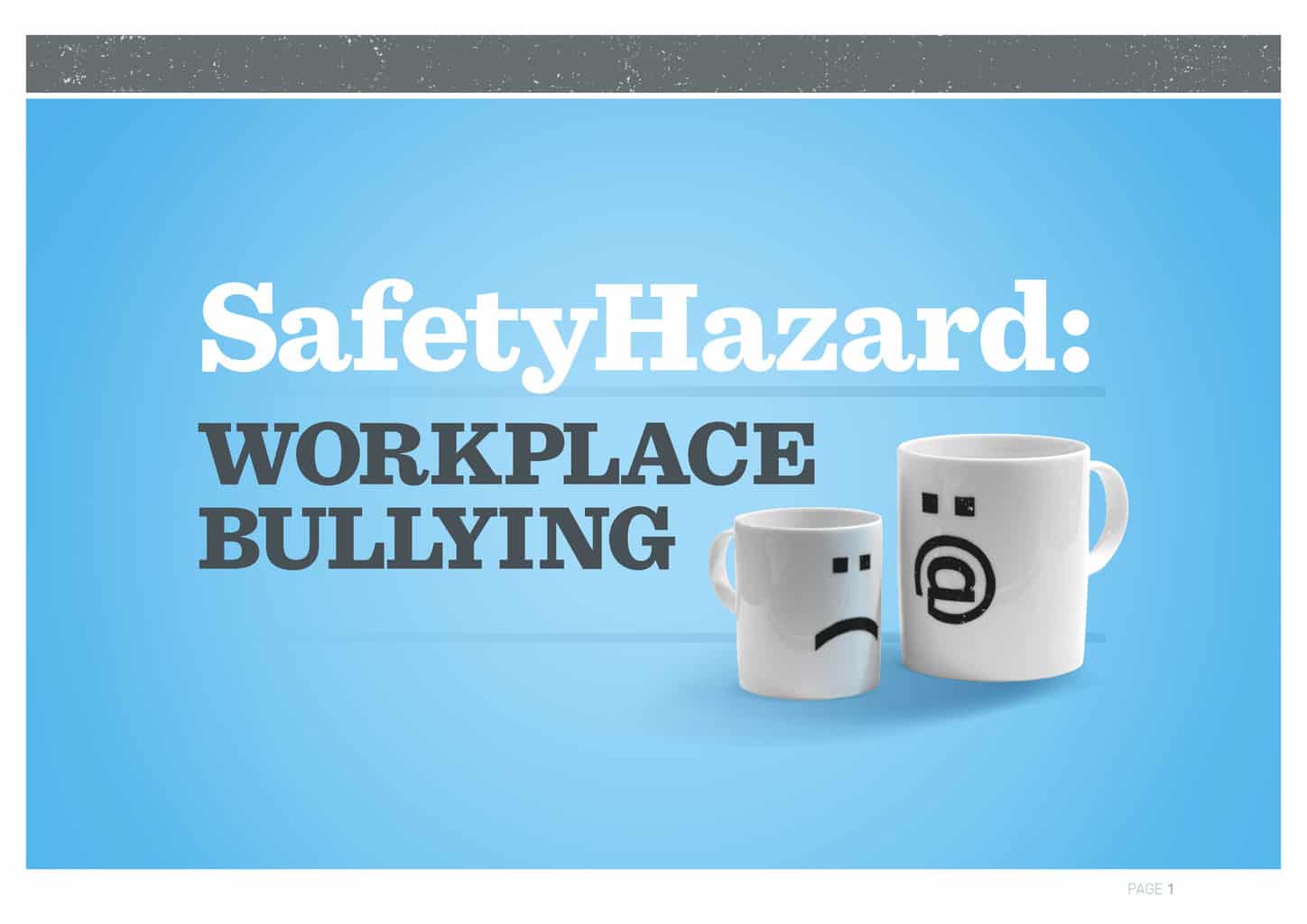
Safety Consultants Australia (SCA) released a “blueprint” on Safety Hazard: Workplace Bullying in March 2012 that has been recirculated this week. The blueprint is a useful example of the care that needs to be taken when summarising data on workplace bullying.

SCA states, IN VERY BIG LETTERS, that the Productivity Commission estimated that

“Workplace Bullying costs Australian employers between $6 – $36 billion every year.”

SCA has released a flyer with the same information in EVEN BIGGER LETTERS however the Productivity Commission’s report Performance Benchmarking of Australian Business Regulation: Occupational Health & Safety (2010)  states on page 279:

“Estimates of the prevalence and cost of psychosocial hazards vary considerably. For example, using international studies as a guide, estimates of the annual cost of workplace bullying to employers and the economy in Australia ranged from $6 billion to $36 billion (in 2000).” Continue reading ““Loose” workplace bullying statistics published”

Concatenate Web Development
© Designed and developed by Concatenate Aust Pty Ltd