The Victorian government’s move to legislate a right to work from home (WFH) at least 2 days per week continues to irritate some Australian executives. So, what is their problem with the proposal of a law that reflects the current practice in most Australian workplaces? Don’t they have other priorities to manage?
Category: business
Is there even a need for a home office?
In today’s The Age newspaper is an article about a worker who claimed part of his rent for his home office as a work-related tax deduction (paywalled). The Australian Taxation Office rejected the claim, but it is now being considered by the Federal Court. There is a comment in the article that questions the need for a home office and challenges the occupational health and safety (OHS) context of working from home.
How BS30480 Challenges Tokenistic Mental Health Programs
British Standards Institute has just published BS30480, a standard called “Suicide and the workplace – Intervention, prevention and support for people affected by suicide – Guide”. It has come at the right time to show that the changes in psychological health at work in Australia are not in isolation.
Note: this article discusses workplace suicide factors.
NSW Debates Dollars While Workers Break Down
In New South Wales, reduced workers’ compensation for those workers suffering from a mental injury remains a politically hot topic. Independent Member of Parliament, Alex Greenwich, asked the Minister for Work Health and Safety, Sophie Cotsis, about maintaining “the sustainability of premiums”. This opened the door for Cotsis to inform the House and to attack the (Conservative) opposition. The debate highlighted the continuing misdirection from much more important and key occupational health and safety (OHS) reforms.
No Excuses, No Transition – Navigating Victoria’s New Psych Safety Code
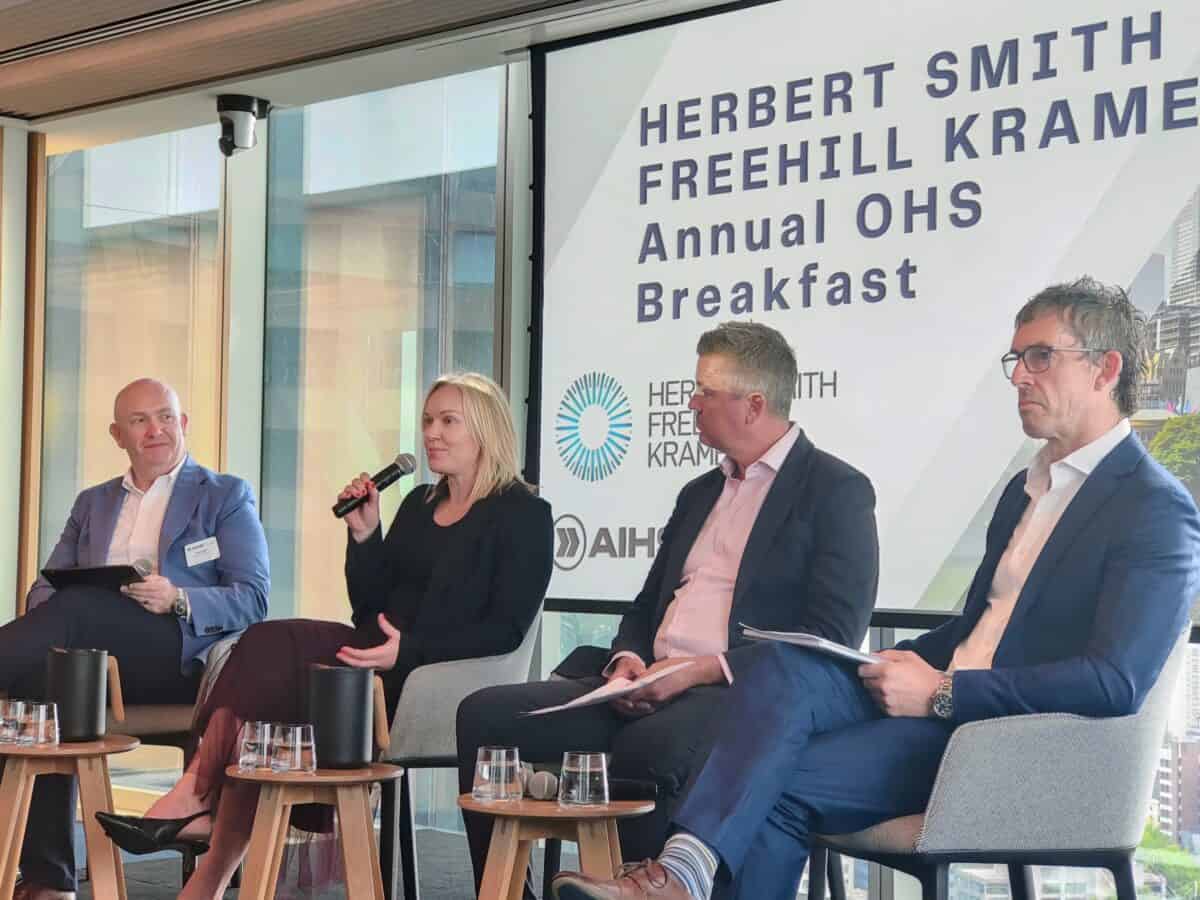
Maddocks law firm has just concluded the second part of their psychological health and safety seminars. Lawyers Catherine Dunlop and Dale McQualter have the advantage of following a seminar on the same topic held by Victoria’s occupational health and safety (OHS) regulator just the other day. The advantage with this seminar is that the lawyers feel comfortable in giving their opinions and advice in contrast to the careful words of the WorkSafe people.
Why Known Hazards Still Kill – Falls from Heights
Recently WorkSafe Victoria revealed that in 2025:
“In the first half of this year, 174 Workcover claims have been lodged from the construction industry, from falls alone. A further 34 businesses have been charged and another 28 duty holders faced legal action, accumulating more than 2.54 million in fines, undertakings and costs. That already tops the entire 2024 figure of $1.65 million from 33 charged or prosecuted entities.”
I had the opportunity to ask WorkSafe’s Chief Health and Safety Officer, Sam Jenkin (pictured above), why such a well-known workplace hazard persists.
Why do we need a “positive duty” to prevent harm?
In 2023, a Royal Commission into Violence, Abuse, Neglect and Exploitation of People with Disability recommended that the Commonwealth Disability Discrimination Act 1992 be amended to introduce a positive duty on all duty-holders to eliminate disability discrimination, harassment and victimisation. This echoes the imposition in 2022 of a positive duty to prevent sexual harassment. Occupational health and safety (OHS) legislation has had its positive duty to prevent work-related harm since 1985. So why this current push for positive duties?