The wisdom of a farming Near Miss

Australia’s occupational health and safety (OHS) agenda seems largely dictated by high risk industries like construction in some States and the mining sector in others. But agriculture is common to all Australia States and is consistently included in the official and unofficial workplace fatality data. New research has been released into serious farm injuries and which voices are the most effective in improving the situation.

The level of risk in Australian farms is illustrated well by

Subscribe to SafetyAtWorkBlog to continue reading.
Subscribe Help
Already a member? Log in here

Interview with Dr Gerry Ayers

This weekend is the International Workers Memorial Day.  In Victoria, in particular and in Australia more generally, it is highly likely that the issue of Industrial Manslaughter laws will be raised as part of a trade union campaign.

Dr Gerry Ayers, the OHS&E Manager of one of the branches of the CFMEU, features in an online petition about these laws and it seemed the right time to interview Dr Ayers about these laws but also about workplace health and safety enforcement and practices more generally.

Subscribe to SafetyAtWorkBlog to continue reading.
Subscribe Help
Already a member? Log in here

Flogging the banks could help safety

Australia’s Royal Commission into banking and financial services is a few months in and the evidence provided of wrongdoing is so substantial that those who were critical of the need for such an investigation are admitting they were wrong.
SafetyAtWorkBlog is applying the logic that occupational health and safety (OHS) succeeds best when it is part of the organisational culture.  Australia has often held its banking and financial services as “world-class” and many of that industry sector’s leaders have been prominent in speaking about the importance of leadership and corporate morality.

The financial and banking industry’s credibility and authority in Australia is gone and the OHS profession can learn much from this failure, even when the failure is in its early stages of exposure.

Subscribe to SafetyAtWorkBlog to continue reading.
Subscribe Help
Already a member? Log in here

First WHS Review submission released is hard work but useful

The Minerals Council of Australia (MCA) has released its submission to the Independent Review of Work Health and Safety Laws.  It is a good example of the business-speak that can erode the effectiveness of clear communication, but the submission is still revealing.  Here is an example from its Executive Summary:

“A nationally-consistent, risk-based preventative Work Health and Safety (WHS) regulatory system, supported by industry-specific regulation, would deliver benefits based on greater certainty, consistency and efficiency. It would also help to ensure that compliance challenges do not detract from the practical tasks of identifying, managing and minimising risk and the continuous improvement of safety and health outcomes by companies.” (Page 3)

So, the MCA wants national occupational health and safety (OHS) laws?

Subscribe to SafetyAtWorkBlog to continue reading.
Subscribe Help
Already a member? Log in here

Why don’t employers pay attention to psychological harm?

The Safety Institute of Australia (SIA) is an active supporter of Safe Work Australia‘s (SWA) recent attention to the risks of psychosocial hazards in the workplace.  On 10 April 2018, the SIA reiterated this support and its anticipation of a new SWA guide on the issue but the media release  includes a statement that may be a little too polite towards employers and not sufficiently inquisitive about the safety professional’s role.

The CEO of the SIA,

Subscribe to SafetyAtWorkBlog to continue reading.
Subscribe Help
Already a member? Log in here

Sexual harassment Code developed in isolation

Screen Australia has released its sexual harassment code of conduct.  If any film project in Australia desires government funding it will need to comply with this Code.  The Code is a good starting point and will need support from a broad range of elements of the entertainment industry but this Code is indicative of problems with many such codes that see the issue as a legal one rather than a safety and cultural one.

Subscribe to SafetyAtWorkBlog to continue reading.
Subscribe Help
Already a member? Log in here

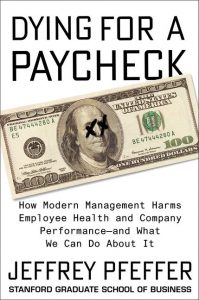
Pfeffer cuts through on OHS

“…if we truly care about human beings and their lives, including how long people live…. we need to first understand and then alter those workplace conditions that sicken and kill people” (page 25 – “Dying For A Paycheck”)

Jeffrey Pfeffer has been doing the rounds of the Safety and Human Resources conferences for some time, talking about “dying for a paycheck”.  This year he published a book of that title, a book that should be obligatory reading for occupational health and safety (OHS) professionals and, more importantly, company executives.

This book is one of the few that I have read from cover-to-cover and wanted to do so in as short a time as possible because I wanted to understand the big interconnected picture of business management and policy setting that Pfeffer discusses.

Pfeffer presents a lot of data packaged in a fresh and fascinating form but regularly complains about the lack of data.  One of the joys in the book is being tantalised by what data he presents but then being frustrated when realising that that is the extent of the data available.   Continue reading “Pfeffer cuts through on OHS”

Concatenate Web Development
© Designed and developed by Concatenate Aust Pty Ltd