
In 2023, a Royal Commission into Violence, Abuse, Neglect and Exploitation of People with Disability recommended that the Commonwealth Disability Discrimination Act 1992 be amended to introduce a positive duty on all duty-holders to eliminate disability discrimination, harassment and victimisation. This echoes the imposition in 2022 of a positive duty to prevent sexual harassment. Occupational health and safety (OHS) legislation has had its positive duty to prevent work-related harm since 1985. So why this current push for positive duties?
Category: business
OHS Lessons from the Antoinette Lattouf Case
Just before Christmas in 2023, Antoinette Lattouf was taken off-air by the Australian Broadcasting Corporation halfway through her five-day contract as a radio fill-in. It sparked an acrimonious unfair dismissal dispute. Last week the Australian Labour Law Association held a webinar on the case which touched on the occupational health and safety (OHS) perspective.

Governments should set the OHS bar much higher
It should be clear to readers by now that I am not a lawyer. My interest is in the practical application and compliance with occupational health and safety (OHS) laws. Those laws often encouraged employers to look for the source of workplace harms and hazards, with government agencies advising that addressing these causes is the most effective and cost-effective way to manage OHS. In this context, it seems to me that clients can significantly influence OHS, as they may be a major source of work-related harms and risks. But their role is often downplayed.

Denmark and Australia Compared on Psychosocial Safety
Niru Tyagi recently wrote on LinkedIn about Denmark’s regulatory approach to work-related psychosocial hazards, comparing it the current Australian approach, framing Denmark as creating an industrial obligation. It is a perceptive comparison but downplays the significance in Australia of the criterion of reasonably practicable.

OHS and Politics
In support of Australia’s Safe Work Month, I have recorded a 12-minute opinion piece on how Australian politics since 2010 has affected the perception and development of occupational health and safety, based on past SafetyAtWorkBlog articles.
It is an interesting opportunity to reflect on the decisions and actions of influential individuals like Julia Gillard, Kristina Keneally, Jeff Lawrence, and David Gregory.

Culture is the New Compliance in Victoria’s Psychological Health Code
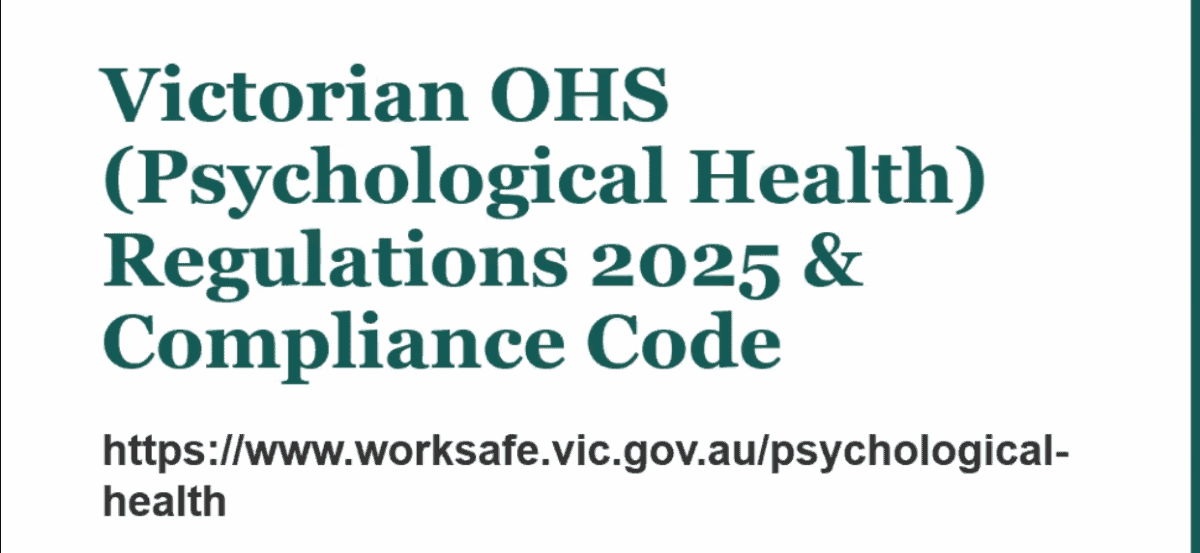
The most significant challenges for employers in Victoria’s new OHS (Psychological Health) Regulations, supported by a new Compliance Code, are likely to be fostering a strong workplace safety culture. Occupational health and safety (OHS) advocates have been emphasising the importance of culture for several decades now (Sociologists examined it decades before). It appears that we will be hearing a great deal more about culture for some time to come, but what is expected of employers?
Polishing What Exists: Making Sense of the New Psych Safety Code
Prominent occupational health and safety (OHS) lawyers Dale McQualter and Catherine Dunlop have just concluded the first of two online seminars about Victoria’s new psychological/psychosocial regulations and compliance code. Many employers will have a lot of work to do to comply, but the overall sense was one of reassurance.