Proposed drug testing – a political tool

On 6 February 2014 the Victorian Premier. Denis Napthine, announced the intention to

“…require construction companies to implement comprehensive drug and alcohol screening measures to ensure the safety of workers to be eligible to tender for Victorian Government construction contracts.”

This is to be part of the occupational health and safety (OHS) obligations of companies under the Implementation Guidelines to the Victorian Code of Practice for the Building and Construction Industry.  Understandably the construction union, particularly, is angry and feels as if it is being singled out.  Both organisations have chosen their words very carefully. Premier Napthine is quoted as saying:

“Reports of illicit drug use and distribution on Victorian construction sites are widespread.”

The CFMEU‘s Victorian Secretary John Setka has stated that

“There is no epidemic of drug taking on construction sites…. Our Health and Safety representatives who look out for workers’ health and safety are not reporting a problem.”

It is unlikely there is an epidemic of drug use but the Premier is talking of drugs AND alcohol.  
Subscribe to SafetyAtWorkBlog to continue reading.
Subscribe Help
Already a member? Log in here

Citi Research report provides insight into Australian corporate safety performance

On 29 January 2014 Australia’s Fairfax newspapers published an article called “Safety performances at Australia’s top companies is serious business” written by Adele Ferguson.  The article is based on an analysis by Citi Research of the safety performance of companies listed in Australia’s ASX100 share index.  Citi Research (Citi) has kindly provided SafetyAtWorkBlog with a copy of this report developed for its fund manager and superfund clients.  It is a terrific reference document providing a useful insight to the OHS performance of prominent Australian corporations.  It cannot be definitive but we know of nothing else like it in Australia.

In the Fairfax article Ferguson wrote:

“While safety is a complex issue largely due to the fact that safety records are difficult to measure and difficult to compare across companies and industries, it is an important area to explore. For starters, it is a good proxy for the way a company deals with staff and manages risk more generally.”

Safety does not have to be complex but the measurement of safety performance can be as, even though there is a (dreadfully outdated) Australian Standard for measuring OHS performance, companies tweak the existing measures and the principal measurement, the Lost Time Injury Frequency Rate (LTIFR), has been found to be a flawed indicator.  LTIFR is tolerated as a measurement simply because a better alternative has not been developed or widely accepted.

The Citi Research report lists LTIFRs for most of the 117 companies but it balances this with almost as many Total Recordable Injury Frequency Rates (TRIFR).  

Subscribe to SafetyAtWorkBlog to continue reading.
Subscribe Help
Already a member? Log in here

Interesting new appointment at South Australia’s Master Builders

Modern workers rarely stay in jobs longer than six or seven years because they choose to move on or are working on projects that have a short lifespan. Sometimes opportunities arise that can steer people in unpredictable directions, sometimes to positions of influence.  One example of this type of journey could be Ian Markos.

One newspaper recently wrote:

“The recently appointed director of policy for the SA branch of the MBA, Ian Markos, said a “nanny state” approach was stifling job creation. “There’s a raft of laws and regulations. You’ve got employment laws, you’ve got taxation laws, you’ve got environmental laws, you’ve got work health and safety laws, local council regulations. We’re saying enough is enough,” he said.”

Criticism of occupational health and safety (OHS) laws is not surprising from the Master Builders Association but Ian Markos was with South Australia’s OHS regulator, SafeWorkSA, for many years (with a once-only appearance on Gardening Australia) as the Chief Officer, Compliance, Advisory, Legal and Investigations. Continue reading “Interesting new appointment at South Australia’s Master Builders”

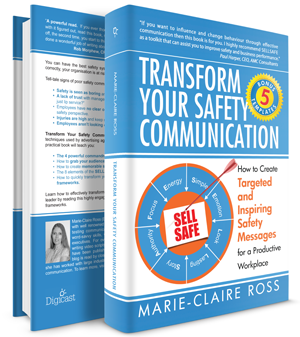
A bright new book on safety communications

Australian marketer and communicator, Marie-Claire Ross, has moved from video to print with a new book called “Transform Your Safety Communication“.  The book  approaches safety communications from the marketing perspective and provides a terrific primer in how to write about workplace safety effectively.

Marie-Claire Ross writes that

“Too often, safety professionals are taught about compliance, but not the right skills to influence and engage others.” (page 12)

This is not a deficiency of just the OHS academia.  Such a statement would equally apply to most professions.  Commercial communication skills, those required other than for essays, assignments and theses, are rarely included in any curriculum other than journalism and marketing.  As such, this book is likely to have benefits way beyond the safety profession. Continue reading “A bright new book on safety communications”

Safety Culture can distract from safety management

Mohammad Rabbi has recently written that

“…safety culture is something that must permeate an entire organization. Its application largely depends on the investment, training, employee attitude, environment, location, laws, customs and practices in the industry.  So how can organizations go about developing a safety culture?”

He is right that any safety culture has a wide range of business and social contexts but the quote, and the article, Workplace Safety Culture 101, seems to miss a couple of contextual realities.  Many of these issues quoted appear to be basic elements of business and safety management and not dependent on safety culture programs.

Subscribe to SafetyAtWorkBlog to continue reading.
Subscribe Help
Already a member? Log in here

Incident investigation findings should be shared

Accident reportMany people, and OHS professionals, complain about the lack of research in Australia into occupational health and safety issues.  Research is occurring but often this is inaccessible to companies, professionals and decision-makers due to unjustifiable costs for the articles and journals.  Yet there is OHS research, of a type, that can be done by any company should they choose to do so – incident investigation.

Individual investigation reports may only address one set of circumstances, those that led to an incident or, rarely but importantly, a near miss or a systems breach, but together these reports may identify a systemic problem or illustrate broader safer deficiencies in an industry sector.

Subscribe to SafetyAtWorkBlog to continue reading.
Subscribe Help
Already a member? Log in here

New book provides fresh context to OHS

SafetyAtWorkBlog regularly receives excellent review books from the New York publishing company, BaywoodPublishing.  The latest is entitled Safety or Profit? – International Studies in Governance, Change and the Work Environment.   I have yet to get beyond the introduction to the chapters by Australian academics on precarious workers (Quinlan) and the decriminalisation of OHS (Johnstone) but the introduction is fascinating.

The most fascinating is its discussion of Lord Robens’ Report of the Inquiry into Health and Safety at Work from 1973. The editors, Theo Nichols and David Walters, question the “major advance” many claimed for the Robens report by comparing it reviews 40 years earlier.  Nichols and Walters quote the conservatism that led to Robens seeing criminal law as being “largely irrelevant”, and legal sanctions being “counter to our philosophy”.  However, they do admit that Robens was prophetic on the growth of self-regulation and the duties of care.

Nichols and Walters also remind us that the Robens-inspired Health and Safety At Work Act of 1974 did not recommend the creation of Occupational Health and Safety (OHS) representatives.

Subscribe to SafetyAtWorkBlog to continue reading.
Subscribe Help
Already a member? Log in here
Concatenate Web Development
© Designed and developed by Concatenate Aust Pty Ltd