
Safety culture change through a regulatory-based market mechanism

In late August 2012 at a breakfast seminar, the Director of Construction Code Compliance, Nigel Hadgkiss outlined the 1999 Victorian Code of Practice for the Building and Construction Industry, which complements a 1997 National Code, and recently released implementation guidelines being imposed on many Victorian construction companies by the Liberal Government. The Code and implementation guidelines are ostensibly about industrial relations or, as Australia is increasingly calling them, workplace relations but do contain some interesting safety elements.

An intriguing element of the Code and guidelines is the introduction of a workplace culture through contract obligations and how this may affect workplace safety.

Hadgkiss stated, according to a copy of his presentation, that

“Where a party tenders for public work called for after 1 July 2012, the party is required to comply on any subsequent privately funded work.”

This quote means that any company that applies for a Victorian Government contract, of specific costs and other criteria, must comply with the Code.  Any client is entitled to impose their own contractual conditions. The obligation that  “the party is required to comply on any subsequent privately funded work” means that even if the contractor or party fails to win the contract it tendered for its management of  any subsequent project, even one from non-government funding, must also comply with the Code.

One of the four priority elements of the Code is occupational health and safety, so OHS requirements will spread from principal contractor, or tenderer, to contractor, sub-contractors and sub-sub-contractors like a virus or an “ITI”, an industry-transmitted infection.   Continue reading “Safety culture change through a regulatory-based market mechanism”
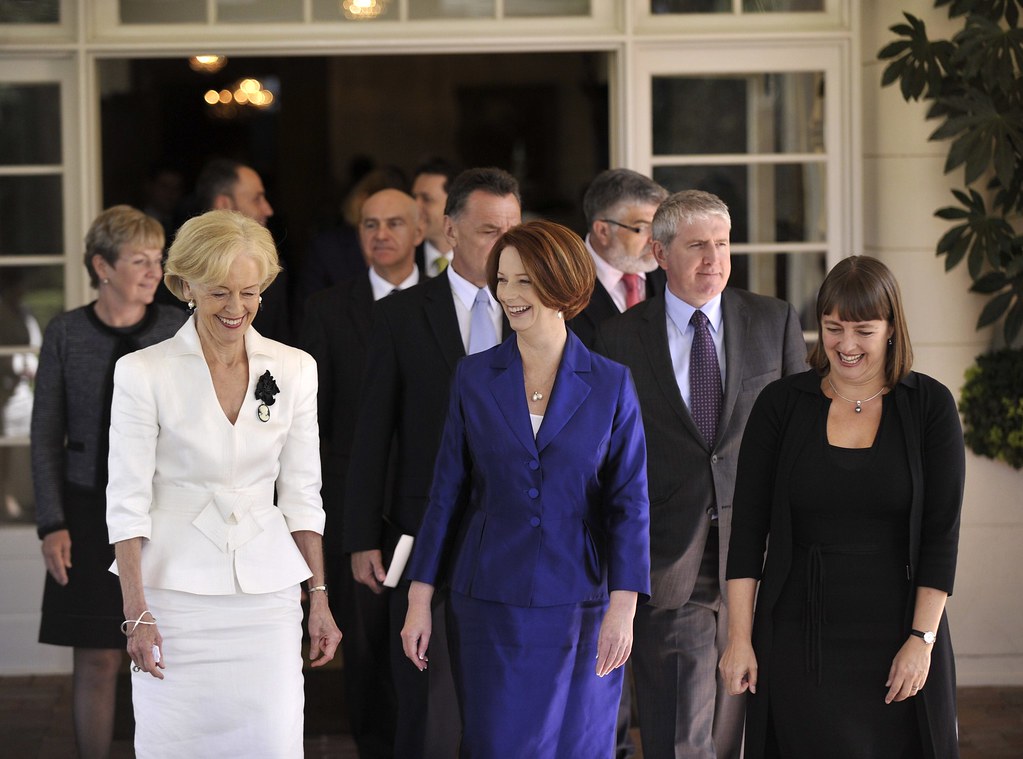
Inside Australian PM’s political problems is a nugget of workplace safety

Prime Minister Gillard (centre) and others at Government House Canberra in March 2012

The Australian Prime Minister, Julia Gillard, has been under intense media pressure over an issue concerning her conduct as a lawyer around 17 years ago.

It involves legal work for unions, her personal relationship at the time with a union official who has been described as “dodgy” and of most relevance to this blog, workplace safety.

Missed in all the debate is that the workplace safety issue seems to support the assertions of many in the business and industry associations that OHS is frequently used by trade unions as an excuse for action in other areas.  These other areas are usually industrial relations but in this instance OHS was used to mask a unionist’s alleged misuse of member and industry funds. Continue reading “Inside Australian PM’s political problems is a nugget of workplace safety”

Principled pragmatism – Human Rights included in OHS Due Diligence

On 16 August 2012, Australia’s Workplace Relations Minister, Bill Shorten, said in Parliament, in relation to new asbestos management initiatives, that”

“On 14 March this year, in my first ministerial statement on workplace health and safety in this place, I said that every Australian who goes to work should return home safely. I know both sides of the House endorse this universal human right and today I reaffirm our commitment to this principle…” (page 13, Hansard. emphasis added)

It is very common to hear safety professionals and company executives echo the statement that workers should return home in an uninjured state.  But few would be aware or, perhaps, agree that this is a human rights statement.

Following an earlier blog post, one reader has pointed us to the United Nations Guiding Principles for Business and Human Rights that were released in 2011. According to the author, John Ruggie, these principles:

“… highlight what steps States should take to foster business respect for human rights; provide a blueprint for companies to know and show that they respect human rights, and reduce the risk of causing or contributing to human rights harm; and constitute a set of benchmarks for stakeholders to assess business respect for human rights. Continue reading “Principled pragmatism – Human Rights included in OHS Due Diligence”

Extraordinary duty of care prosecution over a near miss

Near miss events, or “close calls”, are important opportunities to review safety and work processes.  In fact they can be the best opportunities as the participants and witnesses are still alive and can provide detailed information on the mistakes, breakages or oversights.  But rarely are companies prosecuted for near misses.

In Western Australia, a company has been found guilty of breaching its duty of care after two of its workers were lost for almost a whole day, and was fined over $A50,000, the highest fine of this type.  The near miss is almost comical and at least one newspaper has described it as a “comedy of errors“, except that it could easily have resulted in tragedy.  WorkSafeWA’s (long) media release, provides the details:

MAXNetwork was contracted to the Department of Education, Employment and Workplace Relations to consult with disadvantaged job seekers, in this case through their office in Kalgoorlie.

A number of employment consultants work at the Kalgoorlie office, and they regularly travel to remote areas – some accessible only by dirt roads and narrow tracks – to work with job seekers.

In December 2009, two of the company’s Kalgoorlie area employment consultants were instructed to do an “outreach visit” to the remote community of Tjuntjuntjara, around 600km north-east of Kalgoorlie in the Great Victoria Desert.

The two consultants departed Kalgoorlie in a Toyota Prado leased by MAXNetwork at around 6.00am on a journey estimated to take nine to ten hours on a road with no signs that was a narrow track in some places.

The women were not provided with a map, GPS or any other navigational aid, and consequently they became lost. They had received no training or instruction on travelling in remote areas, and so did not know what to do in the event of becoming lost.

The satellite telephone provided to the consultants did not work, and management was aware of this prior to the trip. In addition, there was no schedule for regular contact with workers in remote locations so no-one realised the women were overdue. Continue reading “Extraordinary duty of care prosecution over a near miss”

Where do workers and managers learn about respect?

The origins of workplace bullying behaviour seem many.  One of the issues to, hopefully, emerge from Australia’s inquiry into workplace bullying is how to prevent and minimise bullying, but to do so, one will need to identify the causes.  And these causes need to be more than an amorphous, unhelpful concept like “workplace culture”.

David Yamadamake this comment in his blog, “Minding the Workplace“, about a recent article in a New York Times blog (gosh, social media feeds social media.  What’s a newspaper, Daddy?):

“Doctors and lawyers in training may have no idea how to conduct themselves as practitioners, other than being influenced by a lot of unfortunate “role models” on television. If we want to prevent workplace bullying, the training schools for these professions are the first and perhaps best places to start.”

This point links thematically to several recent SafetyAtWorkBlog articles about defining a safety profession, moving from a practice to a profession, workplace culture and workplace bullying. Continue reading “Where do workers and managers learn about respect?”

Unnecessary pissing contest in the Western Australian safety profession

In Western Australia in 2010, the Safety Institute of Australia (SIA) conducted its conference, the WA Safety Show, at the end of August.  In 2011, the SIA did not hold a conference in that State but in 2012 the WA Safety Show returned to Perth however it was oddly rescheduled earlier in the month, August 7-9.  Curiously there is another safety conference occurring in Perth on those very same days, only 500 metres away and it happens to be conducted by Safety In Workplaces Australia (SIWA), a recent safety professional association that emerged from disenfranchised SIA members.

The 2010 WA Safety Show was organised by the then secretary of the WA branch of the SIA, Gavin Waugh, who is now the President of SIWA.  In 2012 there is both a WA Safety Show and a WA Safety Conference happening on the same days within 500 metres of each other but run by different safety professional organisations.

What the ??? Continue reading “Unnecessary pissing contest in the Western Australian safety profession”

More barriers appear to safety education reform

The latest edition of National Safety magazine reports on the voluntary accreditation of OHS university courses.  The article is generally supportive of the initiative administered by the Australian OHS Education Accreditation Board (AOHSEAB), but hints at some of the problems and should have clarified some of the organisational linkages.

There is no mention in the article of the professional, administrative and financial links between AOHSEAB and the Safety Institute of Australia (SIA).  There is no mention of Pam Pryor’s membership with the SIA even though she is the AOHSEAB’s registrar, a Fellow of the SIA and secretary of the SIA’s Education Chapter, although the Fellow status of Professor Dino Pisaniello is noted later in the article.

The strong linkages between the AOHSEAB and the SIA provide an important context to the comments of Greg Stagbouer, an SIA Director, Continue reading “More barriers appear to safety education reform”

Concatenate Web Development
© Designed and developed by Concatenate Aust Pty Ltd