Supreme Court decision limits public knowledge of OHS offences

Woman CelebratingIn May 2013 Fiona Austin (@upfrontfi) a lawyer with the Australian law firm, Herbert Smith Freehills (HSF), tweeted:

“Great win in the Supreme Court! No more naming and shaming for health and safety offenders in Queensland”

The Supreme Court decision is an appalling situation over which OHS professionals and regulators should be outraged.

Austin and other HSF lawyers authored a longer article on the case and totally miss the point of why OHS offenders should be named.  Shaming of offenders is a different matter.

The article explains how a decision under the Penalties and Sentences Act 1992 (Qld) may stop the OHS regulator in Queensland, Work Health and Safety Queensland, from listing the names of offenders on its website. Continue reading “Supreme Court decision limits public knowledge of OHS offences”

New Zealand railways, red tape, politics and workplace deaths

cover of NZ RailOn 28 April 2013, New Zealand lawyer, Hazel Armstrong, published a 48-page book on how workplace fatalities and the management of the NZ rail industry has been related to politics and economics.

This is an ideological position more than anything else and the evidence is thin in much of this short book but there is considerable power in the description of the manipulation of occupational health and safety regulations and oversight during the political privatisation of the NZ rail sector.  Many countries have privatised previously nationalised, or government-owned, enterprises usually on the argument of productivity and efficiency increases.  Armstrong argues that these arguments were used to justify breaking the trade union dominance of the rail industry. Continue reading “New Zealand railways, red tape, politics and workplace deaths”

Short-sighted redefinition of worker

In May 2013, Workcover Queensland supported the government’s intention to change the definition of worker to match that of the Australian Taxation Office (ATO).  The definition re-emphasises the significance of the employer/employee relationship.  Workplace health and safety laws through most of Australia have recently changed to remove the reliance on the employer/employee relationship with the intention of clarifying the lines of responsibility for preventing harm.  The diversity between workers’ compensation and OHS definitions unnecessarily complicates the management of a worker’s health through the linear experience of employment.

The government believes such changes will reduce “red tape” but only in the narrow context of workers compensation.  The Work Health and Safety Act expands the definition of worker but another piece of legislation in the same State restricts it.  Inconsistencies of concepts are likely to lead to duplications, confusion and arguments that may generate as much unnecessary business and legal costs as the initiatives were intended to save. Continue reading “Short-sighted redefinition of worker”

Melbourne Business School takes the high road on fall prevention

Below is a guest post from long time SafetyAtWorkBlog reader, Marian Macdonald.

Workplace Access & Safety height safety consultant Aaron Carratello on a walkway built for access to HVAC equipment at Mt Eliza Business School

It was when Simon Murray put himself in the witness box and imagined what a judge would say that investing in walkways and guardrails became a ‘no brainer’.

The property and facility manager of the Melbourne Business School was faced with an important decision: whether to install extra roof anchors and static lines or shift towards more passive forms of fall prevention.

Roof anchors were cheaper initially, while the walkways and guardrails offered a far lower lifetime cost but, in the end, price was not the issue.

“A judge would ask whether we had done what was ‘reasonably practicable’,” Mr Murray says, “and if we’d only installed roof anchors and static lines to reach our HVAC equipment, the answer would have been ‘no’.” Continue reading “Melbourne Business School takes the high road on fall prevention”

Is safety leadership the panacea for unsafe workplaces?

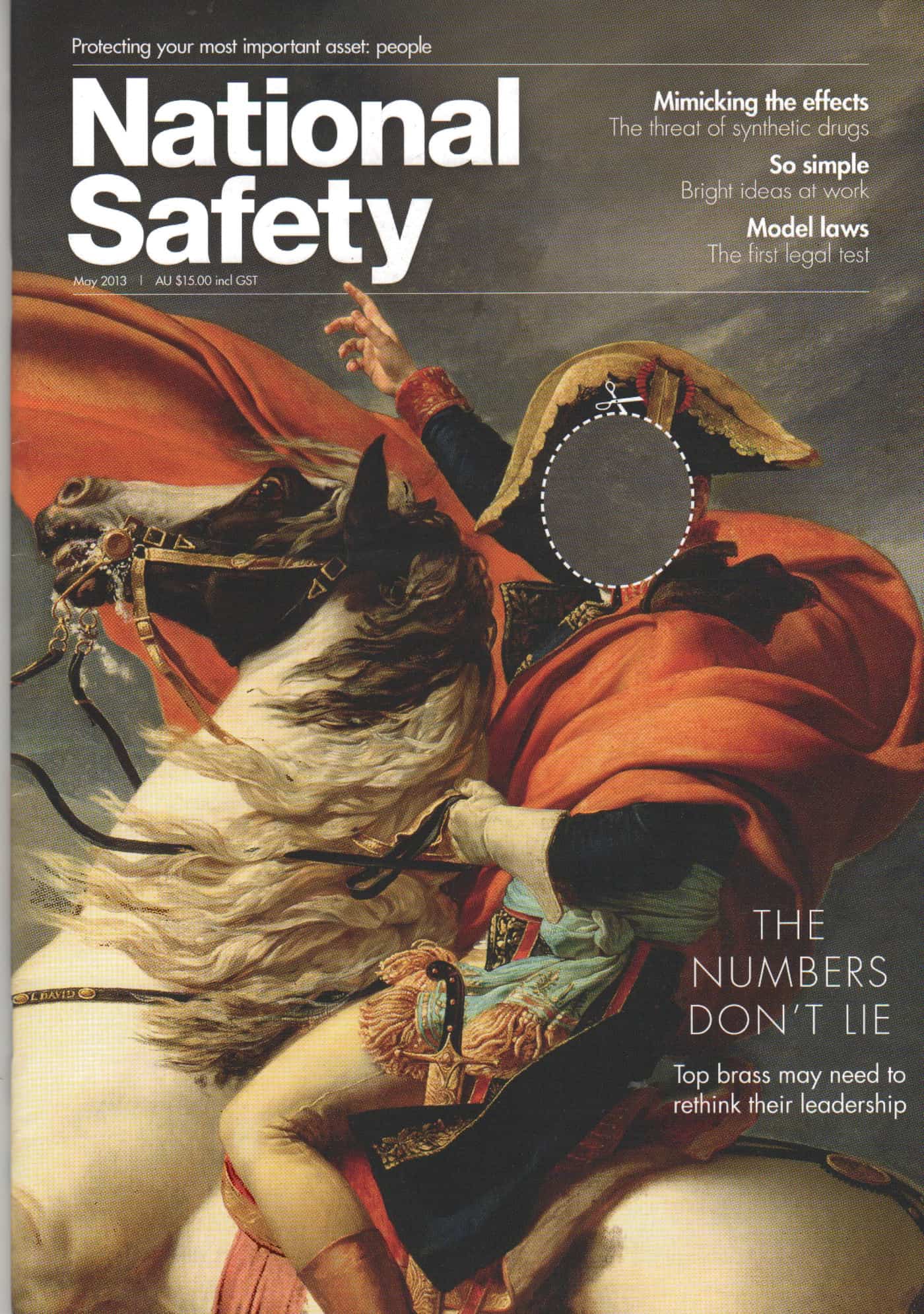
National Safety Cover May 2013The May 2013 National Safety magazine has an article on safety leadership by Australia lawyer, Michael Tooma.  It is a terrific article but it also highlights the lack of case studies of the practical reality of safety leadership in Australia and the great distance still required to improve safety. Tooma starts the article with

“It is widely recognised that strong safety leadership is integral to work, health and safety performance in any organisation.” [emphasis added]

Later he writes

“There is little doubt that safety leadership is a prerequisite to a positive safety culture in any organisation.”

These equivocations may indicate authorial caution on the part of Michael Tooma but  they could illustrate that the role of safety leadership still remains open to question. Continue reading “Is safety leadership the panacea for unsafe workplaces?”

Workers Memorial Day ceremony, industrial manslaughter and red tape

ACTU President Ged Kearney addresses the event. (image: VTHC)

The President of the Australian Council of Trade Unions (ACTU), Ged Kearney, spoke briefly at the Workers Memorial Day ceremony in Melbourne Victoria on 29 April 2013.  Kearney reiterated the call for industrial manslaughter laws in Australia echoing the statements by the ACTU’s Michael Borowick yesterday and the ACTU media release. Continue reading “Workers Memorial Day ceremony, industrial manslaughter and red tape”

National Workers Memorial opens

Yesterday Australia opened its National Workers Memorial in Canberra.  The Workplace Relations Minister  Bill Shorten, spoke at the ceremony with, largely, an edited and reduced version of the speech he presented in Brisbane earlier last week.  The Canberra speech dropped  all the ANZAC Day references and spoke about the importance of remembering.

“By erecting this monument, we tie the lives and memories and families of thousands of Australians to this place.  We stand here in this place as a mark of respect from a civilised community as an expression of failure and regret.  That’s what all memorials are, and this one is no different.  This is a symbol of the mourning for those lost too early from our tribe Australia.” Continue reading “National Workers Memorial opens”

Concatenate Web Development
© Designed and developed by Concatenate Aust Pty Ltd