
The Asphyxiation of OHS

Good OHS thinking and practice are being slowly asphyxiated.  By far most suggestions by workers, unions or good consultants for Health & Safety improvements are ‘choked’ by management naysayers and bureaucrats more in touch with their current minister’s moods than workplace reality.  Not choked immediately or blatantly.   In fact, that person may be patted on the back and encouraged to raise more OHS matters, “Yes, mate, good!  Tell us what else we’re doing wrong, very very helpful.  You just keep on telling us”……..  And slowly any significant discussion about OHS problems is suppressed and killed.

The majority of workers in Australia work in small workplaces where (typically) practical OHS programs are regarded by managers as a nuisance, a bit of ‘over-the-top’ nonsense that slows down productivity.  It’s regarded as an irritant of fashion that will pass, like the fashion-related, politically correct things to say. Continue reading “The Asphyxiation of OHS”
Important OHS and legal issues in findings of South Australian Coroner into young man’s death

The debate on OHS laws will be passionate in the pre-election frenzy of New South Wales but the OHS law reform is a national strategy and the safety debate is not asleep in the other States.

On 11 February 2011, AAP ran an article about the long-lasting familial and social effects a horrible workplace incident in South Australia in 2004.  Diemould Tooling Services (fined in 2009) took its appeal against prosecution to the High Court of Australia in 2008 and on 10 February 2011, almost six years after the death of 18-year-old Daniel Madeley, South Australian Coroner Mark Johns has said, at Madeley’s inquest:

“A horizontal boring machine had been operated at Diemould for years in a condition which could only be described as deplorably unsafe. It could have been guarded, but was not. It could have had a braking system, but did not. It could have had an automated lubrication system, but did not.

“Many other things could have been done, but any one of these would have been sufficient to save Mr Madeley’s life….”

Coroner Johns was very critical of SafeWorkSA about its actions following the 2004 death.  The coroner’s findings make for disturbing reading on several issues. Continue reading “Important OHS and legal issues in findings of South Australian Coroner into young man’s death”

Business jumps the gun on OHS, unions hope for the best

As the Australian State of New South Wales approaches its March 2011 election day, the lobbying is becoming more fierce.  In fact,  conservation opposition leader, Barry O’Farrell will need to rein in some of his business colleagues if the lobbying becomes too fierce.

It is widely tipped that O’Farrell will win the election and people are already planning for his ascension.  If the business pressure becomes too overt, it may reduce the size of the landslide win that is being predicted.

For example, prior to the Council of Australian Governments meeting organised by the federal (Labor) government, the New South Wales Minerals Council provides an example of the issue they will be running on through to the election.  CEO Dr Nikki Williams has said in a media release this afternoon: Continue reading “Business jumps the gun on OHS, unions hope for the best”

Good Comcare content on effects of OHS harmonisation

Australia’s Comcare was the first of the OHS regulators to provide an information session on Australia’s attempts to harmonise its OHS laws across many different jurisdictions and industry sectors.  The Melbourne seminar on 7 February 2011 could have been presented better but some useful information was available.

Content – Inspectorate

The most significant OHS information to come out of the event was that Comcare is making a serious attempt to move its enforcement from the investigatory model to inspectorate.  Michael Barnes acknowledged that this will be a considerable culture change for Comcare staff and, by extension, many Comcare clients.  This is a major change of emphasis as illustrated by Victoria’s WorkSafe that went through this exercise over the last five years or so.  This program will take many years to introduce and still more years to be accepted.

Basically the OHS “policeman” will have additional obligations to advise clients on ways to comply with OHS laws.  There has always been a tension when OHS inspectors, who often know the most appropriate control measure in work situations, are bound to not advise as they would be overstepping their authority. Continue reading “Good Comcare content on effects of OHS harmonisation”

OHS needs innovative thinking to manage fatigue

The December 2010 edition of WorkForce Management magazine (not available online) reports on a recent US survey concerning fatigue. The raw data is not available but the survey of 820 companies showed that over 80 per cent of respondents believed that fatigue was more of a workplace issue that in the past.

This may indicate an increased awareness or an increased reality but regardless, the hazard is gaining more attention.

Of greater interest is the possible causes identified in the survey. These include:

  • “Reduced head count,
  • Lack of boundaries between home life and work,
  • Second jobs,
  • A culture of ‘wanting to do it all'”.

How many of these contributory factors can an OHS professional affect? Continue reading “OHS needs innovative thinking to manage fatigue”

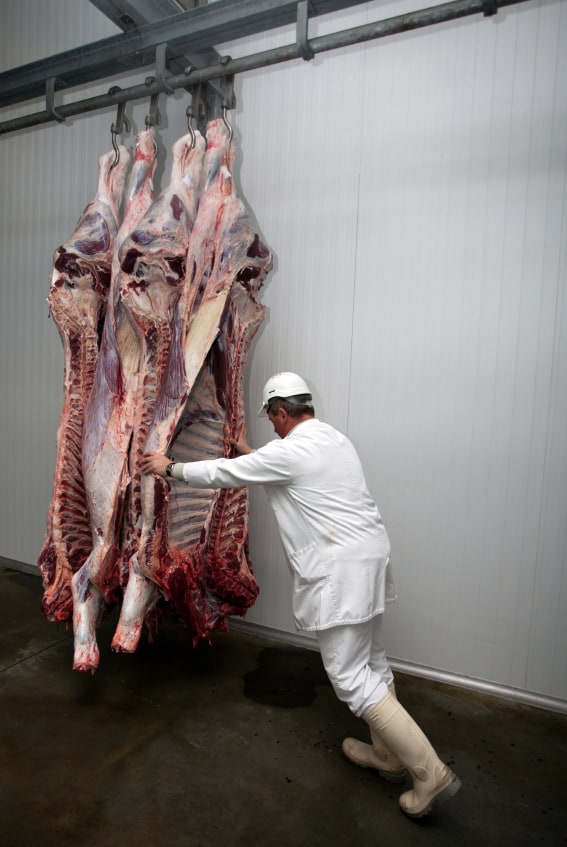
Only animals should die in abattoirs

The Sunday Age of 30 January 2011 ran an article about the status of workplace safety in some of Victoria’s abattoirs.  The article has some similarities to the landmark investigations by Eric Schlosser into work practices and compensation issues related to meatworks in the United States.

The Sunday Age says that

“(Last financial year [2009/2010], there were 355 workers’ compensation claims in Victoria’s meat industry that required at least 10 days off work, or cost more than $580 in treatment, or both – almost one a day. Nationally the industry’s injury and illness rate remains twice as high as that in the construction industry, and four times the average of all workplaces.”

Many would say that meat work is “inherently dangerous” but in the article lawyer Trevor Monti, contests the perception

”Yes, it’s a difficult industry and the work can be hard,” he says. ”But with proper consideration given to the system of work, the risk of injury can be significantly reduced.”

This is a position with which OHS professionals and regulators would agree.

It is significant that, if the comparative figures quoted above by the Sunday Age are accurate, abattoirs do not receive the enforcement attention that the construction industry receives.  Is it that the construction industry is largely unionised and the meat industry much less so?  Is it that abattoirs are rorting the immigration visa system as asserted by the Australian Meat Industry? Continue reading “Only animals should die in abattoirs”

Quad bike fatality costs over $80k in penalties

A Western Australian company has been fined $A50,000 over the death of one of its workers in November 2008  The worker rode a quad bike into a wire gate and died.  The recent WorkSafe WA media release focuses, understandably on the fine imposed in the Perth Magistrates’ Court on Jenara P/L but a clearer picture of the incident is available from an earlier WorkSafe report into the incident.  The accused, in this instance, was Seatown Holdings, a labour hire firm who was fined $A30,000 :

“The accused was a labour hire company which employed a worker for remuneration and arranged for said worker to work for Jenara Pty Ltd who was one of its clients.

The client ran a grain growing farm near Miling.

During the afternoon on Sunday 16 November 2008 the worker was working alone and riding an All Terrain Vehicle (ATV) on a road on the client’s farm when he rode into a wire gate known as a ‘cockies gate’. Continue reading “Quad bike fatality costs over $80k in penalties”

Concatenate Web Development
© Designed and developed by Concatenate Aust Pty Ltd