60 Minutes, Dust and Responsibility for Workplace Safety

On 8 June 2008, a US 60 Minutes report on combustible dust joined the conga-line of critics of the Occupational Safety And Health Administration.  The tone of the report is set by the reporter, Scott Pelley’s introduction stating that it is OSHA’s responsibility to avoid the explosions.  For OHS practitioners and professionals this is a peculiar statement as it is usually the employer’s responsibility for workplace safety.

The 60 Minutes report illustrates the difficulty that OHS inspectors face when visiting workplaces. Can an inspector be expected to identify ALL the hazards present in a workplace?  This is a constant problem for OHS regulators, employers and sadly, the Courts.

The accusation in the 60 Minutes report is that inspectors had no information or training on the explosive hazards of dust.  Training is not the solution for everything and an inspector’s state of knowledge should have identified dust as a potential hazard.  Even if the hazard was identified in terms of an inhalation risk, or housekeeping, the explosive risk would be reduced if housekeeping was applied properly.

OSHA clearly stated the responsibility of workplace safety being on the employers.  The missing element of the entire 60 Minutes report is that the site operators and employers who have experienced dust explosions were not interviewed.


More information on the February 2008 explosion at the Imperial Sugar plant mentioned in the report is available by clicking HERE

For those of you who find dust explosions exciting a video of a dust explosion in a silo is available HERE

For those employers or inspectors who did not do high school science, a schoolroom example of the combustible hazards of dust can be found HERE

 
Blog Directory - Blogged

Workers Compensation changes in Australia

In The Australian on 10 June 2008, Paul Kerin , Professorial Fellow of the Melbourne Business School writes on the rescuing Australia’s various workers’ compensation schemes by removing any state involvement in the insurance schemes.  He makes a strong case but writes a few peculiar comments that need consioderation. He says “US workplace deaths would be one-third…

Subscribe to SafetyAtWorkBlog to continue reading.
Subscribe Help
Already a member? Log in here

Economic fallout of Apache Energy pipeline explosion


According to an AAP report published in The Australian on 6 June 2008, Paul Adams, head of research at DJ Carmichael, spoke about the impact of the Apache Energy explosion.

“If damage to the Apache plant turned out to be significant, the incident had the potential to “hit WA’s mining industry hard”, Mr Adams said.

Apache could face a massive compensation bill if the incident was found to be the result of negligent maintenance practices, Mr Adams said.”

Further details emerged about the damage from the explosion.  Apparently at least three of Apache Energy’s online pipelines were on fire.  Apache could not say how long the shut down of the plant would continue for as the site needs to be further investigated.

Incident scene 5 June 2008


New York Crane Safety Podcast

On 3 June 2008, Brian Lehrer of radio station WNYC conducted a discussion on the issues of occupational health safety as it relates to New York City’s second crane collapse in a couple of months and a sharp rise in construction deaths so far in 2008.

The speakers are very critical of the Federal Occupational Safety & Health Administration and the resources provided to it by the Federal Government.  Speakers also raise the issues of the rate of construction, the skill levels of inspectors, shortage of building equipment, union membership, in passing, the legal status of migrant workers, and the assessment criteria of inspectors on construction sites.

The resource levels and strategic planning matters raised in this discussion echo many of the debates that are occuring in Europe and Australia.

The podcast is available for download by clicking HERE

Pipeline Explosion in Western Australia

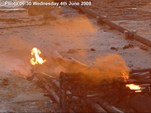
Western Australia’s gas supply has been disrupted due to an explosion at the Apache Energy off Dampier (shown below) on 3 June 2008.  Thirty per cent of the gas supply for that state is out of action.

There were no injuries and personnel were evacuated safely. The explosion site is pictured below.

This explosion presents important energy supply questions for the Western Australian government but, in the context of this blog, there are several paths to follow.  One will be to watch how Apache Energy handles the disaster management and business continuity.  The government will, undoubtedly, begin an inquiry and it will be interesting to note the assessment team structure and reporting lines. 

Another perspective will be to watch all of this evolve in comparison with the Esso Longford explosion in Victoria in 1998 which took out domestic and industrial gas supplies for almost two weeks. This incident lead to a Royal Commission. Compare and contrast.


New seismology report on Crandall Canyon mine disaster

I reported on the August 6 2007 Crandall Canyon mine disaster in my OHS publications last year as there seemed to be some similarities between that disaster, in which 6 workers and 3 rescuers died, and the events at Beaconsfield Mine in Tasmania of April 2006.  At the time seismological events were mentioned as a possible cause of the mine collapses.

According to an August 17 2007 AFP report in Safety At Work magazine:

“Controversy has swirled over the precise cause of the initial cave-in, with mine owner Robert Murray insisting it was the result of a powerful 3.9 magnitude earthquake. However, scientists at monitoring stations in Salt Lake City have suggested the seismic activity was caused by mining excavation.

The University of Utah Seismograph Station said the cave-in yesterday had been recorded as a 1.6 magnitude event at 6.39pm (1239 AEST). Spokesman Lee Siegel told the Salt Lake Tribune newspaper the nature of the seismic waves measured indicated it was a “mining-induced settling of the mountain”.

A seismological report dated May 2 2008 says that there are indications

“…that most of the seismic wave energy of this event was generated by the mine collapse rather than a naturally-occurring earthquake.”

A June 2 2008 TV report on KSL shows old footage of the mine owner, Bob Murray, denying that the seismic event was made by minework processes. There is now a mountain (or coalmine) of evidence to the contrary.

Of interest on this issue of mine safety are two general statements issued by the CEO of CONSOL Energy shortly after the mine collapse and later to the Utah Mine Safety Commission in January 2008.

Times when work/life balance should be sacrificed

Further to my post on public service workloads, the Finance Minister, Lindsay Tanner, author of the 2003 book on work/life balance, has stated on television (if you get through the fuel price discussion) that 

“There’s always going to be some disgruntled people in a large organisation,” he said. “Whether there’s truth in what they say, who knows. You just don’t know. But I believe that things will settle down to a degree. We’ve got a big agenda, we expect a lot of ourselves, we expect a lot of people working with us but it’s for the betterment of the nation, it’s for getting better outcomes for Australia.”

The challenge facing the government at the moment is that it is confusing productivity with hours of work. And I don’t accept that there is a difference between those who work in the civil service and those in private companies in terms of the health and safety risks associated with hours of work.

In today’s The Australian newspaper, John McDonnell, a public policy consultant, mentions the inconsistency in the government’s approach in passing.  He says

“leaving aside the inconsistency between the Government’s view of work-life balance for the public service as opposed to that for the rest of the community…”

Lindsay Tanner has written about work-life balance yet is not prepared to apply his knowledge to the industry he works in.  His comments above, and similar ones from his colleagues, are the first time that I have heard patriotism used in relation to workload. I wonder when the public service workers compensation claims begin to appear for stress-related disorders and depression, whether they will be rejected on the basis of “working for the betterment of the nation”.

Concatenate Web Development
© Designed and developed by Concatenate Aust Pty Ltd