
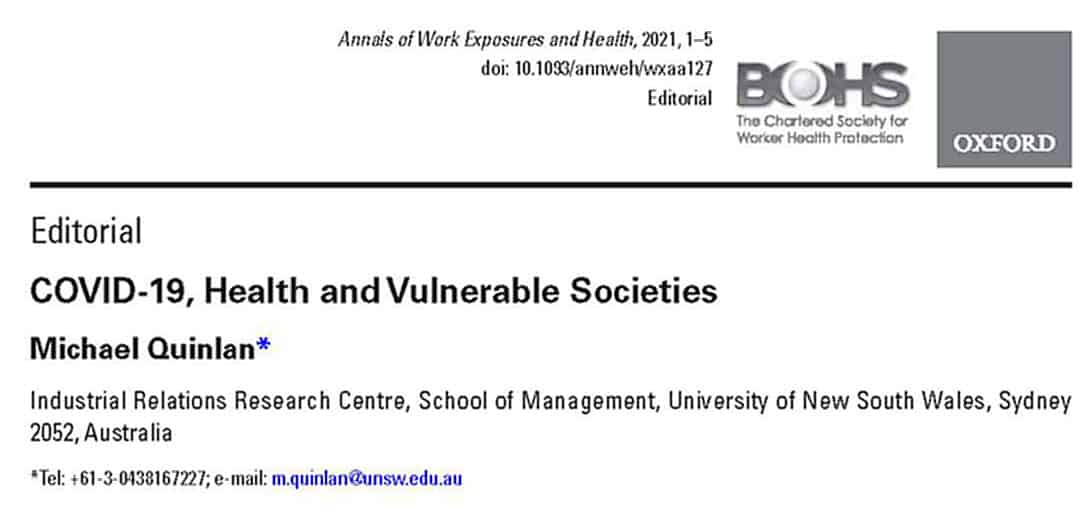
In the middle of a pandemic, it is easy to be locked into small issues, especially if they directly relate to you, such as lockdowns or sick relatives but it is important to be reminded of the broader social context. Professor Michael Quinlan recently wrote an editorial for the Annals of Work Exposures and Health, entitled “COVID-19, Health and Vulnerable Societies”.
Category: business
“safety theft” in the gig economy
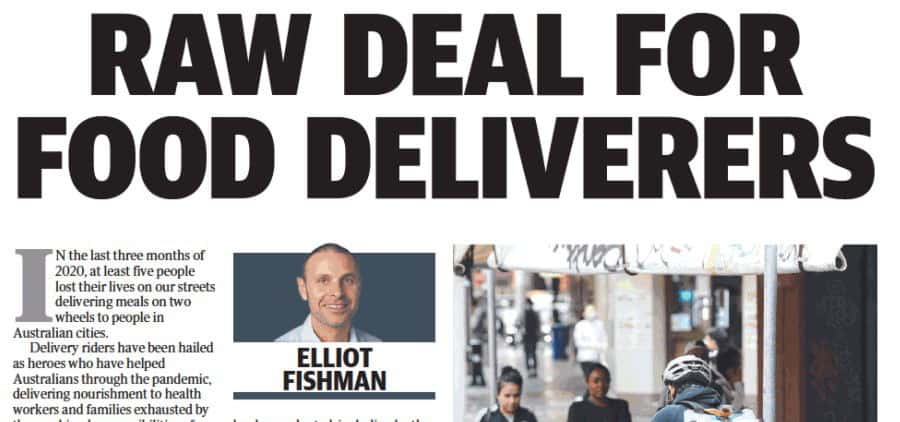
An opinion piece by Dr Elliot Fishman, of the Institute for Sensible Transport published in the HeraldSun newspaper on January 3, 2021 mentions Industrial Manslaughter in relation to food delivery drivers. (The article appears to be unavailable online) The link is tenuous and seems outside of Dr Fishman’s main area of expertise, but that seems to be the nature of Industrial Manslaughter penalties, they pop up in all sorts of discussions, many unrelated to the point being made.
The point Dr Fishman seems to be making is that the delivery of food on two-wheeled vehicles is dangerous, as shown by recent deaths of several riders in Victoria and New South Wales, and he poses several questions and suggestions to improve the situation:
Business nuggets from the Australian Financial Review
It is not possible to write as many occupational health and safety (OHS) articles as I would like to, and my newspaper clippings files are bulging by the time I get some time to tidy up. The Australian Financial Review (AFR) is an expensive business newspaper that often touches on OHS matters even though OHS may not be the core of the story. Below is a short discussion of many of those clippings from 2020. Most of the AFR articles are paywalled but can often be tracked down through other measures.
OHS and the Four Day Week
Recently the BBC’s Business Daily had a short discussion about the introduction of the 4 Day Week. This workplace reform has knocked about for a few years now and seems to have some mental health and job satisfaction benefits. This is enough for it to interest occupational health and safety (OHS), especially as it is one of the few examples of a structural and organisational change rather than an intervention aimed at each individual worker.
The BBC discussion indicates the difference (it may be a schism) between a new way of thinking about work and the old traditional way. The opponent to the 4 Day Week emphasises the individual over the organisational and compares service industries to those that produce goods.
The episode, now a podcast, is a good introduction to the for and against of the 4 Day Week but careful listening shows the challenge ahead.
Continue reading “OHS and the Four Day Week”
Right information, wrong magazine
The OHS Professional magazine for December 2020 contains a very good article about workplace psychological risks and the occupational health and safety (OHS) strategy to prevent mental harm. The only negative is that it is not published in a Human Resources magazine, or one for company directors. The preventative techniques are well known to the OHS profession and based on independent scientific evidence, but it is other managerial disciplines that need to learn the difference between preventing psychological harm and providing symptomatic relief.

All being well!
This time last year Australia was facing horrendous bushfires and days of thick smoke. Yesterday we, in Melbourne, received over an inch of rainfall. For many Christmas was far less than joyous. At the same time a global incurable coronavirus was spreading.
Occupational health and safety (OHS) took a back seat in many ways but also came to the fore in others, depending on how exposed employers felt their businesses were and whether OHS professionals were sufficiently adaptable; depending on whether one saw public health that affects work as a workplace hazard, or let the public health people get on with their work. In all these circumstances there was a little bit of panic and varying levels of fear and anguish.
Continue reading “All being well!”‘No Bystanders Rule’ Bullshit
Guest Post by Dr Rebecca Michalak
About couple of weeks ago, the Australian Financial Review (AFR) featured a piece on a law firm that had introduced a mandatory approach to reporting sexual harassment – referred to as a ‘no bystanders’ rule.
To be clear upfront, here is my disclaimer – I am not directly commenting on the law firm in question; there isn’t enough information in the articles to make any objective judgements on that front. The references used from the two media pieces are for illustrative purposes only. Call them ‘conversation starters.’
In the AFR piece, the contractual obligation was outlined to involve:
“…chang(ing) ‘should’ (report) to ‘must’ – so any staff member who experiences, witnesses, or becomes aware of sexual harassment must report it,”
with the affiliated claim being,
Continue reading “‘No Bystanders Rule’ Bullshit”“That shift really reinforces that there is zero tolerance – and there are no confidences to be kept; it needs to be outed – bystanders [staying silent] will no longer be tolerated.“