More safety in politics

Here’s a quick summary of several mentions of occupational health and safety (OHS) in the various Parliaments in Australia over the last week or so.

Answers to Questions on Notice

In Parliamentary Committees, speakers often put questions “on notice” as they do not have the answer at hand. Often these questions fade from memory but answers do appear, usually. A good example has been provided in the South Australian Parliament on September 11, 2009 with the Treasurer, Rob Lucas, providing answers to questions from Estimates Committee B on July 24 2019. For the number junkies out there, according to Hansard, in 2018/19 SafeWork SA:

Subscribe to SafetyAtWorkBlog to continue reading.
Subscribe Help
Already a member? Log in here

Aim for prevention, to affect real change

The Minerals Council of Australia (MCA) has released its submission (not yet online) to the Safe Work Australia’s (SWA) review of the Regulatory Impact Statement on the recommendations from the Boland review of the Model Work Health and Safety laws. It is comprehensive but contains little that is new. An interesting interpretation of the submission comes from considering how the MCA’s recommendations prevent harm, for prevention is the challenge.

Subscribe to SafetyAtWorkBlog to continue reading.
Subscribe Help
Already a member? Log in here

Listening anew to the voice that has always been there

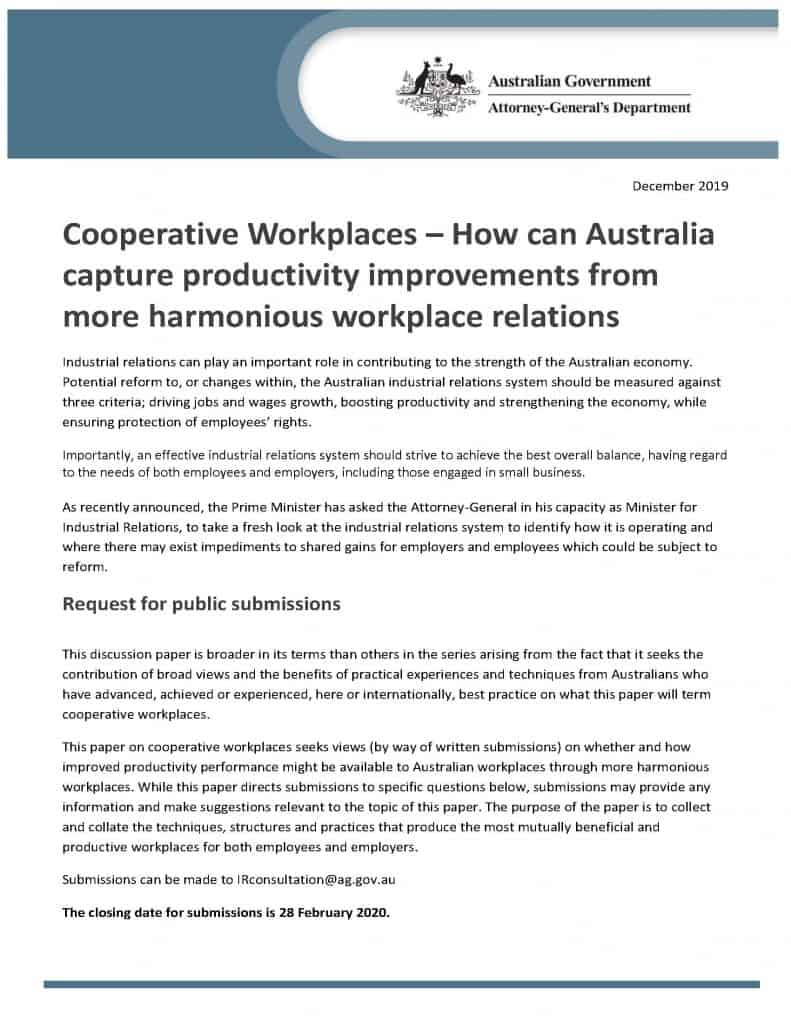
The growth of visible and prominent customer services, such as those in the collective term of “gig economy” – has coincided with an increased consideration of alternative socioeconomic structures and broader political diversity, especially in the UK and to a lesser extent Australia and New Zealand. One manifestation of this change is an emerging consideration of Co-operatives and worker ownership. This may seem outside the occupational health and safety (OHS) purview of this blog but co-operatives often allow workers more input into business operations and therefore more influence on OHS standards and management. However, should this influence come from increased worker wealth or is OHS more fundamental than money?

Subscribe to SafetyAtWorkBlog to continue reading.
Subscribe Help
Already a member? Log in here

Keep talking and making submissions – what to ask about dust

Government attention on the risks of silicosis, especially those related to engineered stone, continues to increase. Australia has established a National Dust Disease Taskforce to investigate the risks and to make recommendations to the government at the end of 2020. A national investigation is warranted but occupational health and safety (OHS) is regulated at State level so it could be many years until safety improves on this matter, if the States wait for the Taskforce’s final report.

Luckily, the debate on silicosis risks continue in various Parliaments and the Taskforce is seeking submissions.

Subscribe to SafetyAtWorkBlog to continue reading.
Subscribe Help
Already a member? Log in here

Suicide prevention at Victoria’s Royal Commission

The Royal Commission into Victoria’s Mental Health System began the first of a couple of days focusing on suicide prevention by reminding the audience that there are three kinds of interventions:

  • Universal – population level wellness
  • Selective – those who have suicidal thoughts and behaviours
  • Indicated – those who are engaging in suicidal behaviour

Occupational health and safety (OHS) concerns about harm prevention overlap with each of these to some extent, but the approach with the most opportunity for the prevention of harm is likely to be in Universal intervention. SafetyAtWorkBlog looked for discussion of work-related harm and interventions in yesterday’s Public Hearings.

Subscribe to SafetyAtWorkBlog to continue reading.
Subscribe Help
Already a member? Log in here

Safety remains a muddle in Australia’s trucking industry

SafetyAtWorkBlog believes the fact that commercial vehicles are also workplaces remains under-utilised in Australia. There are hints that this position is shared by others and that the analysis of occupational health and safety (OHS) in the transport sector is maturing. An Issues Paper released in May 2019 by the Productivity Commission (PC) as party of the review of the 2009 National Transport Regulatory Reform program looks at potential safety outcomes.

In each of the sectors within the reform program – heavy vehicles, rail and maritime – safety improvements, enhancements and improvements were expected. The PC accepts the multidisciplinary and multi-factorial elements of OHS:

“…. the national laws and regulators are only one influence on safety outcomes. The multiplicity of influences on safety outcomes raises challenges for measurement of the contribution of the national system to any changes in safety outcomes since the system was introduced. The Commission envisages that the direct net benefits from safety related reforms must be assessed by the use of simple methods such as benchmarking (including to other countries) and other descriptive analyses. For example, Hassall (2014) estimates the accident rate (broken down by accident severity) per 100 million kilometres.”

page 12

(Given that the PC has a separate inquiry into mental health, it will be interesting to see if this perspective is consistent across different sectors)

Subscribe to SafetyAtWorkBlog to continue reading.
Subscribe Help
Already a member? Log in here

Bereaved families group demands changes

Documents related to the development and implementation of Industrial Manslaughter laws in Victoria and seen by SafetyAtWorkBlog say that the Department of Justice and Community Services will draft a policy paper on the laws prior to the proposed Industrial Manslaughter Bill being presented to Parliament in October or November. October’s Work Health and Safety Month promises to be lively this year.


Participants in the Workplace Fatalities and Serious Incidents Reference Group had expressed concerns about the phoenixing of companies after a workplace fatality and that workplaces where deaths have occurred should be treated as a crime scene that:

“…should not be operational until a full investigation is complete”

Subscribe to SafetyAtWorkBlog to continue reading.
Subscribe Help
Already a member? Log in here
Concatenate Web Development
© Designed and developed by Concatenate Aust Pty Ltd