

Victoria joins the push for licencing labour hire

Victoria is the latest Australian State to introduce laws into Parliament that establish a licencing scheme for labour hire operators. The Labour Hire Licensing Bill 2017 was read into Parliament on 14 December 2017 (Hansard, pages 55-61)

The Bill is compatible with the laws passed recently in Queensland and South Australia which apply a universal licencing scheme rather than a sectoral one as preferred by some organisations.  This should make the scheme easier to administer as it removes demarcation disputes and, as pointed out by the Minister for Roads and Road Safety, Luke Donnellan, removes loopholes of opportunity for avoiding obligations – a critical consideration in a sector that has shown such disregard for legal obligations. Continue reading “Victoria joins the push for licencing labour hire”
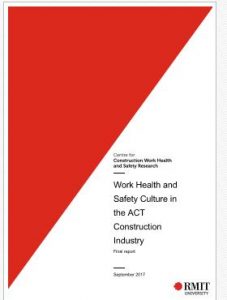
Latest safety culture report on construction has lessons for all

In 2012, the Australian Capital Territory (ACT) government undertook a review of safety in its construction industry and produced a report called “Getting Home Safely“. In early 2017, the Government contracted RMIT University to review the construction sector’s work health and safety culture in the aftermath of the 2012 report and government actions since them.   The September 2017 report was only recently made public.

The RMIT University report includes a very good and super-current discussion about safety culture and safety climate but its findings are of limited help in improving OHS performance in the construction sector.

Subscribe to SafetyAtWorkBlog to continue reading.
Subscribe Help
Already a member? Log in here

Labour Hire registration is closer but still messy

Australia has a political structure of States and Territories existing within a Federation or Commonwealth.  Legislative change has a smooth journey when political stars are aligned, where the same political party is in power at State and Federal levels.  Federal change is even smoother when the same political party has control of both houses of Parliament.  Not surprisingly, this ultimate combination is rare and could be as damaging to occupational health and safety (OHS) as it can be beneficial.  The recent OHS harmonisation process is a good example of a political mess.

This may be the reality of Australian politics but it doesn’t need to be.

Several Australian States have

Subscribe to SafetyAtWorkBlog to continue reading.
Subscribe Help
Already a member? Log in here

Queensland’s report may not be “best practice” but demands attention

The Queensland Government has released the final report of its “Best Practice Review of Workplace Health and Safety Queensland“. Most of the media attention is given to the introduction of Industrial Manslaughter laws but there are some interesting recommendations and discussion on Enforceable Undertakings, insurance products and other matters of interest to business and safety professionals.

The Queensland Government announced the review earlier this year, particularly, in response to fatalities at Dreamworld and Eagle Farm. A Discussion Paper was released in April.

Industrial Manslaughter

Industrial Manslaughter laws have been floating around Australia’s occupational health and safety (OHS), legal union and political sectors for many years.  Only the Australian Capital Territory (ACT) introduced such a law and the Crimes (Industrial Manslaughter) Amendment Act 2003 remains in effect.

The significance in this Queensland report is that the document is entitled “Best Practice” so the panel, based on its own experience and the many submissions it received, adds considerable weight to these controversial laws.

Subscribe to SafetyAtWorkBlog to continue reading.
Subscribe Help
Already a member? Log in here

SafetyConnect conference connects

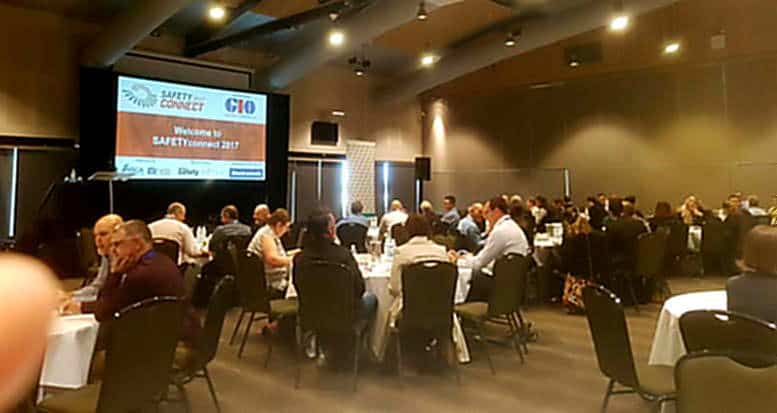
This week’s SAFETYconnect conference hosted by the NSCA Foundation in Sydney had a very good strike rate of interesting speakers on its first day.  Only one speaker missed the safety mark – it was as if they had been handed a marketing presentation instead of safety and, regardless of the safety audience, give it anyway.

This conference was notable for the way that the ‘safety differently’/Safety II movement has moved into mainstream safety management.  The most obvious example of this was a presentation by QantasLink.

Subscribe to SafetyAtWorkBlog to continue reading.
Subscribe Help
Already a member? Log in here

SWMS deficiencies are symptoms of bigger OHS challenges

The use and abuse of Safe Work Method Statements (SWMS) has been researched in Australia for several years. SafetyAtWorkBlog has seen a copy of an unreleased report prepared for Safe Work Australia that identifies major problems with the use of SWMS but that makes recommendations which seem unlikely to achieve the level of change required.

The  February 2017 report “The Efficacy of Safe Work Method Statement and WHS Management Plans in Construction” (written by

Subscribe to SafetyAtWorkBlog to continue reading.
Subscribe Help
Already a member? Log in here

Canberra Hospital demolition deserves a unified safety story

It is the twentieth anniversary of the explosive demolition of the Canberra Hospital.  The demolition was meant to be an implosion but instead debris scatter well outside the designated safety zone resulting in the death of one person and injuries to nine.  Such events are significant at the time but fade from memory until anniversaries are noted, however, there are important occupational health and safety (OHS) lessons from such incidents which do not have the drama of a Piper Alpha or a Challenger but are nevertheless as instructive.

Subscribe to SafetyAtWorkBlog to continue reading.
Subscribe Help
Already a member? Log in here
Concatenate Web Development
© Designed and developed by Concatenate Aust Pty Ltd