Quinlan’s time capsule includes useful OHS perspectives

Professor Michael Quinlan has been writing about occupational health and safety (OHS) and industrial relations for several decades. His writing has matured over that time as indicated by his most recent book, Ten Pathways to Death and Disaster.  In 1980, one of his articles looked at OHS through the prisms of Capitalism and Marxism.  It is remarkable how much an article that was written early in Quinlan’s career and at a time when OHS was considered another country remains relevant today.  This perspective contrasts strongly with the current dominant thinking on OHS and as a result sounds fresh and may offer some solutions.

In Quinlan’s 1980 article, “The Profits of Death: Workers’ Health and Capitalism”*, he writes that

“contrary to popular belief there is no objective irrefutable definition of illness”.

This could equally be applied to safety.  But searching for THE definition of things can lead to everlasting colloquia of academic experts without helping those who need to work within and apply safety concepts.

Subscribe to SafetyAtWorkBlog to continue reading.
Subscribe Help
Already a member? Log in here

From suicides to suicide apps – the iPhone

It’s soon to be the tenth anniversary of the iPhone.  Tech writers are preparing their articles based on comparisons of how the iPhone has changed and how it has changed the world.  But there has always been a dark side to the production of the iPhone and modern technologies, as a whole.

Subscribe to SafetyAtWorkBlog to continue reading.
Subscribe Help
Already a member? Log in here

Grenfell Tower and other incidents illustrate major deficiencies in OHS perceptions

A recent investigative report into workplace safety at Los Alamos laboratory in the United States included this statement:

“The Center’s probe revealed worker safety risks, previously unpublicized accidents, and dangerously lax management practices at other nuclear weapons-related facilities. The investigation further found that penalties for these practices were relatively light, and that many of the firms that run these facilities were awarded tens of millions of dollars in profits in the same years that major safety lapses occurred. Some were awarded new contracts despite repeated, avoidable accidents, including some that exposed workers to radiation.”

The whole article deserves reading but this paragraph in particular illustrates that deficiencies in procurement apply to large organisations in high risk sectors just as much as it can in the small to medium-sized business sector.  A major reason is that detailed and diligent procurement has been seen as red tape and it seems to have taken disasters like Grenfell Tower to illustrate the moral deficiencies and short-term economic fantasies of

Subscribe to SafetyAtWorkBlog to continue reading.
Subscribe Help
Already a member? Log in here

The challenges of Todd Conklin

Earlier this month SafetyAtWorkBlog published an article based on an anecdote by Todd Conklin about a glove.  There was much more that Conklin shared at the SafeGuard conference in New Zealand.  Below are several of his slides/aphorisms/questions that may challenge the way you think about managing occupational health and safety (OHS) in your workplace.

Subscribe to SafetyAtWorkBlog to continue reading.
Subscribe Help
Already a member? Log in here

Safety Culture and/or safetyculture

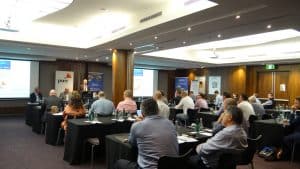
Kevin Jones speaking a SafetyCulture’s Sydney office

SafetyAtWorkBlog and others have been critical of some of the products and practices of Australia safety company SafetyCulture. However Luke Anear, SafetyCulture’s CEO invited me to speak at a briefing for his staff and this seemed a good opportunity to better understand his company.

Subscribe to SafetyAtWorkBlog to continue reading.
Subscribe Help
Already a member? Log in here

The next step in incident investigations – Learning Teams

The SafeGuard conference in Auckland this week has provided some excellent occupational health and safety (OHS) insights but the standout, on Day 1, was the end of the day panel.  Often these are dull and given to less than half the audience who have either had children to collect or choose to go to the casino next door.

This panel comprised two representatives of Contact Energy,

Subscribe to SafetyAtWorkBlog to continue reading.
Subscribe Help
Already a member? Log in here

Workplace mindfulness? The jury is still out

At a well-attended La Trobe University alumni seminar in May 2017, researchers discussed the reality and the hype surrounding mindfulness. They explained the varieties of mindfulness, the clinic research history over the last four decades and the personal advantages of living mindfully. However in the workplace and organisational context, they said that there was insufficient evidence to show benefits from workplace mindfulness in this “emerging area of research”.

The seminar was hosted by Latrobe University with three speakers

Many mindfulness advocates have developed programs that they claim can offer substantial benefits to workplaces by increasing productivity and reducing injury and illness, primarily, by changing the behaviours and attitudes of employees.  This individual approach is often dropped into a workplace and promoted as an organisational opportunity.  But the La Trobe researchers mentioned that this is a very recent perspective.

Subscribe to SafetyAtWorkBlog to continue reading.
Subscribe Help
Already a member? Log in here
Concatenate Web Development
© Designed and developed by Concatenate Aust Pty Ltd