
 The ideal outcome of attending a safety conference or seminar is to hear something new, some innovation that inspires, or gain a hint for a potential opportunity. In occupational health and safety (OHS) this rarely happens. So the most common outcome is clarification or reinforcement. This was my experience at a Professor Erik Hollnagel seminar in Melbourne on October 3, 2017.
Hollnagel’s Safety II concept has been round for several years now and has had considerable influence on the thinking of OHS professionals, if no one else. Safety II has generated several commercial and academic offshoots that provide hope for a more realistic and practical application of safety principles.
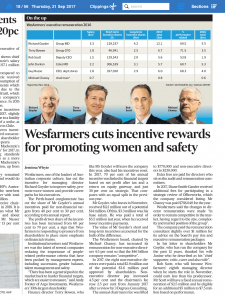 Today’s issue of the Australian Financial Review (AFR) contained an article that shows that the trend for companies and boards embracing their occupational health and safety (OHS) obligations is not uniform. The article “W
 The launch of a “Vision Zero” campaign about occupational health and safety (OHS) was a major element of the recent
  Every safety conference needs a
  If occupational health and safety (OHS) is to include the “whole-of-life” for workers, companies, products and projects, OHS professionals need to expand their pool of knowledge to meet the demands for an inclusive organisational culture. One recent research paper supports this approach by looking at the return to work of cancer survivors.
  A major theme of the