Is overwork part of the Australian Government’s project management difficulties?

On the Insiders television program on 21 February 2010, host Barrie Cassidy closed a long interview with the Communications Minister Stephen Conroy but asking about the workload of public servants in supporting government programs.  The video is available on-line and the comments are at the 11 minute mark.

Conroy says that the “cracking pace” the Prime Minister, Kevin Rudd, established from the start of his government has continues.  Rudd continues to expect high performance from his Ministers, staff and public servants.  Conroy talks about the change that has been demanded of the public service and that this has generated more workload.  He forecasts that the workload may ease if the Government achieves a second term of office.

Cassidy makes the link between the “pushing people too hard” and the failure of Government schemes such as the insulation scheme that was cancelled by the Environment Minister, Peter Garrett on 19 February 2010. Continue reading “Is overwork part of the Australian Government’s project management difficulties?”

US report is aimed at the wrong workplace safety target

A media release from Utah in the United States has been circulating through the internet overnight that claims:

“A new study released today by VitalSmarts found that five threats to workers’ safety are commonly left undiscussed and lead to avoidable injury or fatalities.” [link added]

The release lists those five threats as:

OHS and the death of Brodie Panlock from bullying

On 8 February 2010, four workers at Café Vamp, a small restaurant in Melbourne Victoria, were fined a total of $A335,000 for repeatedly bullying, or allowing bullying to occur to, 19-year-old Brodie Panlock.  Brodie jumped from a building in September 2006.  Her family watched Brodie die from head injuries three days later.  They were unaware that Brodie was being bullied at work.

Subscribe to SafetyAtWorkBlog to continue reading.
Subscribe Help
Already a member? Log in here

“Respect Agenda” – seriously?

Recently the Victorian Premier, John Brumby reshuffled his Cabinet and created a new portfolio the “Respect Agenda”.  The Minister with responsibility for the portfolio is ex-footballer Justin Madden.  Very little has been revealed about the agenda, which has been launched after a major international kerfuffle over serious racist attacks against Indian students.  It is likely to be relevant that 2010 is an election year for Victoria.

It is useful to consider these political pledges in the light of the workplace-related suicide of Brodie Panlock in 2006. Continue reading ““Respect Agenda” – seriously?”

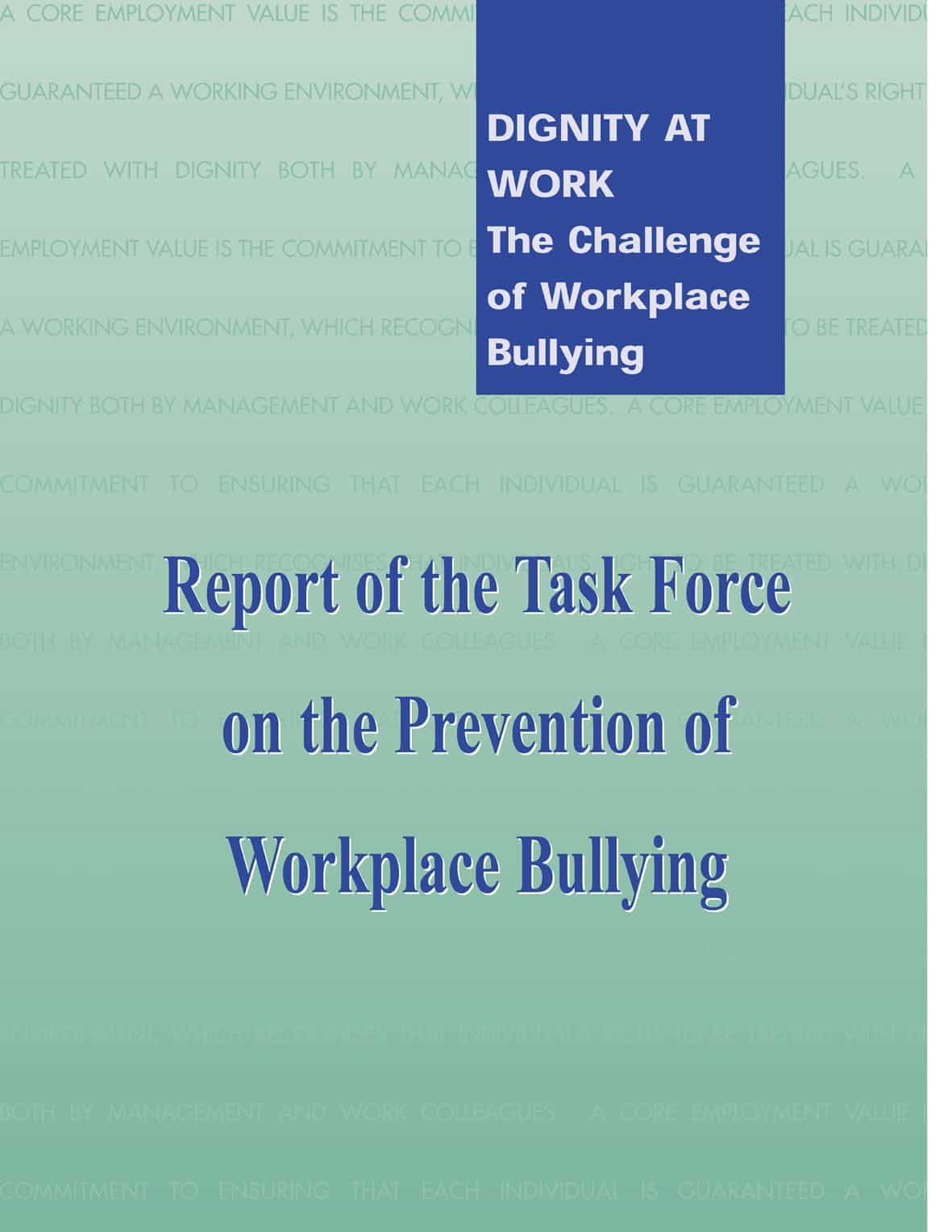
Dignity At Work, different UK and Australian approaches

On 26 January 2010, a fascinating document was released from England concerning  workplace harassment and violence.  This builds on earlier work in Europe and has led to the joint guidance on “Preventing Workplace Harassment and Violence“.

The guidance has the demonstrated support of employer, employee and government representatives who have committed to

“…ensuring that the risks of encountering harassment and violence whilst at work are assessed, prevented or controlled.”

Significantly they also state

“We will implement our agreement and review its operation.”

Continue reading “Dignity At Work, different UK and Australian approaches”

Sandman lecture online

In November 2009, Peter Sandman delivered the Berreth Lecture at the annual conference of the National Public Health Information Coalition (NPHIC).  Significantly Sandman was asked not to present on risk communication but about his experiences in risk communication and how he came to prominence in the field.

The NPHIC has made the 65-minute video of his lecture available on-line. Sandman has the audio available through his website. The speech notes are also available but, as is his wont, Sandman diverges from the “script” frequently.

Continue reading “Sandman lecture online”

Workplace skin cancer risk remains high

The July 2004 edition of SafetyATWORK magazine contained an interview with Sam Holt the CEO of Australian company Skin Patrol.  The fascinating service of Skin Patrol was that they travelled the outback of Australia with a mobile skin cancer testing unit.  That is a big area to cover but with the increasing incidence of skin cancer and the acceptance of ultraviolet exposure as an OHS problem, the service seemed timely.

(The interview is available HERE)

SafetyAtWorkBlog was contacted by Skin Patrol in early December 2009 as it was releasing the findings of a survey of 1,000 outdoor workers.  Its survey has these key findings:

  • 2.5 times the national reported incidence of malignant melanoma
  • One in 10 patients had a lesion highly suspicious of skin cancer
  • 26% of patients were diagnosed with moderate to severe sun damage
  • 70% of patients diagnosed with a lesion suspicious of skin cancer were aged 40 years or greater
  • Over 90% of workers who attended the Skin Patrol clinic because they were worried about a particular spot or the condition of their skin had not had their skin checked in the past 12 months prior to the onsite clinic.

The company’s media release also states:

“The incidence of melanoma for all Australians currently sits at 46 in 100,000, however for those that work outdoors that figure jumps to 100 in 100,000.”

The risks from exposure to ultraviolet are well established and our understanding of the risks have changed considerably within one generation.  The Australian culture has changed to one of sun-worshipping to one where the wearing of hats is enforced at school, hard hats have wide brim attachments, and outdoor work is undertaken in long pants and long-sleeved shirts.  Occupational control measures have been introduced.

Of course, particularly in the construction industry, principle contractors still struggle in a getting compliance with the UV-protection policies but that’s the case for many OHS policies.

Skin cancer risks through high UV exposure are well-established OHS Issues but the reality still does not mean that controlling the hazard is easy to manage.  Culturally we still want to have a tanned complexion even if it is sprayed on.  Tanned skin is still synonymous with good health even though the medical evidence differs.

Skin cancer risks in the workplace are simply another of those workplace hazards that are ahead of the non-workplace culture and that safety professionals need to manage.  The attraction with this hazard is that there is no disputing the evidence.

Kevin Jones

Concatenate Web Development
© Designed and developed by Concatenate Aust Pty Ltd