Japanese depression contrasts the Western understanding of workplace mental health

frustrated young asian businessman

Australian workplace mental health advocates often seem to shy away from discussions of suicide, perhaps because suicides are not a regular occurrence at work or because work-related suicide remains stigmatised.  To better understand this overlap between suicide and mental health, and the working environment, it may be useful to look at the Japanese experience where work-related suicides, specifically karoshi, seems to have occurred before the appearance or recognition of mental ill-health and depression.

Recently the BBC released a series of broadcasts and podcasts looking at mental health issues.  The first episode discussed “Depression in Japan”.  The whole series Borders of Sanity will be of interest to mental health students and professionals but the Japanese episode reinforces that the recognition and treatment of depression is not the same around the world.  The appearance of depression in Japan is a very recent occurrence and shows the links between mental health and culture, particularly as it relates to the role of work, our place in work and our relationships with our bosses.

Japan has a unique approach to work and the relationships within work.  Some of the practices have been exported to other countries as we have seen in companies like Toyota but the perception of workload, diligence, commitment and loyalty has some echoes in Western workplaces.

Karoshi has been reported on in the West many times before, often as a peculiar quirk of the Orient but the recent BBC podcast is less about suicide and more about depression and mental health.  The West has a long tradition of psychoanalysis where stress, anxiety and depression have been defined, refined and integrated into our cultures.  This is still in its early stages in Japan and the full podcast is a fascinating counterpoint to the Western perception of workplace mental health.

Kevin Jones

Workplace suicide reflection

A letter to the Australian & New Zealand Journal of Psychiatry (subscription only) has provided a slightly different perspective on the Australia suicide statistics released earlier this year, and some of the reporting on the statistics. This is an important perspective when considering suicide interventions.

Allison Milner and Andrew Page note that the Australian Bureau of Statistics suicide data only covered the last 10 years which misses out on a comparison from last century which would show the change from 2013 to 2014 to be “less noteworthy”.

On the issue workplace suicides, Milner and Page advocate the integration of prevention strategies into the workplace but also write that

“Workplace suicide prevention activities show promise, but more rigorous evaluation is needed”.

The authors emphasise that

“Perhaps the more important message from the most recent statistics is that suicide among older age males (⩾60 years) and middle-aged males (45–59 years) continue to increase….”

This is an important consideration should your workforce match these demographics.

Milner and Page urge readers to focus on evidence-based approaches to suicide prevention. Such evidence will assist OHS professionals and business owners in considering a worst-case mental health scenario and adjusting these measures to match the mental health profiles of their workplaces and that of their clients.

The research also serves as a caution against immediate commentary on statistics by showing a measured assessment of data. Much of the statistical and academic research reports are murky and complex because the audience is, primarily, academic peers but time and reflection allows for alternate perspectives and, sometimes, plain English translations.

Kevin Jones

Independent analysis of WorkSafe Victoria

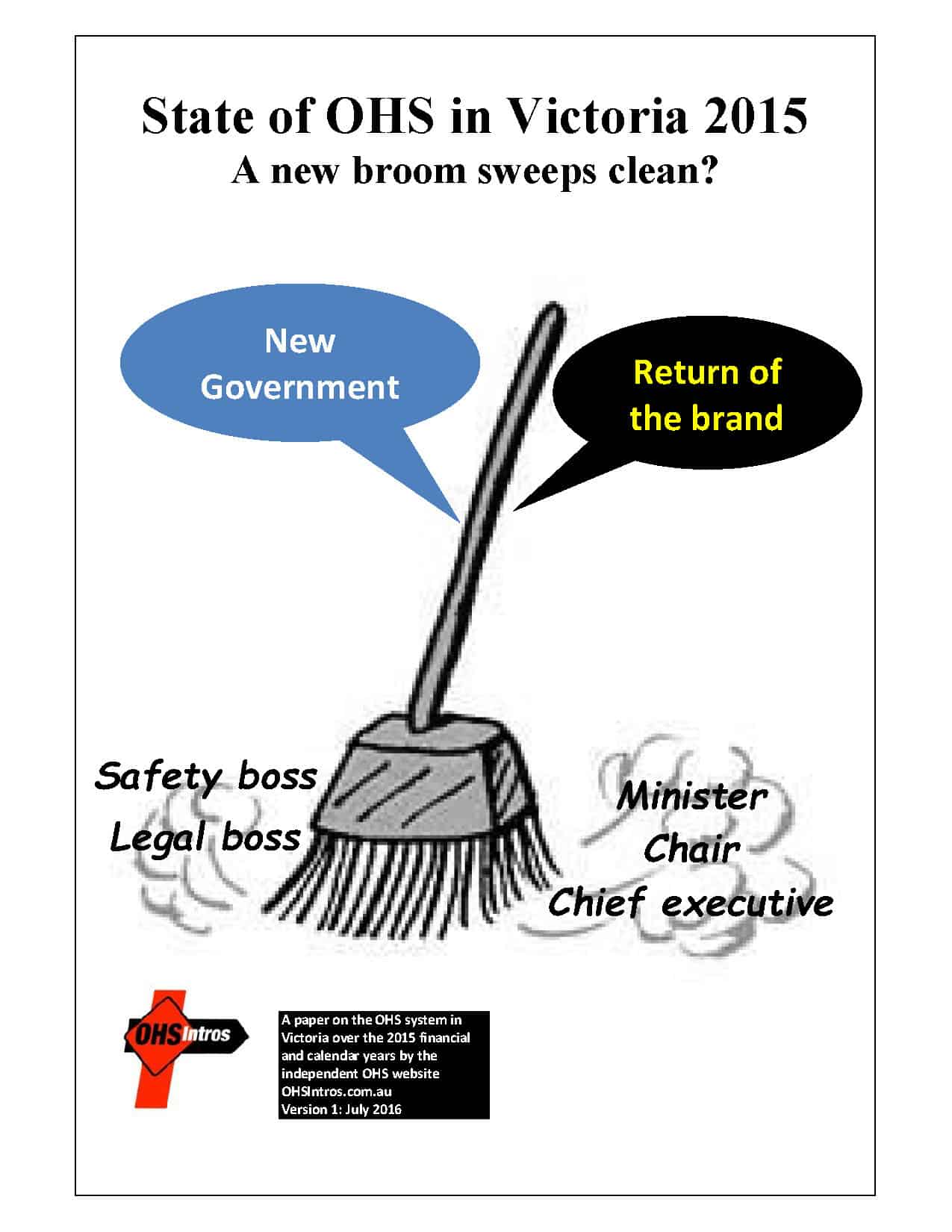
Cover of State of OHS in Victoria 2015Barry Naismith‘s third report into the operations and performance of WorkSafe Victoria was released on July 22, 2014. Naismith produces these reports through a combination of publicly available information in the press, a dive into the resources of the WorkSafe Library (visit before it moves to Geelong) and requests to WorkSafe.  This level of analysis and interpretation is rarely available outside of formal academic research and Naismith provides the all-important social and political context from which much academic occupational health and safety (OHS) research shies.

His latest paper focuses on 2015. Continue reading “Independent analysis of WorkSafe Victoria”

Miserable failures in OHS of labour hire workers

Two recent occupational health and safety (OHS) prosecutions in South Australia related to labour hire employees and providers indicate changes in enforcement approach and clues for change as they illustrate how some people and companies have almost no regard for the safety of its employees.

According to a SafeWorkSA media release dated 28 May 2016 (not available online at the time of writing):

“The Industrial Court convicted Queensland based labour hire company, Fix Force (Qld) Pty Ltd, and imposed a penalty of $150 000 plus court costs.

On 22 October 2012, Mr Clinton Benson, a contracted employee on the South Road Superway project, suffered life threatening injuries when his head was crushed between a lifting arm and welding table.

Following investigation by SafeWork SA, Fix Force (Qld) Pty Ltd was charged with offences under the then Occupational Health Safety and Welfare Act 1986 (SA), for failure to ensure its employee was safe from injury and risk to health whist at work, as far as was reasonably practicable.”

Continue reading “Miserable failures in OHS of labour hire workers”

Irony in tragedy masks an interesting legal career

On Sunday 23 May 2016, Queen’s Counsel Ross Ray died after being pinned under a rolled over quad bike on his Victorian hobby farm.  According to one early media report, he was not wearing a helmet nor was his quad bike fitted with a crush protection device (CPD). In the past he has represented quad bike manufacturers who object to devices that can protect this type of incident.  If the report is true, his death appears ironic but Ross Ray was involved in a lot more occupational health and safety cases than just quad bikes. Continue reading “Irony in tragedy masks an interesting legal career”

Gerry Ayers on International Workers Memorial Day

On the evening of 28 April 2016, (Australian time), Professor Mike Behm of North Carolina, Ciaran McAleenan in Ireland and others coordinated an online discussion about the importance of International Workers Memorial Day (IWMD).  Dr Gerry Ayers was scheduled to participate but was beaten by technical problems.  However he shared his thoughts about the memorial and has allowed SafetyAtWorkBlog to reproduce his thoughts.  These are included below: Continue reading “Gerry Ayers on International Workers Memorial Day”

Concatenate Web Development
© Designed and developed by Concatenate Aust Pty Ltd