
OHS professionals should be more politically active

Occupational health and safety (OHS) is inextricably linked to everyday life and everyday politics but it is treated as somehow separate, even by those who are experts in OHS.  This is not the case with industrial relations which is much more grounded in the political realities.

Industrial relations has been pushed by the trade union movement that has always seen workers’ rights as a social issue.  The OHS profession and its associations have been content, largely, to live within the factory fence.  Until recently OHS laws related solely to the workplace and OHS professionals had the luxury of a clear demarcation for its operations.

But new OHS laws acknowledge the responsibility for the effects of work on those other than workers, and those who are neighbours to workplaces.  Australian OHS professionals have been slow to embrace the social role that has been foisted on them.  There seems no excuse for this.

Recently, a
Subscribe to SafetyAtWorkBlog to continue reading.
Subscribe Help
Already a member? Log in here

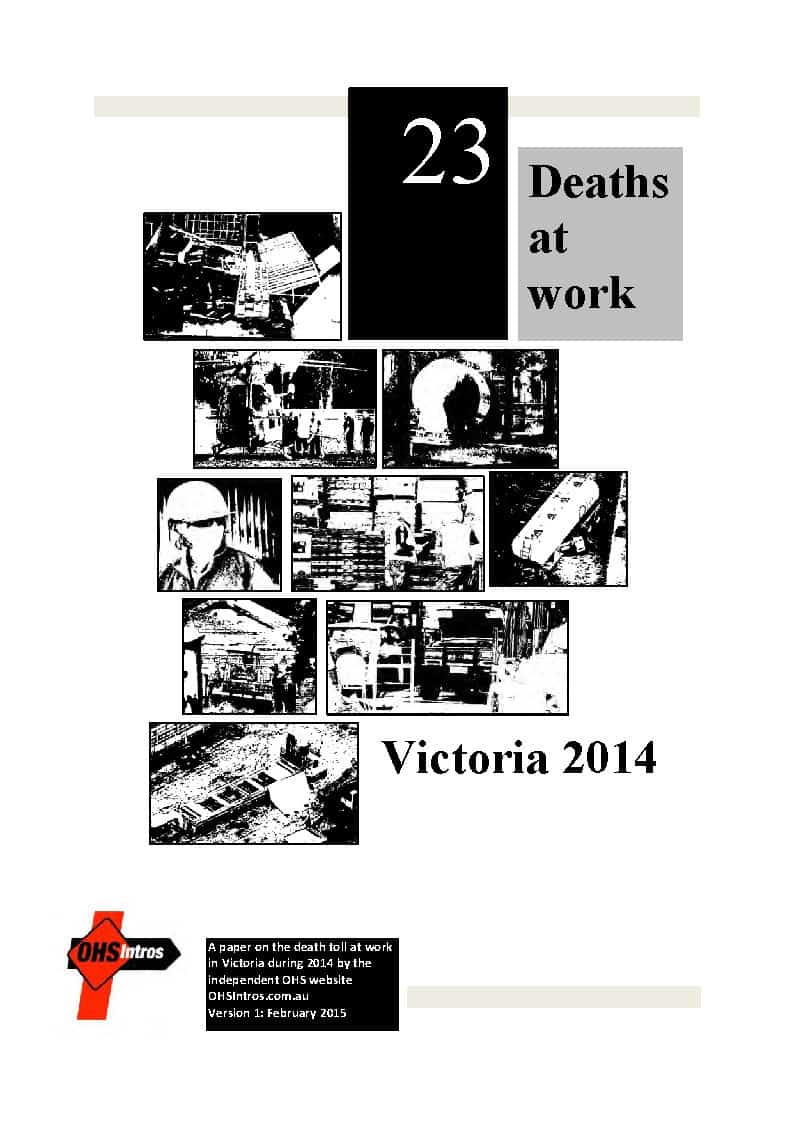
New analysis of deaths at work

Cover of Deaths at Work 2014Barry Naismith has followed up his first report into WorkSafe with a second that analyses the workplace deaths in Victoria since 1985.

One of the attractions of Naismith’s analyses is that he considers the broader context to the data.  His first report looked at WorkSafe Victoria’s actions and policies in relation to the executive and board complexion.  In this report he looks at the frequency of deaths with WorkSafe campaigns and enforcement response.

The analysis may not have the authority of a fully-funded research program from an academic institution but the level of detail he has collected from official sources is impressive, and in the absence of any other analysis, Naismith’s work deserves serious attention.

Kevin Jones

Trade Union Royal Commission affects OHS credibility

Whether one believes that the Royal Commission into Trade Union Governance and Corruption is a political witch-hunt or a genuine attempt to clean up a corrupt industry sector, the Royal Commission seems to have revealed an abuse and exploitation of occupational health and safety (OHS) – an exploitation that has received next to no attention. The release of the Commission’s interim report allows for a quick analysis of this situation.

Former Prime Minister Julia Gillard was a particular target of the Commission in relation to a “slush fund” established by her then-boyfriend, Bruce Wilson, commonly referred to as the “AWU affair“.  The “slush fund”, known as the Australian Workers Union Workplace Reform Association, was developed, according to Gillard

“… to support the re-election of union officials who would campaign for workplace reforms including better occupational health and safety.” (Interim Report, Vol 1, page 99)

Subscribe to SafetyAtWorkBlog to continue reading.
Subscribe Help
Already a member? Log in here

Some are losing faith in the Victorian Workcover Authority

At a remembrance service in December 2014, the founder and outgoing deputy director of the Creative Ministries Network (CMN), John Bottomley, explained his refusal of funding from the Victorian WorkCover Authority (VWA) for CMN’s work-related grief support services (now called GriefWork). VWA has a different take on his comments.

In discussing the relevance of the Book of Isaiah to the motivations of the CMN to help people, Bottomley said that

“… it is God’s response to injustice and suffering that has planted this same spirit at the heart of our endeavours to transform work-related harm.

So CMN rejected VWA’s contract in April this year, after WorkSafe had funded our agency for over ten years to provide grief support services. My reason for rejecting the new contract was that VWA wanted to hide bereaved families grief from the public domain of injustice at work. The contract brief treated grief as an individual psychological problem to be addressed behind the closed doors of a clinic shut off from the rest of society. The contract wanted to treat work-related grief like an illness, and treat grieving families as sick and lacking the ability to ‘cope’. This heaps injustice upon injustice.”

Subscribe to SafetyAtWorkBlog to continue reading.
Subscribe Help
Already a member? Log in here

A top OHS blog for 2014

I am very proud to receive recognition from LexisNexis again in 2014 for my work on the SafetyAtWorkBlog.  On 16 December 2014 LexisNexis Legal Newsroom Workers’ Compensation named the SafetyAtWorkBlog as one of the Top Blogs for Workers’ Compensation and Workplace Issues. It is a great honour for a blog that is self-funded and written in my spare time.

LexisNexis has described some of the articles as “insightful and entertaining” and reflective. One article in particular was a discussion spurred by the writings of Terry Reis and would not have been possible without his initial article.

I thank LexisNexis for this unexpected honour and feel very proud to be amongst the other honourees for 2014.  It is good to see new ones on the list and encourage all those OHS professionals who feel they have something to say, to say it.  The more voices the OHS profession has, the richer our debates and the greater our state of knowledge.

Kevin Jones


What if “reasonably practicable” was applied to a disease outbreak?

There seems to be an increasing trend for the principles of occupational health and safety (OHS) to be applied to matters outside the workplace.  OHS principles were created to reflect the values of society in the 1970s and 80s and, although the laws have changed to reflect economic needs, the principles remain basically the same.  A major legal change has been the move away from preventing harm “at the source” to one of reasonable practicability and this can reduce the overall level of safety available to workers and others.

It is interesting to note that statements on the current Ebola outbreak argue the sense in dealing with the outbreak “at the source”.  Why do we accept a reasonably practicable control measure for harm at work but expect a stronger preventative measure for public health threats?  Shouldn’t we be aiming to reduce all harm “at the source” regardless of the type of harm? Continue reading “What if “reasonably practicable” was applied to a disease outbreak?”

Whitlam’s dismissal diverted workers compensation reform

In October 2014, one of Australia’s Prime Ministers, Gough Whitlam, died at the age of 98.  Whitlam introduced major social reforms, many which still exist today (just).  One reform he valued but was not able to achieve was a national accident compensation scheme. It is worth noting when reading of the current economic and moral arguments over workplace responsibility and over-regulation that Whitlam’s national accident compensation scheme included workers compensation.

In 1974, during Whitlam’s time as the Prime Minister of Australia, the New Zealand government established a no-fault accident compensation scheme following the 1967 Royal Commission of Inquiry into Compensation for Personal Injury in New Zealand chaired by Owen Woodhouse.  Woodhouse was invited to assess the likelihood of a similar scheme being introduced in Australia.  He completed his inquiry (not available online) for such a scheme and legislation was drafted. The bill was in the Australian Parliament when the Whitlam government was dismissed by Governor-General John Kerr.  As a result of the political machinations of the Liberal Party of Australia, Australia missed the opportunity to have a national accident compensation scheme. Continue reading “Whitlam’s dismissal diverted workers compensation reform”

Concatenate Web Development
© Designed and developed by Concatenate Aust Pty Ltd