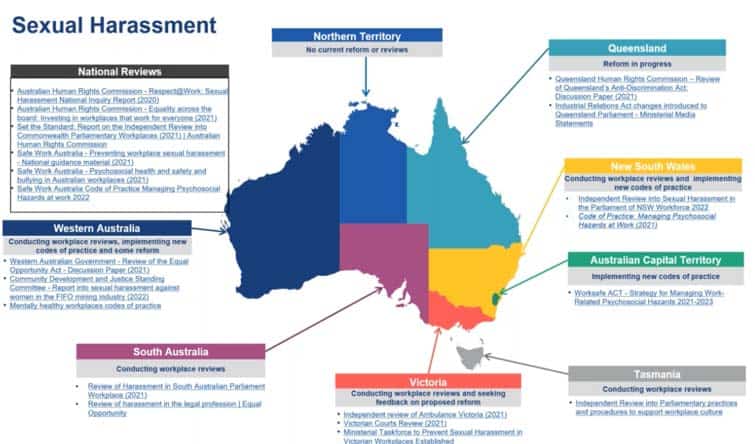
WorkSafe Victoria has actively campaigned against occupational violence for the last few years. The pandemic, understandably, brought the focus onto violence against emergency services workers and healthcare staff. Recently the campaign has focussed on gendered violence at work. The intention is to be inclusive, to address the variety of violent acts and the variety of people gendered violence affects, but it is not as inclusive as it could be.
Category: Duty of Care
New mental health code and regulations
Last week Safe Work Australia released its “Managing psychosocial hazards at work – Code of Practice“. It offers solid guidance on psychosocial hazards reflective of the work already conducted by Victoria, New South Wales and other jurisdictions and in support of the new regulations in the Model Work Health and Safety laws. In connection with a blog article earlier today, the Code provides some insight into cognitive demands.
Heat and the need to change work
Europe is experiencing heat at, or close to, levels never recorded before. This has caused the mainstream media to issue advice on how to avoid adverse health impacts from heat exposure. However, the necessary changes to work are not receiving the attention they should.
Australia has faced such situations before, especially in the last decade, so there is some generic occupational health and safety (OHS) available for translation to the European circumstance.
Continue reading “Heat and the need to change work”Action on Health and Safety is always a choice
Last week epidemiologist Hassan Vally wrote one article in The Age called either “Health or economy a false choice” or “COVID caution can be a win for both public health and business” (paywalled), depending on the sub-editor and format. Curiously one has a negative implication, the other, the opposite. Either way, the article illustrates the public health dichotomy that mirrors that of occupational health and safety (OHS).
OHS often requires a decision between profit or production and safety. Public Health deciders need to consider the interests of the public and the duties of government. I prefer the former headline because it states that this decision is a “choice”. Safety, occupational or public, is always a choice.
COVID-19 lessons are more likely to come from an independent investigation than from OHS prosecutions
WorkSafe Victoria has a window of two years, within which it must start a prosecution for breaches of the occupational health and safety (OHS) legislation. As a result, a small number of notable prosecutions commenced recently from the early days of the coronavirus pandemic.
Over the last few weeks, Worksafe has started court action against St Basil’s Homes For The Aged, Heritage Care Pty Ltd and an individual nurse.
Guilt, shame, dissatisfaction: workers and customers on the gig economy (and how to make it better)
This article is republished from The Conversation under a Creative Commons license. Read the original article.
The gig economy is in trouble. Rideshare drivers are cancelling in droves. Wait times for food delivery are ballooning out and driver shortages are leading to food waste.
So, what’s going on? To find out more, I interviewed 30 Melbourne gig workers who worked as rideshare drivers, food deliverers or for task-based platforms such as Airtasker.
I also spoke to 30 customers who use such services, and to 20 industry stakeholders. My colleague, Elizabeth Straughan from the University of Melbourne, conducted a further ten interviews with gig workers after the pandemic set in, to learn how they’d been affected.
Continue reading “Guilt, shame, dissatisfaction: workers and customers on the gig economy (and how to make it better)”Sunlight on “an atmosphere of fear’
The Queensland Government and Premier Annastacia Palaszczuk have been under heavy criticism for their workplace cultures and leadership since the release of the Coaldrake report last week – a “review of culture and accountability in the Queensland public sector”.
The report is very critical of the Queensland government’s management of the public service, identifying problems with the overuse of external consultants, issues of unfairness, the lack of transparency and openness, bullying and more. These findings could apply to most of the contemporary public sectors in Australia nationally and locally (as well as most medium- to large-sized companies).