Safety leadership through action rather than PowerPoint

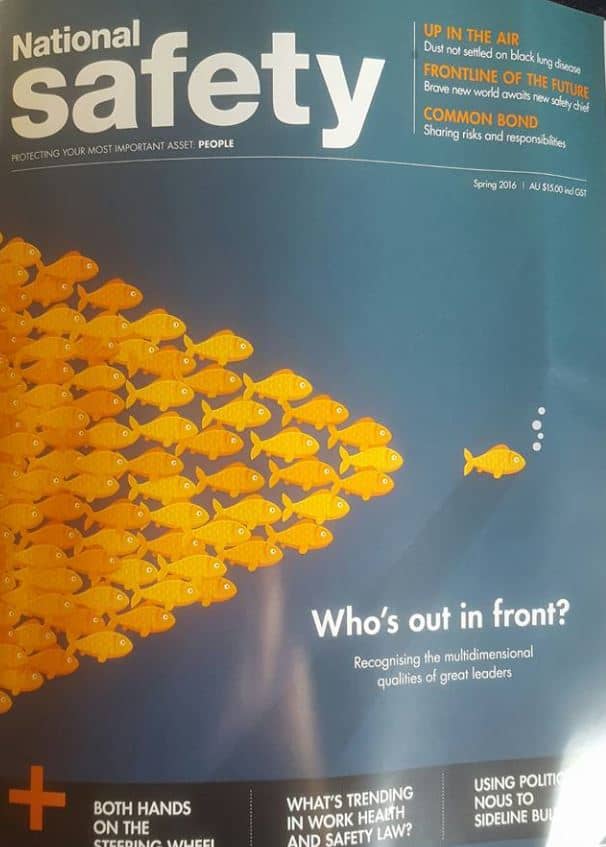
The Spring 2016 edition of National Safety magazine includes a cover story on leadership written by me.  In it John Lacey insists that safety leadership begins at the top.  This position is supported by many business and occupational health and safety (OHS) advocates but this seems to me to be based on a misunderstanding of leadership.

nsca-mag-coverIn response to a question about leadership in small- to medium-sized businesses, Lacey said that leadership “applies to all”:
“[Leadership] is not different but how to apply it will be different. The start must be from the top down. The basic values, behaviours, knowledge and systems will be defined by the organisation no matter how large or small it is.”

This is remarkably like safety culture and my response is that leadership can be displayed by anyone at any level of a company or society and can manifest at any organisational level.  The fact is that it is easier to sell a commodified leadership to executives as they are expected to show leadership in times of crisis or stockmarket uncertainty and most of us translate that into leadership of safety.

Leadership, as with most elements of OHS, takes time and effort – sometimes over generations.  This is particularly so with anything concerning corporations that are wary of change unless that change supports profit and shareholder returns. (I would argue safety increases profits and company value but this is an argument than struggles for traction)

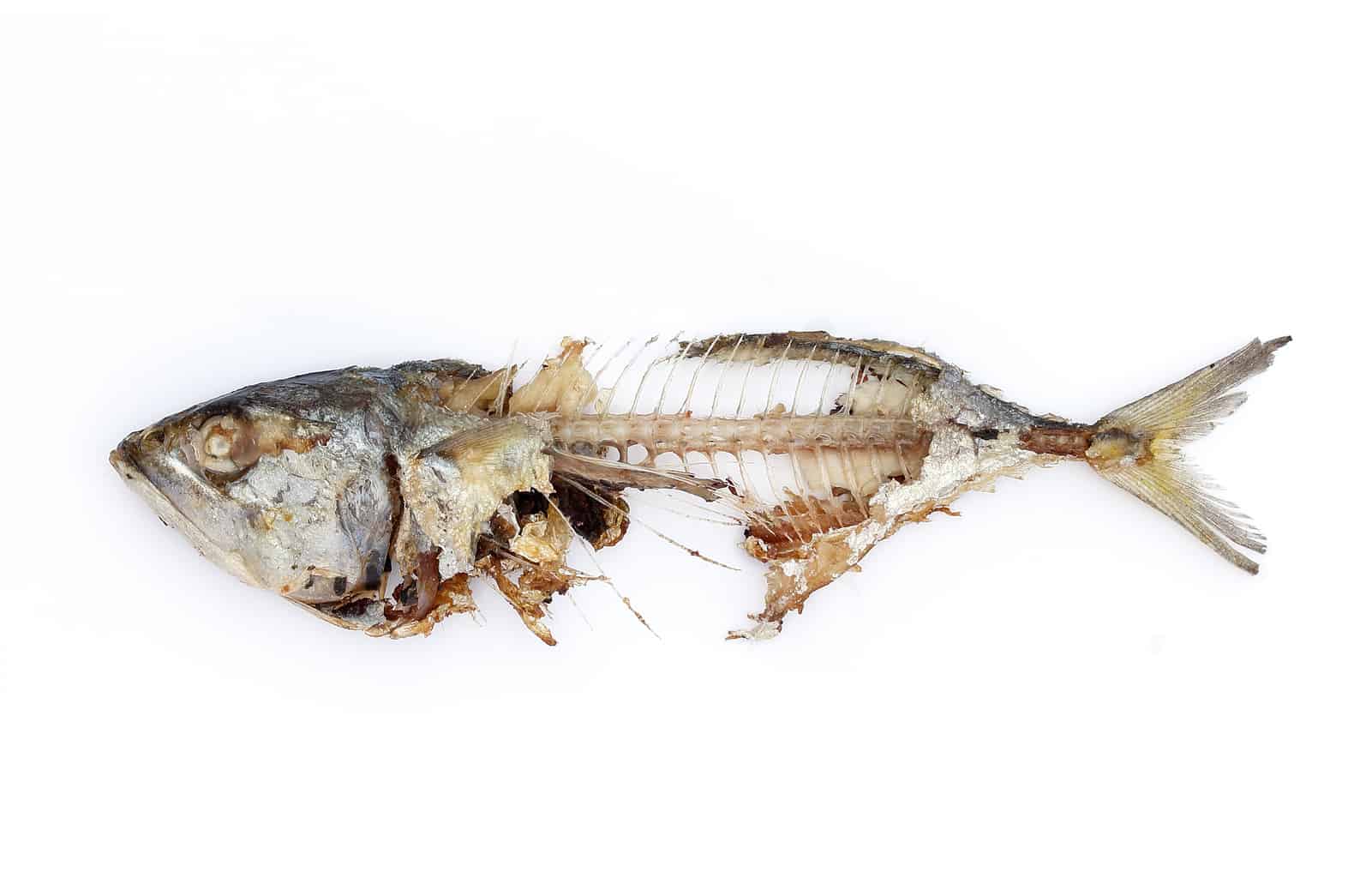
The most abused aphorism used to justify this focus on executive leadership is that “a fish rots from the head down”. Nonsense.  As this website states, it is the guts of a fish that rots first.

fish boneThe attention given to senior executive leadership is an organisational echo of the economic trickle-down theory which has been roundly dismissed as flawed and, in some instances, has contributed to increasing socio-economic inequality.

Lacey acknowledges that anybody within an organisation can lead although leadership starts from the top.  He supports my contention that leadership occurs at all levels of a business and that actions show leadership and safety, probably, more effectively and cheaper than any training session.  Lacey says

“…even the gesture of picking-up litter or wearing the correct [personal protective equipment] in front of others in the work team can be seen as a form of leadership. Leading by example is an old but such a true saying. 

These actions are the best way of improving workplace safety and showing leadership, and for the least cost.  Safety should be improved by actions rather than PowerPoint.

Kevin Jones

[Note: please support National Safety magazine if you can.  It is not available online and only through subscription but it is one of the few hard copy OHS magazines left in Australia and one of the few, if not the last, that actually pays its writers (not as much as we’d like but that’s the continuous battle of the freelance writer).  This stance is keeping advertorials at bay and gives National Safety an integrity that is often missing in other safety publications]

Labour Hire Inquiry recommends a licencing scheme

Following, ostensibly, the Four Corners exposé of labour hire exploitation in Australia last year, the Victorian Government established an inquiry.  That Inquiry’s final report has been released with lots of recommendations, several pertaining to occupational health and safety (OHS).  The Government’s media release response is HERE. The main recommendations related to OHS are: I recommend…

Subscribe to SafetyAtWorkBlog to continue reading.
Subscribe Help
Already a member? Log in here

Taking Total Cost of Injury seriously could substantially change how safety is managed

Cost is the last consideration in occupational health and safety (OHS) but is usually the first consideration in all other decisions.  “Can we afford to improve something? No.  So let’s do something else”.  There is something fundamentally skewed in determining the cost-benefit analysis when it comes to workplace safety. For several years Safe Work Australia (SWA)…

Subscribe to SafetyAtWorkBlog to continue reading.
Subscribe Help
Already a member? Log in here

Safety disruption gets context

The second session of the SIA National Convention is flatter than the the first, not because it is not interesting but because it is providing us with the social context for occupational health and safety (OHS) rather than challenging the OHS profession.

Bernard Salt is a very high profile demographer whose job is almost entirely about providing social context to whatever we do. He mentioned OHS specifically only four times and then primarily to do with driving trucks but the age data Salt presented shows the need for improvement in the health and wellbeing of the workforce so that quality of life can extend in line with the extended period of our lives.

gahan-sia-conf-2016Peter Gahan (pictured right, speaking)of the Centre of Workplace Leadership is a regular speaker at the Safety Institute of Australia’s conferences. His outline reflects the theme of this conference by disrupting our sense of security and career.

The challenge comes from how we respond to this unease. If we curl up on the couch to binge watch a show, the career is over. We need to look for the opportunities that the disruption offers but this may require us to reassess, if not throw out, the foundations of our profession or the dreams on which we chose our career.

Richard Coleman is well known in the Australian OHS profession through his prominent safety career. His attraction as a conference speaker was on display because he was able to adjust his presentation to accommodate the examples and context that previous speakers addressed. Coleman focused on the digital disruption, particularly as it affects blue collar occupations. He believes that some of these jobs will go within the next five years.

Coleman’s focus on digital disruption provided a great summary of the OHS application of augmented reality and wearable technology. The latter has the best opportunity for safety improvement, particularly in the area of manual handling. Sensor technology can provide better levels of information and in real time that allows immediate interventions at times of great risk.

What these speakers and the panel are all about is to think creatively and think big. Fantasise about your job and the tasks you do now and whether they will exist in ten years and how you can change them now to prepare for the future. If your job leads to a dead-end, change the job. It seems easier to do this now, than ever before

Kevin Jones

Cabbage Salad and Safety podcast – Episode 4

Podcasting is not always as easy as talking to a microphone or interviewing someone across a desk.  Episode 4 of the Cabbage Salad and Safety podcast that is posted online today was the third take.

Part of the challenge with podcasting is trusting that what you are saying is interesting, another part is not to talk shit.  Thankfully (we think) it was the first of these challenges that caused us to re-record.  Very few of us hear our conversations back.  Our threads of thought are usually clear to ourselves but we are unsure of how it sounds to others.  It is the difference between speaking and listening in a conversation.  Listening to what one says can be a confronting experieince.

Episode 4 uses Corr’s Mid-year Review as the launching pad for a discussion on disruption, duty of care, contractor management and my inadequacies.

The next episode will be recorded at the Safety Convention in Sydney, taking in some of the topics being presented but also including a short review of the conference.

As always, please include your comments about the podcast below or email me by clicking on my name.

Kevin Jones

Corporate culture on show from ASIC at the Governance Institute

20160731_211159On 22 July 2016, the Governance Institute of Australia conducted a seminar at which John Price (pictured right), a Commissioner with the Australian Securities and Investments Commission (ASIC) discussed Board and Organisational Culture.  The issue of culture has been an important discussion point with ASIC and Australian businesses recently and this discussion included consideration of the role of occupational health and safety (OHS).

Although the seminar was not a speech, the discussion paralleled many of the points that Price made in this May 2016 speech.   The speech is a useful insight into how an Australian corporate regulator sees culture and it is not very different from how the OHS profession sees it.  Price references the Criminal Code that

“…defines corporate culture as including an organisation’s attitudes, policies, rules, course of conduct and practices.”

He also said that

“Culture matters to ASIC because poor culture can be a driver of poor conduct.”

Subscribe to SafetyAtWorkBlog to continue reading.
Subscribe Help
Already a member? Log in here

Independent analysis of WorkSafe Victoria

Cover of State of OHS in Victoria 2015Barry Naismith‘s third report into the operations and performance of WorkSafe Victoria was released on July 22, 2014. Naismith produces these reports through a combination of publicly available information in the press, a dive into the resources of the WorkSafe Library (visit before it moves to Geelong) and requests to WorkSafe.  This level of analysis and interpretation is rarely available outside of formal academic research and Naismith provides the all-important social and political context from which much academic occupational health and safety (OHS) research shies.

His latest paper focuses on 2015. Continue reading “Independent analysis of WorkSafe Victoria”

Concatenate Web Development
© Designed and developed by Concatenate Aust Pty Ltd