
Culture – piss or get off the pot.

Andrew Hopkins has described organisational culture as “the way we as an organisation do things around here”.  The sociology of this statement is sound and the occupational health and safety (OHS) context seems to be an accepted element of safety management.  But for OHS professionals to continue to advocate the importance of a safety culture it is necessary for them to be aware of how culture is being interpreted and applied elsewhere. The Australian Labor Party recently stated that the Australian banking system needs a Royal Commission because, as Senator Sam Dastyari stated:

“We’ve seen scandal after scandal. We’ve seen failure after failure and we’ve seen a banking sector and a culture develop where effectively these matters are constantly being ignored”.

Subscribe to SafetyAtWorkBlog to continue reading.
Subscribe Help
Already a member? Log in here

Are OHS professionals on the ‘B’ Ark?

In The Restaurant at the End of the Universe Douglas Adams has a character tell a story of a ship of middle managers being sent from a supposedly doomed plant to colonise a new world.  The ‘B’ Ark contains millions of

“Hairdressers, tired TV producers, insurance salesmen, personnel officers, security guards, public relations executives, management consultants,….”

I think occupational health and safety (OHS) professionals are lucky they were not included in the list because many people consider OHS professionals to be little more than a nuisance.   Continue reading “Are OHS professionals on the ‘B’ Ark?”

Prescient research on OHS, values and sustainability

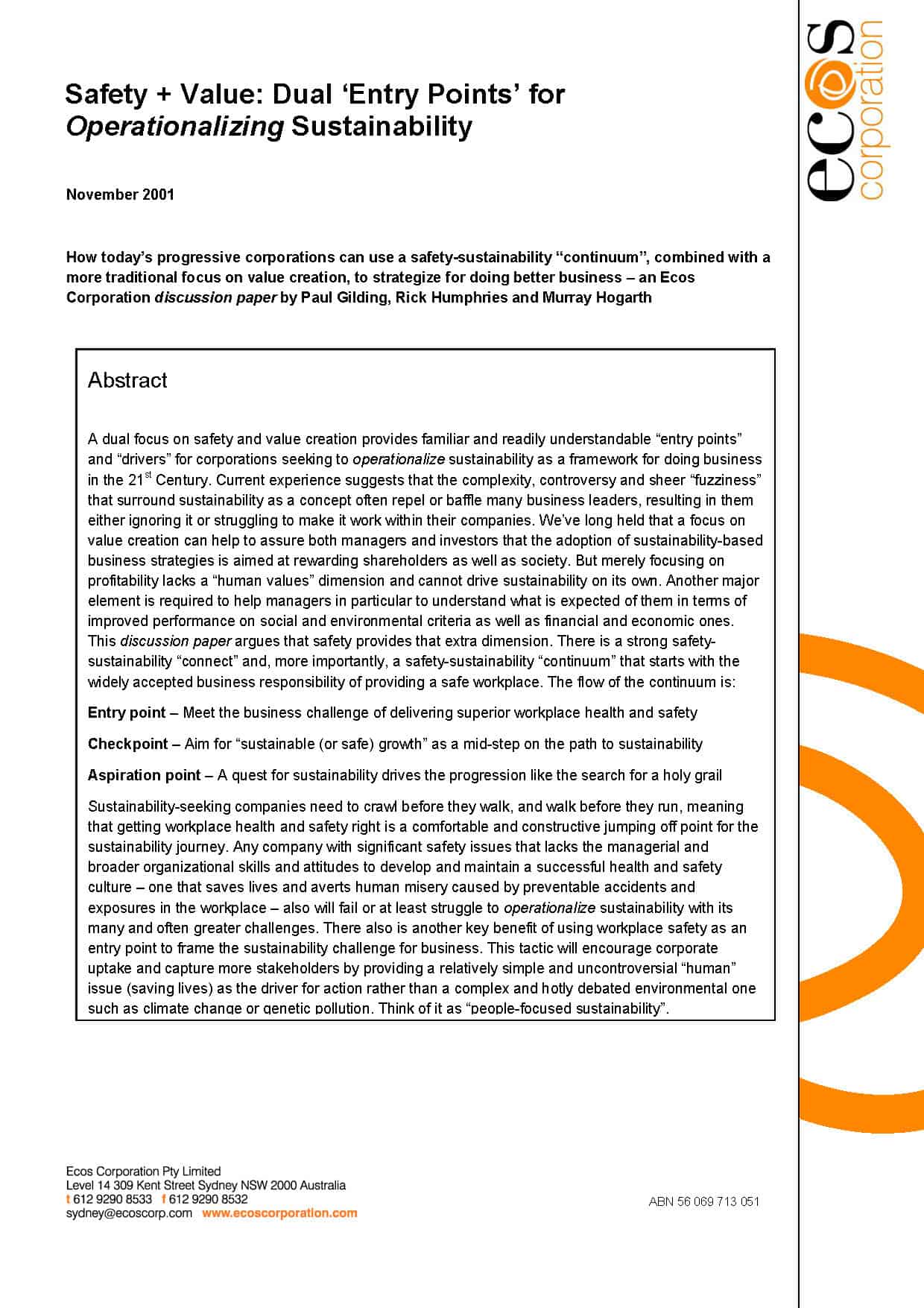
Cover of Ecos+Corporation+The+Safety+Sustainability+Connect+Paper (1)It has become fashionable to place occupational health and safety (OHS) in the organisational context of business sustainability.  But this is not a new phenomenon in Australia.  In 2001 the Ecos Corporation published a discussion paper called “Safety + Value: Entry Points for Operationalizing Sustainability.”* It states

“A dual focus on safety and value creation provides familiar and readily understandable “entry points” and “drivers” for corporations seeking to operationalize sustainability as a framework for doing business in the 21st Century.”

Subscribe to SafetyAtWorkBlog to continue reading.
Subscribe Help
Already a member? Log in here

What does the Prime Minister’s criticism of banking culture mean for OHS?

Some of Australia’s mainstream media reported on Prime Minister Malcolm Turnbull‘s admonishment of the banking sector on April 6 2016.  He accused them of having an unhealthy culture, reflecting a general and growing public dissatisfaction with large financial institutions, insurance companies and other corporations.

Given that the dominant perspective on occupational health and safety (OHS), at the moment, is the importance of an organisational culture that values workplace safety, it is worth looking at Prime Minister Turnbull’s words and those of prominent executives and financial regulators recently reported in the mainstream press.

Continue reading “What does the Prime Minister’s criticism of banking culture mean for OHS?”

Labour Hire Inquiry submissions address OHS, sort of

The Victorian Government has concluded the public hearing section of its inquiry into Labour Hire. Industrial Relations Minister Natalie Hutchins has said in a media release that

“Evidence has been put to the inquiry suggesting widespread  underpayment of award wages, tax avoidance, nonpayment of superannuation, poor occupational health and safety practices, maltreatment of workers and backpackers on visas, and, in some instances, allegations of illegal conduct.”

This article focusses on the occupational health and safety (OHS) evidence provided through the

Subscribe to SafetyAtWorkBlog to continue reading.
Subscribe Help
Already a member? Log in here

Overburden exposes the social burden of workplace death and illness

On 26 February 2016, a recent documentary about a portion of the American coal-mining industry, Overburden, was shown with a panel discussion, as part of the Transitions Film Festival in Melbourne. The film is commonly promoted as an environmental film but it also touches on

  • Corporate and executive arrogance;
  • A complete disregard to worker safety;
  • Excessive influence of industry lobbyists in the political process;
  • The socio-economic impacts of allowing an industrial monopoly;
  • Personal perspectives of risk.

The trailer hints at some of these issues. (A traditional mainstream review of the film is available HERE)

The panel drew direct lines between the Appalachian issues raised in the film with the socio-economic issues in Victoria’s LaTrobe Valley that resulted from the Hazelwood Mine Fire. Continue reading “Overburden exposes the social burden of workplace death and illness”

Concatenate Web Development
© Designed and developed by Concatenate Aust Pty Ltd