

Starting January 1, 2025, Australia will have new laws and penalties for intentional wage theft beginning January 1, 2025. The usual business lobby groups are bleating about the unfair imposition of costs and time on their members. But what about the significant impact on workers’ health, safety and dignity?
Category: employers

New class action on sexual abuse in Australian mining
Many of the prominent Australian mining companies are in the process of changing their cultures to minimise the risk of sexual assaults and harassment after several recent damning inquiries into worker health and safety. Everyone seems to agree that cultural change can take a long time. I am not convinced. Change will take time if one operates within the existing organisational and operational parameters and structures. But sometimes, the harm to workers is so great that a long time exacerbates unfairness and injustice.
Red flags for OHS misunderstandings
Occupational health and safety (OHS) continues to have a credibility problem and a poor social profile. Some of this is due to OHS peddling nonsense, but probably no more than any other discipline. Some of it is due to employers and other corporate leaders using OHS as camouflage for inaction or as a distraction from a different workplace issue. Some of it is due to ignorance.
It is up to all of us to strengthen the discipline’s credibility. To help with this, here are three words commonly used by leaders that we need to question and challenge whenever they are used.
Continue reading “Red flags for OHS misunderstandings”
What should Victoria’s new WorkSafe Minister do now?
The Victoria Premier, Jacinta Allan, reshuffled her Cabinet and recently allocated responsibility for the Workcover and Transport Accident Commission portfolios to Deputy Premier Ben Carroll. This may be the first time a politician of that position has been given these portfolios. But what should Ben Carroll do now?
Continue reading “What should Victoria’s new WorkSafe Minister do now?”
Why buy a dog and bark yourself?
Effectiveness is critical in assessing one’s occupational health and safety (OHS) management system. One must be sure that the system works and to repair or improve that system when a deficiency is identified. We must create and maintain a safe system of work, and we must trust it and respect it.
So why do we feel the need to remind our colleagues of their OHS obligations, which the system has already educated them about? Indeed, they are grown-ups who know what they need to do and appreciate the importance of their own safety and the safety of their teams. Part of growing up is learning from one’s mistakes by experiencing the consequences of one’s decisions and actions. A large part of OHS management is keeping people from harm and recognising and accepting that people are integral to the management system.

OHS must be careful discussing complacency
The latest edition of OHS Professional magazine carried a long article by Kerry Smith titled “Understanding and Combating Complacency in the Workplace.” The article uses examples at the worker level when the greatest risk posed by complacency is likely to be with managers, executives, their attitudes to safety, and their own safety management systems.
A cultural shift may require a re-analysis of moral priorities
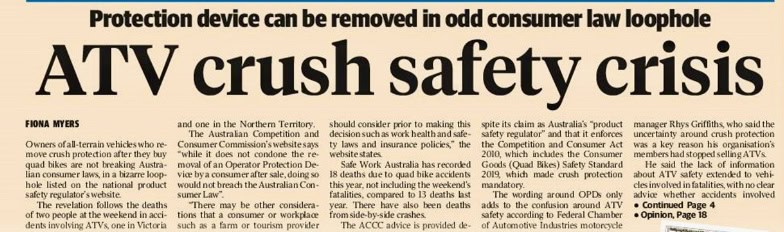
Last week, The Weekly Times, a prominent Australian agriculture newspaper, reported on some peculiar behaviours by farmers and quad bike owners. Under laws introduced by the Australian Competition and Consumer Commission, removing vital occupational health and safety (OHS) operator protection devices is permissible. Why would farmers remove a critical safety device and endanger themselves and others?