
Analysis of Montara oil spill reports begins

Legal analysis of the Montara oil spill inquiry reports have started to emerge.  One of the first is by Allens Arthur Robinson (AAR).  It does not discuss safety specifically but in many people’s minds Montara was not an occupational safety disaster as no one was injured.  To many the explosion has far more relevance as an environmental or process safety matter but considerable benefit can be gained by realising the Montara oil disaster was a substantial near-miss.

AAR looks at broader impacts of the Australian government’s response to the disaster.  AAR states that “we can expect to see moves by the Federal Government towards establishing a national regulator.”  Why should such a move only apply to offshore petroleum exploration?  If there is considerable administrative and regulatory advantages in a single petroleum exploration regulator, why not apply the same approach to the regulation of workplace safety? Continue reading “Analysis of Montara oil spill reports begins”
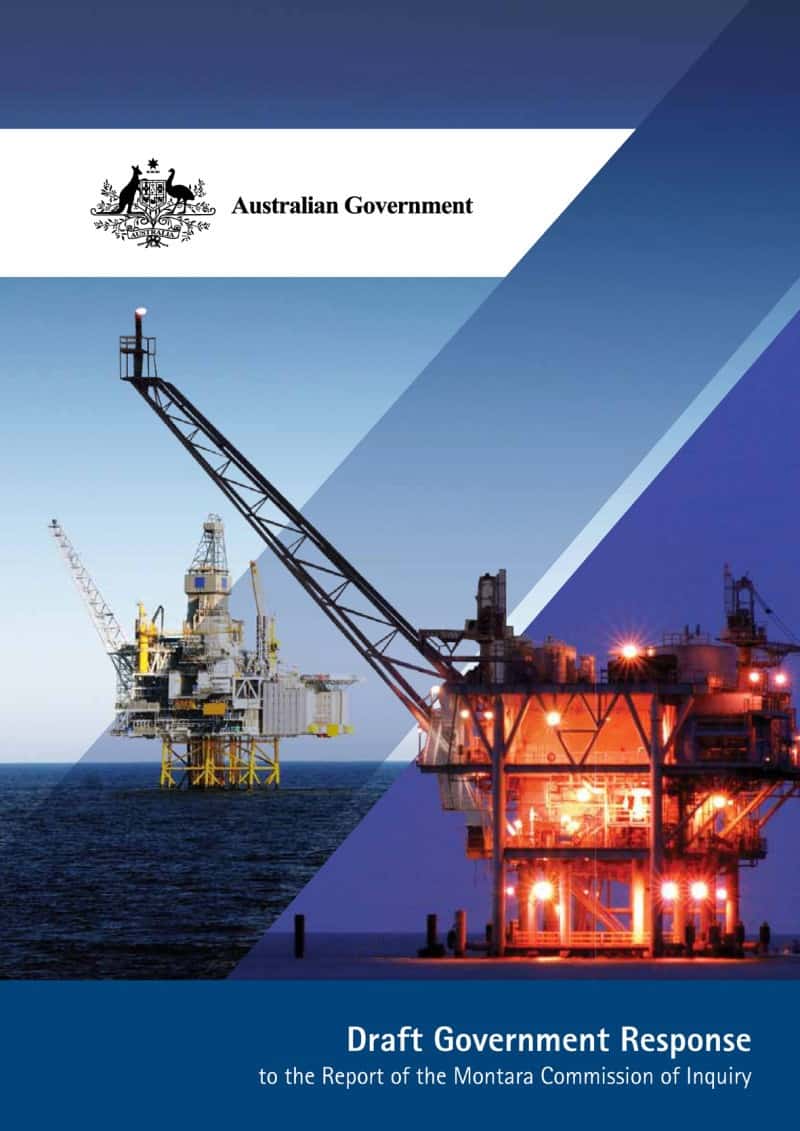
Montara oil spill report finally released

On 24 November 2010, the Australian Government finally released the investigation report into the 2009 Montara oil spill in the Timor Sea that has similarities to the oil rig explosion of BP in the Gulf of Mexico in 2010.

The Energy & Resources Minister, Martin Ferguson, has sat on the report since the Board of Inquiry presented its findings in June 2010 even though there could have been industry-wide safety and design lessons.  Significantly, the report was released after the recent Federal election  and, according to the Minister’s media release, has found :

“At the heart of this matter is the failure of the operator and the failure of the regulator to adhere to this regime.  Montara was preventable.  If either – or preferably both – PTTEP AA or the Northern Territory Designated Authority had done their jobs properly and complied with requirements, the Montara Blowout would never have happened.”

For those readers in America and the Gulf of Mexico, these words may echo what they have heard only a few months ago.

The Government response supports the Report’s finding states:

“…that PTTEP AA’s widespread and systemic procedural shortcomings were a direct cause of the Montara incident.  In addition, the Report identified concerns relating to the integrity of the remaining wells (H2, H3, H4 and GI) at the Montara Wellhead Platform.  The Commissioner concluded that PTTEP AA did not achieve proper control of any of the five wells at the Montara oil field, and that PTTEP AA’s internal systems were insufficient to achieve a high quality of assurance in respect of well operations.” [link added] Continue reading “Montara oil spill report finally released”

Australian OHS expert in advisory role on Gulf oil spill

Australian Professor Andrew Hopkins is currently in the United States advising the Chemical Safety Board in its investigation of the Gulf of Mexico oil spill.

Several months ago it was rumoured that Hopkins would be part of the Commission of Inquiry, a rumour quickly denied by Hopkins and others.

According to a media release from FutureMedia, Hopkins will

“…spend several months working at the Board’s office in Denver as well as interviewing company managers in both the US and in London, where BP is headquartered.”

Hopkins has been interviewed by many media outlets in relation to the Gulf Oil Spill and BP’s safety culture due to his investigation of the Texas Oil Refinery explosion at a BP facility in 2005.  Continue reading “Australian OHS expert in advisory role on Gulf oil spill”

Politics overrides safety

Why has the Australian government refused to release the investigation report into the Montara oil spill?

SafetyAtWorkBlog’s interest in this report is principally over the identification of potential risk control measures that could reduce the chances of another deep-sea oil rig exploding or identify any design or safety features that could stop such a savage leak of oil into the community.

The Australian Broadcasting Corporation reported on 12 August 2010 about the devastation to East Timor’s fishing and seaweed industries as a result of the spill in 2009 .  An earlier media report about Indonesia seeking compensation for its seaweed beds is available HERE.

The Australian Resources Minister, Martin Ferguson, said on 11 August 2010:

“The lessons to be learned from Montara, and I might say the Gulf [of Mexico], create a clear need in a very sensitive, important national industry, both environmentally, economically and from a health and safety point of view, for a strong single national regulator that’s well resourced and focussed,” ……

This may be the way to go but AAP reports that Ferguson he is refusing to release the investigation report until after the August 2010 general election!! Continue reading “Politics overrides safety”

New UK podcast on drilling regulation

HSE podcasts are almost always worth listening to.  The June 2010 podcast capitalises on the topicality of offshore oil drilling generated by the BP incident in the Gulf of Mexico.

The podcast is available for listening online

The important element of the podcast is whether such deepwater drilling incidents could occur elsewhere?  This is useful not only for the UK jurisdiction but for Europe and Australia.

The interview discusses the value of a “safety case” regulatory regime and the disadvantages of a prescriptive regime.

Interestingly the UK wells are individually notified to HSE almost a month before drilling is due to commence.  This allows for an assessment of the well design and structure prior to activation.

Clearly, this approach stems from the Piper Alpha explosion in 1988.  The BP Gulf incident can be considered the United States’ Piper Alpha.

It raises the question of did BP, an English company that should have been well aware of the usefulness of the safety case approach to drilling, apply a different approach to its Gulf drilling contractors to that applied elsewhere, and why?  Was BP really committed to “best practice” in safety, or as it called it “beyond the best“?

The Bhopal disaster should be remembered when considering what comes after the BP oil spill

As the BP/Gulf of Mexico oil spill dominates the American media, the rest of world has been noting a closure, of sorts, on the Bhopal disaster of 1984.  Seven former Union Carbide executives have been sentenced to 2 years jail each over the disaster.  The CEO, Warren Anderson, showed an appalling lack corporate leadership by leaving India and not facing the charges laid against him in India.

The disaster exposed half a million people to methyl isocyanate, killed almost 4,000 people, and changed the lives of millions.  These changes continue today with birth defects, health problems and contaminated land.

Some media have noted a similarity in corporate responses to initial investigations and inquiries but there are more important lessons involving safety, corporate responsibility and social policy from the Bhopal legacy that should resonate with those American communities affected by the Gulf of Mexico spill.  The mishandling of the aftermath of the Bhopal disaster has exacerbated the horror of that day which can accurately but heartlessly be described as a “process safety failure”.

These issues are tellingly described and reported in a highly-recommended series of radio programs produced by Radio Netherlands and broadcast on 19 June 2010.

Kevin Jones

Montara oil spill report will provide clues for handling BP inquiry

The Montara oil spill in the Timor Sea that lasted for three months in late 2009 was large but affected no countries directly and is certainly a long way from the Gulf of Mexico and BP.  However there are enough similarities for considerable media attention to be focused on the investigative report into the incident that was handed to the Australian Government on 17 June 2010.

The Australian Resources Minister, Martin Ferguson, acknowledged the receipt of the commission of inquiry’s final report but will not be releasing it yet.

Greens Senator Rachel Seiwert has said:

“The release of all information available to date is essential for the development of new regulatory and environmental procedures….  We need to be better prepared to respond to future disasters in our precious marine environment.”

Seiwert has at least acknowledged the global context of the report:

“Halliburton is reported to have carried out cementing work on both the Montara well and the US Deepwater Horizon well in the Gulf of Mexico. The failure of this cementing has been linked in the media to both spills.”

Speculation is that the report will recommend a “single national regulator for off-shore drilling” according to the Australian Financial Review (AFR) on 19 June 2010 (p5. not available online).   Continue reading “Montara oil spill report will provide clues for handling BP inquiry”

Concatenate Web Development
© Designed and developed by Concatenate Aust Pty Ltd