Only animals should die in abattoirs

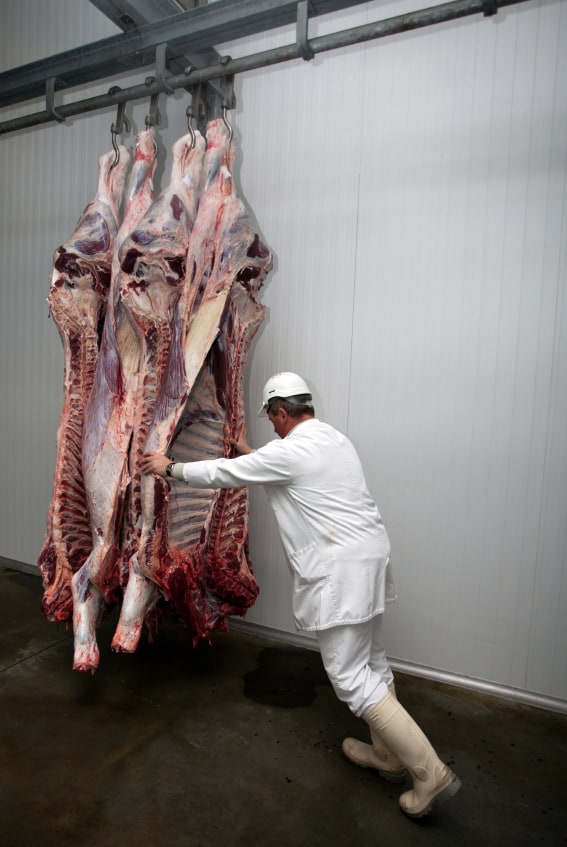
The Sunday Age of 30 January 2011 ran an article about the status of workplace safety in some of Victoria’s abattoirs.  The article has some similarities to the landmark investigations by Eric Schlosser into work practices and compensation issues related to meatworks in the United States.

The Sunday Age says that

“(Last financial year [2009/2010], there were 355 workers’ compensation claims in Victoria’s meat industry that required at least 10 days off work, or cost more than $580 in treatment, or both – almost one a day. Nationally the industry’s injury and illness rate remains twice as high as that in the construction industry, and four times the average of all workplaces.”

Many would say that meat work is “inherently dangerous” but in the article lawyer Trevor Monti, contests the perception

”Yes, it’s a difficult industry and the work can be hard,” he says. ”But with proper consideration given to the system of work, the risk of injury can be significantly reduced.”

This is a position with which OHS professionals and regulators would agree.

It is significant that, if the comparative figures quoted above by the Sunday Age are accurate, abattoirs do not receive the enforcement attention that the construction industry receives.  Is it that the construction industry is largely unionised and the meat industry much less so?  Is it that abattoirs are rorting the immigration visa system as asserted by the Australian Meat Industry? Continue reading “Only animals should die in abattoirs”

NZ Farmers rep enters quad bike safety debate

An opinion piece was published in the New Zealand Herald on 12 January 2011 concerning quad bikes.  There are several points raised by Donald Aubrey, vice-president of Federated Farmers and chairman of the Agricultural Health and Safety Council that can be disputed.

“In the hands of the untrained or the over-confident they can be deadly. And quad bike safety is far from being a problem exclusive to the agricultural sector.”

From the outset Aubrey’s position is clear, the problem with quad bike safet is not design-related, it is lack of training and over-confidence.  Training for quad bike riding has existed for many years and injuries continue to occur.  At what point should more effective controls be introduced? Continue reading “NZ Farmers rep enters quad bike safety debate”

NZ Coroner presses for changes in quad bike safety

One of New Zealand’s coroners, Ian Smith, has set a safety challenge to the OHS regulatory and quad bike distributors.  In the coronial findings (not available online) into the 2008 death of 21-year-old beekeeper, Jody Santos, Coroner Smith has recommended to the Ministers for Transport and Labour:

“The Court endorses the new educational and enforcement programme being proposed by the Department of Labour, but considers that both Ministries undertake an immediate investigation to consider the mandatory installation of:

(i) The compulsory wearing of helmets when operating ATVs in any circumstances; and

(ii) The installation of a roll bar on all A TVs/quad bikes; and

(iii) The installation of lap belts on all ATVs/quad bikes.”

The Department of Labour (DoL) specifically requested that the Coroner remove the mandatory installation recommendation.   Continue reading “NZ Coroner presses for changes in quad bike safety”

The evidence on first aid treatment of burns

The treatment of burns in a workplace setting has always been a contentious matter between first aid trainers and equipment suppliers.  First aid says that initial treatment of burns should be the application of cold running water but equipment suppliers often include burn treatment creams.  What’s the evidence for burn creams?

In December 2010, the Cochrane Library produced a collection of reviews concerning the treatment of burns.  Some of the information in the collection  should be of great use and interest to workplace first aiders.

One report states:

“In the early management of minor burn injury,do silver based products improve burn infection control and healing?

There is not enough evidence to decide whether silver based products improve healing, infection control, pain or other outcomes in people with minor burns.” Continue reading “The evidence on first aid treatment of burns”

Rainbow windmill deaths continue to affect the local community

In March 2010, SafetyAtWorkBlog reported on the deaths of two farmers in the rural town of Rainbow in Victoria.  They died when a windmill they were transporting on a property made contact with overhead power lines.  The deaths continue to be a difficult topic of discussion throughout the Wimmera-Mallee, as I found out over the Christmas holiday season.

The coronial inquest into the deaths of John and Michael Helyar began in Horsham in November 2010 and will continue in April 2011.  Some of the inquest reports in the local newspaper make for harrowing reading but also provide an important insight into the decision-making process that occurs at the site of a workplace fatality and one that involves close friends.

The two articles are

Coronial inquest into tragedy at Rainbow, and

Inquest hears of agonising drama at Rainbow

Kevin Jones

Quad bike safety issues continue with no end in sight

SafetyAtWorkBlog has been following the discussions about safety of all-terrain vehicles and quad bikes for some time.  This is because the use of these vehicles encapsulate so many of the issues that workplace safety needs to deal with:

  • Safe design
  • Personal protective equipment
  • Hierarchy of controls
  • The line between private activity and work activity
  • Personal responsibility
  • The “nanny state”
  • Regulatory safety guidance
  • Industry-based codes of practice

On 19 December 2010, the New Zealand Sunday Star Times ran a feature article on quad bikes, written by Amanda Cropp (I can’t find the article online but please send a link if you can) entitled “Risky Business”.  The article is a fair summation of many of the perspectives and attitudes to quad bike safety.

For those readers who like statistics, Cropp writes that

“The annual ACC [Accident Compensation Corporation] bill for quad bike-related injuries is around $7 million, and Hobbs’ claim was among 2533 in 2009, a sizeable increase on the 457 new claims accepted in 2000.” [link added] Continue reading “Quad bike safety issues continue with no end in sight”

How much significant information do workplace fatalities provide?

Workplace fatalities are terrible, lingering tragedies that generally don’t teach anything new about OHS failures.  I couldn’t find anything new in the frightening detail in the article below (dated 14th December 2010) or in scores of Google searches of industrial/occupational fatalities; though disease fatality epidemiology can be  informative.

If all workplace fatalities in Australia were stopped overnight, most workers wouldn’t notice a single improvement in their own workplace.  They’d still be working in the same cluster of hazards, useless risk assessments and a regular sprinkling of near misses and daily shortcuts.  Despite regulators’ and politicians’ shrieks of dismay at workplace deaths, such fatalities don’t represent the main OHS problem at work.

If any regulator was informed in advance – in some detail – that in a particular industry there would be three fatalities in the next three months (or even intolerable risk) they wouldn’t know how to prevent them.  Example?  Think of the insulation program, which still has some way to go and a few more surprises in store.  Example?  Over the next six months there are likely to be 3-6 quad bike-related fatalities in Australia, mostly as a result of rollovers.

Or think of the value of risk assessments:  example?  Consider the 60,000-80,000 barrels (10,000 tons) of the most dangerous hexachlorobenzene (HCB) waste stockpiled and being repackaged (ultimately, drum to drum) by workers in a primitive work process at Botany Bay Industrial Park, Sydney.  One of the world’s largest stockpiles of such dangerous wastes that no one around the world is prepared to handle.   This is the only place I’ve ever had to wear two layers of protection to inspect. What has the regulator done? Continue reading “How much significant information do workplace fatalities provide?”

Concatenate Web Development
© Designed and developed by Concatenate Aust Pty Ltd