Inaccuracies in AAP article on truck-related fatalities and penalty

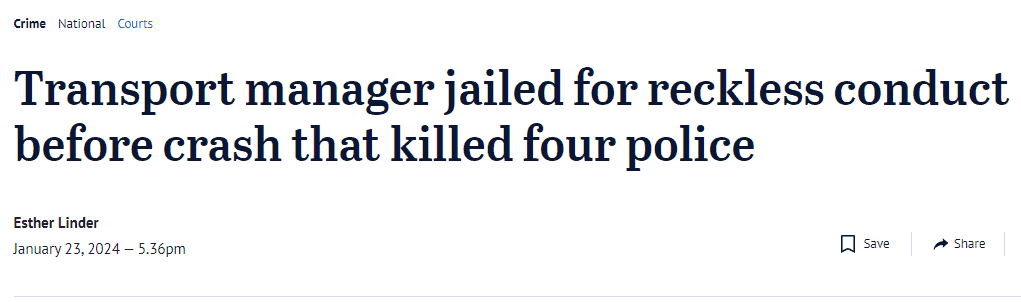
Denise Zumpe is an Australian occupational health and safety (OHS) professional who focuses on workplace health and safety matters in the transport sector. Below is a letter that she intended to send to The Age and writer Esther Linder outlining some inaccuracies in an Australian Associated Press article (paywalled) concerning the jailing of Cris Large, a court case discussed in an earlier SafetyAtWorkBlog article.

“A former transport executive has been jailed for up to three years for his reckless workplace behaviour in the lead-up to a crash that killed four police officers on Melbourne’s Eastern Freeway.”

The AAP article appeared in a number of Australian media. An amended version appeared on ABC News.


Subscribe to SafetyAtWorkBlog to continue reading.
Subscribe Help
Already a member? Log in here

The sleeper IR issue of the Right-to-Disconnect wakes up

This week, the Australian Parliament debates further workplace relations legislative system changes. These will have occupational health and safety (OHS) impacts, usually indirectly; however, one clear OHS element in the proposed legislation is the Right-to-Disconnect.

This change has been a long time coming and has clear and proven mental health and social benefits for workers, but you won’t hear much of the OHS justification in the media. Most of the business opposition has been alarmist noise claiming the world will end. According to the Australian Financial Review (AFR) editorial on February 1 2024. Workplace Relations Minister Tony Burke:

Subscribe to SafetyAtWorkBlog to continue reading.
Subscribe Help
Already a member? Log in here

Predatory Capitalism and OHS

A fundamental aim of occupational health and safety (OHS) is the prevention of harm. To determine the most effective ways of preventing work-related harm, OHS professionals must investigate the source of harm. This requires them to look beyond their own workplaces to socioeconomic factors. Greed is the source of almost all of the world’s economic woes.

Greed manifests in the OHS context by employers not allocating sufficient resources for people to work safely and healthily. This greed, this seeking of maximum profits and excessive wealth, is supported by legislative, financial and social institutions. A new book by Ingrid Robeyns – “Limitarianism, – The Case Against Extreme Wealth” – offers several examples of how greed creates unsafe work.

Subscribe to SafetyAtWorkBlog to continue reading.
Subscribe Help
Already a member? Log in here

Understanding Grief

Occupational health and safety (OHS) has always dealt with death. Many of the most significant legislative and operational changes have resulted from one or more work-related deaths. The horror and tragedy of each death cause us to redouble our efforts to prevent untimely death.

The reality of occupational deaths and the quest to prevent death are crucial elements of OHS’s beliefs, philosophy and principles. Each of these deaths generates grief, an emotional and mental state that an Australian book explores from the “lived experience”.

Life After is a curious book published in 2021.

Subscribe to SafetyAtWorkBlog to continue reading.
Subscribe Help
Already a member? Log in here

A curious omission from NY Times well-being article in The Age

Another article reporting on Dr William Fleming’s workplace wellness research appeared recently in the New York Times, reproduced in some Australian newspapers like The Age (not available online). Newspapers are entitled to edit other newspaper’s articles for many reasons. Most tweaks are legitimate, but, in this case, The Age dropped an entire paragraph, which does not reflect the balance of the full NYTimes article.

Subscribe to SafetyAtWorkBlog to continue reading.
Subscribe Help
Already a member? Log in here

Are wellbeing programs “safe washing” their OHS performance?

First, there was brainwashing, then greenwashing and safewashing. Could the well-being industry be accused of safewashing? Has well-being had its day in the sun?

The first use of safewash to describe presenting occupational health and safety (OHS) information in a diffused truth was in the 2016 research paper by Sharron O’Neill, Jack Flanagan and Kevin Clarke, called “Safewash! Risk attenuation and the (Mis)reporting of corporate safety performance to investors” (abstract/summary available). It has turned up elsewhere since.

Subscribe to SafetyAtWorkBlog to continue reading.
Subscribe Help
Already a member? Log in here

Dr Fleming’s well-being research has generated controversy, as it should

Dr William Fleming’s open-access article called Employee well‐being outcomes from individual‐level “Mental Health Interventions: Cross‐sectional Evidence from the United Kingdom” is receiving a lot of online and mainstream media attention, and rightly so. It is a robust piece of research from a sample of over 46,000 workers in 233 organisations. The article compares:

“…participants and nonparticipants in a range of common individual‐level well‐being interventions, including resilience training, mindfulness and well‐being apps. Across multiple subjective well‐being indicators, participants appear no better off.”

Subscribe to SafetyAtWorkBlog to continue reading.
Subscribe Help
Already a member? Log in here
Concatenate Web Development
© Designed and developed by Concatenate Aust Pty Ltd