Latest Psych Health Code released

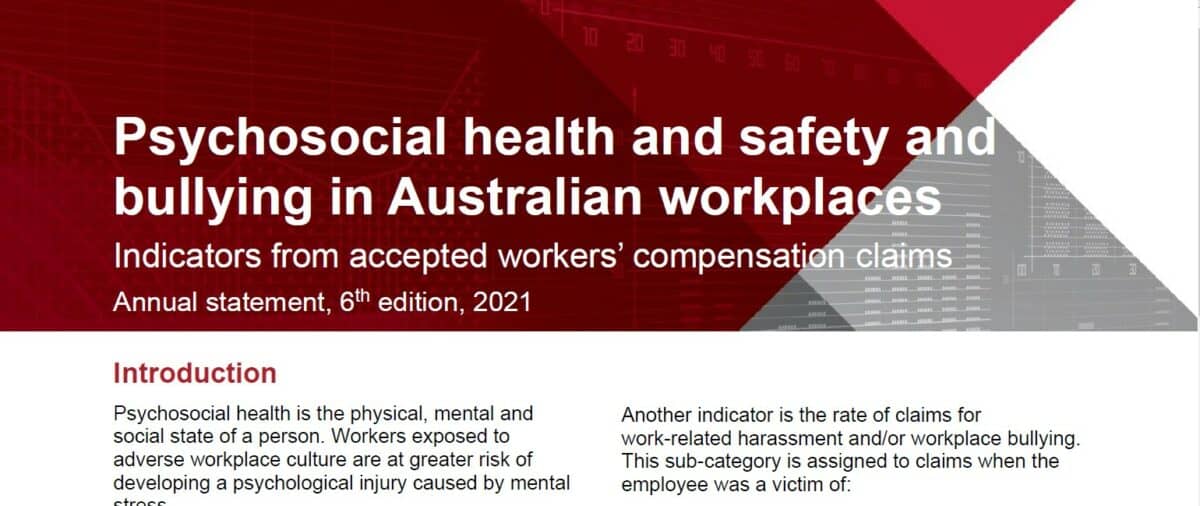
The big occupational health and safety (OHS) news in Australia has been the New South Wales release of its Code of Practice for Managing Psychological Hazards at Work. This Code is not mandatory but is a very good indication of what the OHS regulators (and perhaps eventually the Courts) believe are reasonably practicable measures for employers and business owners to take. These measures are discussed in detail below.

Subscribe to SafetyAtWorkBlog to continue reading.
Subscribe Help
Already a member? Log in here

Industrial Manslaughter or Category 1. Which prevents harm more effectively?

The Communique issued after the May 20, 2021 meeting of the Work Health and Safety (WHS) Ministers says that Australia is not likely to apply an Industrial Manslaughter law nationally:

“While the Northern Territory, Queensland, Western Australia, the Australian Capital Territory and Victoria provided their support for an industrial manslaughter offence, the recommendation did not receive the required majority.”

Some people think that this is no real failure as the Communique also includes “defacto ‘industrial manslaughter’ laws”. Here is the quote that supports that position:

Subscribe to SafetyAtWorkBlog to continue reading.
Subscribe Help
Already a member? Log in here

Stepping forward a bit, maybe

Last week the Australian Council of Trade Unions (ACTU) issued a media release describing the meeting of Work Health and Safety Ministers presenting a

“… huge step forward on mental health…”

The “step” is more walking on the spot than a step forward as the obligation to address psychological hazards in the workplace has existed in Australia for decades. It has just been ignored.

However, what caught my attention was this statement:

“Up to 45 per cent of mental health issues are attributable to work…..”

Subscribe to SafetyAtWorkBlog to continue reading.
Subscribe Help
Already a member? Log in here

Inquiries need more evidence and less anecdote

Recently the Australian Council of Trade Unions (ACTU) made a curious submission to the Federal Government’s Senate Select Committee on Job Security. This submission (not yet available online) illustrates the ACTU’s political and ideological position of job security and precarious work, including the occupational health and safety (OHS) impacts, but it could have been more convincing and helpful.

Here is its section on Insecure Work and Safe Workplaces, the last section before the Conclusion:

Subscribe to SafetyAtWorkBlog to continue reading.
Subscribe Help
Already a member? Log in here

Resilience = the enemy of the Duty of Care

Last year Professor Michael Quinlan and Dr Elsa Underhill wrote about how precarious work arrangements had contributed to the spread and prevalence of COVI19 in Australia and its workplaces. Soon Australia’s Treasurer, Josh Frydenburg, will announce his 2021-22 Budget strategy. It is forecast to include big government spending and in many different areas of Australian industry, but the economy and Australians’ health may be better served by addressing the precarious employment structures on which more and more businesses rely and about which the Government seems disinterested.

In the latest edition of Griffith Review (no. 72), Angela Smith looked at how embedded precarious work is in Australia’s economic rebound. She also looked at how the wellbeing and wellness industries compound the health and safety risks of this type of work in this time of COVID19.

Subscribe to SafetyAtWorkBlog to continue reading.
Subscribe Help
Already a member? Log in here

Non-military safety lessons from the latest Royal Commission (open access)

The Australian Broadcasting Corporation broadcast an episode of The Signal on April 21, 2021, which discussed the complexity of the culture of Australia’s military, and I strongly recommend you listen to it. It does make some points about culture worth contemplating in the context of one’s own workplace and profession.

The most useful point was that an established institution cannot have a uniform culture that meets the expectations of all relevant stakeholders. Generations take their culture with them. So those who started in the military in the 1980s and 1990s (and later) will bring the values and lessons of that time into their maturity and when they move into senior and leadership positions – positions that are intended to both preserve and progress the organisation’s culture. This will result in conflict between the expectations of new recruits and the realities of the established military executives. Not open revolt, but a dissatisfaction that may or may not result in leaving the organisation.

The topic used by The Signal to illustrate the extremes of the defence force members and stakeholders was mental health.

Continue reading “Non-military safety lessons from the latest Royal Commission (open access)”

International perspective on bullying and harassment

In April 2021 the International Association on Workplace Bullying and Harassment conducted its 2002 conference online. The conference was enlightening for its inclusivity.

Many Western countries categorise work-related mental health as if they have minimal overlap. Workplace bullying is often seen as its own discipline with its own guidances, analyses and supporting industries. This can be convenient and has evolved from a reactive and often shallow response from Government.

This structure was acknowledged at the conference but many of the presentations ignored it and spoke about worker health, safety and welfare in the broadest terms.

The conference also balanced detailed local research with broad global contexts. This is the first of a series of articles based on presentations at the conference

Subscribe to SafetyAtWorkBlog to continue reading.
Subscribe Help
Already a member? Log in here
Concatenate Web Development
© Designed and developed by Concatenate Aust Pty Ltd