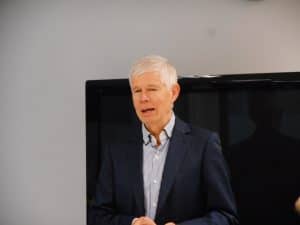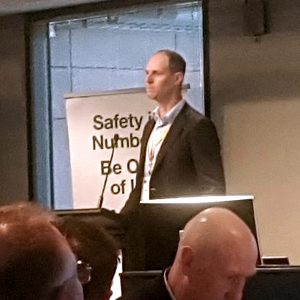
The 21st World Congress on Safety and Health in Singapore has closed. The next will be in 2020 in Toronto Canada. But before the closing ceremony the range of symposia continued. One discussed best practice in occupational health and safety (OHS) and I had the chance to speak about the downside of Zero Harm. The…
Category: evidence
Marnie Williams talks of farm safety, responsibility and a radical future
WorkSafe Victoria’s Executive Director, Health and Safety , Marnie Williams, has had a horrid week. Last Saturday, while being ill with a cold, she stood in for the Victorian Industrial Relations Minister at a Migrant Worker Forum, at which she was asked “what you gonna do about it?”. However she continues to make herself available, a crucial element for any leader of a regulatory agency.
Farm Safety
A couple of days later at a safety conference run by the Safety Institute of Australia, SafetyAtWorkBlog accused WorkSafe of not doing enough about the safety of Victorian farmers. Williams rejected the accusation and forecast a new, and surprising, approach for agricultural safety.
Big OHS data needs to digitise the past
A safety conference in Victoria Australia today heard from Innes Willox of the AIGroup about new challenges in business and occupational health and safety (OHS). As many have mentioned recently big data is a challenge but with important benefits. A major flaw in any of these discussions is an overestimation of data sources and usefulness. Continue reading “Big OHS data needs to digitise the past”
Tassie Coroner releases his safety findings on 7 quad bike deaths
Coincidentally, as an article about quad bike safety was being uploaded to this blog, details of the release of Tasmanian coronial findings were received. The findings were released by Coroner Simon Cooper on August 25 2017 and were not reported widely.
The Coroner investigated seven deaths related to quad bikes but only two occurred on workplaces or as part of performing work – Heather Richardson and Roger Larner. Curiously, WorkSafe Tasmania did not investigate these work-related deaths. Continue reading “Tassie Coroner releases his safety findings on 7 quad bike deaths”
New OHS management elements in ISO45001
Following yesterday’s article on the impending international occupational health and safety (OHS) management Standard, ISO45001, some readers have asked for more details. David Solomon, the Head of the Australian International Delegation of ISO45001 provided a table that compares the elements of ISO45001 with AS4801 and OHSAS18001.
According to Solomon there are several elements that are new to ISO45001, ie. not included overtly in AS4801:
Queensland’s report may not be “best practice” but demands attention
The Queensland Government has released the final report of its “Best Practice Review of Workplace Health and Safety Queensland“. Most of the media attention is given to the introduction of Industrial Manslaughter laws but there are some interesting recommendations and discussion on Enforceable Undertakings, insurance products and other matters of interest to business and safety professionals.
The Queensland Government announced the review earlier this year, particularly, in response to fatalities at Dreamworld and Eagle Farm. A Discussion Paper was released in April.
Industrial Manslaughter
Industrial Manslaughter laws have been floating around Australia’s occupational health and safety (OHS), legal union and political sectors for many years. Only the Australian Capital Territory (ACT) introduced such a law and the Crimes (Industrial Manslaughter) Amendment Act 2003 remains in effect.
The significance in this Queensland report is that the document is entitled “Best Practice” so the panel, based on its own experience and the many submissions it received, adds considerable weight to these controversial laws.
Personalised training, ladder standards and a non-gamechanger

Day 2 of the SAFETYconnect conference commenced with a disrupted panel discussion comprising four representatives of Australia workplace safety regulators. Each representative provided a 10 minute presentation about their agency and their plans. Curiously almost all of them discussed their strategic plans which varied between three and ten years but almost all contained the same aims, targets and challenges.
Some of the most interesting content was in the more practical stream of the conference.