

The 23rd World Congress for Safety and Health at Work was officially opened last evening after a day of occupational health and safety (OHS) workshops. The indigenous Welcome to Country and Smoking Ceremony were excellent, and from the number of delegates recording the dancing, entertaining and enlightening. The same cannot be said for the speeches.
Category: executives

Work From Home conflict between corporate desire and worker reality
The working-from-home (WFH) debate continues in business newspapers with tension about what the employer and worker want. The Australian Financial Review (AFR) has its regular voices from business groups saying that it is damaging productivity for workers to be away from the offices as much as they are, but also reporting the lived experience of working from home with workers identifying positive social and familial benefits.
On November 25, 2023, the newspaper confirmed that Amazon Australia is using career progression as a nudge for workers to come to the offices more frequently.

Politics can mask OHS
The push for workers to return to offices for the majority of their working hours or full-time continues but is one step forward and two back, or vice versa. This is partly due to mixed mainstream and online media messages from conflicting and confusing sources. This is not helpful when one is trying to make a decision on the best available evidence.
A recent example was in the Australian Financial Review (AFR) on November 22, 2023 (paywalled). A commercial real estate services provider CBRE, has released quarterly figures that say workplaces in Melbourne are “only a little over half-occupied on average”. According to Tom Broderick of CBRE:

A transport court case relevant to all managers and employers
In November 2023, Australia’s National Heavy Vehicle Regulator released a “case learning” about a successful prosecution and sentence that the NHVR described as
“One of the most serious examples of a breach under the HVNL [Heavy Vehicle National Laws]”
The seriousness of the breach is perhaps reflected in the fine of A$2.3 million.
It is a significant case and a prosecution with lessons for managers and employers well outside the transport sector. In fact, the NHVR’s “Key takeaways for executives” could form the basis of a solid and productive business management system.
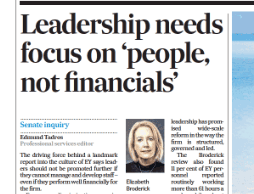
Cultural and operational shortcomings in white-collar work
Long working hours and the billable hours structure received some attention in the prominent business newspaper. the Australian Financial Review, on November 11,2023. Unsurprisingly the article, by Edmund Tadros, about former Sex Discrimination Commissioner, Elizabeth Broderick has garnered attention in the business social media. The article reinforces the unsafe nature of the dominant management practices in white-collar workplaces.

Plain speaking on mental health v nuance
Plain speaking is one of the greatest challenges of any profession. Many professionals struggle to communicate their excellent work and knowledge which has created the moves for Research-To-Practice and specialised communicators (as opposed to public relations advisers). Human Resources (HR) and Occupational Health and Safety (OHS) need communications specialists, or perhaps just interpreters, if a recent article on workers compensation and mental health is anything to go by.
If we are going to achieve a successful and effective change on workplace mental health, we need to start to understand each other.

Downplaying “the source”
Recently on LinkedIn Audrey McGibbon wrote this about an online article discussing working hours in Europe:
“Working excessively long hours is par for the course in many sectors. The reasons for it are complex. The culture created by the collective leadership shadow makes its presence felt in many ways.”
I am not sure that the reasons are complex but the cultural change may be hard.
I think that the challenge is that there are so many reasons, many that are simple. Some are reasons that are beyond the control of employers but most are not, or at least, those that can have the most effective and positive benefit on the mental health of workers, are not.