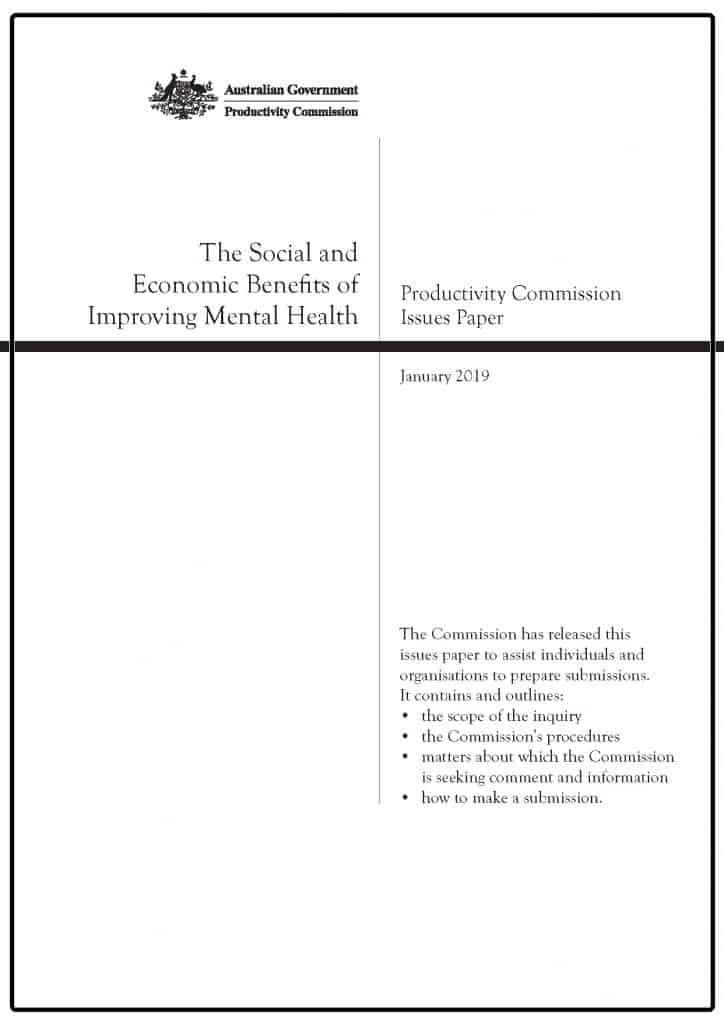
Mental Health Issues Paper provides opportunity for OHS to pitch for legitimacy

Australia’s Productivity Commission (PC) has released its first Issues Paper to assist people in understanding the purposes of the Inquiry and to lodge a submission. The Report provides opportunities for the occupational health and safety (OHS) profession and advocates to explain the relevance of OHS principles in preventing psychological harm. It includes specific work-related questions for people to address in submissions.

Subscribe to SafetyAtWorkBlog to continue reading.
Subscribe Help
Already a member? Log in here

Royal Commission into Mental Health

The Victorian Government has instigated a Royal Commission into Mental Health. At the moment it is receiving submissions to assist it in developing the Terms of Reference. This is an odd process that delays the Commission’s start and is giving the impression that the Commission has already commenced.

However, it is important that occupational health and safety (OHS) advocates become deeply involved in this Royal Commission as psychological harm in the workplace, and caused by the workplace, is a hazard that employers are obliged to try to eliminate. If the workplace context of mental health is not overtly included in the Commission’s Terms of Reference, we will miss a major opportunity for the changes required to prevent psychological incidents and will likely remain with only the symptomatic relief offered by most workplace wellbeing strategies and products.

On the Submissions website, I prioritised “Prevention and Early Intervention” and the “Prevent of Suicide” as my top priorities and make these concise suggestions.

Are there any additional themes that should be included in the terms of reference for the Royal Commission into Mental Health?

It is vital that the issue of Prevention is included in the terms of reference as investment in and attention to prevention has been shown to be the best way to achieve the most return on investment.

The workplace health and safety context should also be mentioned as work can create psychological harm but can also have benefits by providing people with a purpose as well as an independent income.

I encourage all SafetyAtWorkBlog readers who are concerned about workplace psychosocial hazards to visit the submission web page so that the Commission understands the importance that occupational health and safety has in preventing harm.

Kevin Jones

Too big to change

The strong readership of the article on truck driver safety based on the research of Dr Clare George resulted in one reader remind me of Australian research from 2017 that looked at similar issues.
In 2017 Louise Thornthwaite and Sharron O’Neill published “Regulating the work health and safety of Australian road freight transport drivers: summary report“.  The authors wrote:

“Work health and safety (WHS) is a significant issue for the heavy vehicle road freight transport industry. The sector has a history of the highest fatalities and serious injury rates of any industry in Australia. While media focuses on drivers killed in road crashes, these represent only a subset of the hundreds of drivers killed or permanently disabled, and thousands more injured, in and around trucks each and every year.

Subscribe to SafetyAtWorkBlog to continue reading.
Subscribe Help
Already a member? Log in here

Jordan Barab provides important OHS insights

I learnt more about the politics of the United States from Doonesbury than I did from television news and analysis.  I learn more about the politics of occupational health and safety (OHS)  in the United States from Jordan Barab‘s Confined Space newsletter/blog than I do any other media source.  Although the US’s OHS legal structures are different from Australia and other Commonwealth countries, the political ideologies and maneuverings, and fads and statistics are noted by political parties outside the United States.

Recently Barab posted a Year in Review article which is obligatory reading.  His key issues included:

  • A New and Improved Congress (or at least the House)
  • A Headless Agency
  • Inspectors down, enforcement units down, penalties down
  • Return of Black Lung
  • Brett Kavanaugh
  • Regulatory Rollback
  • The Fate of the Labor Movement

Anything sound familiar in your own jurisdiction?

Subscribe to SafetyAtWorkBlog to continue reading.
Subscribe Help
Already a member? Log in here

HR and Legal have failed to address sexual harassment. Could OHS do better?

2019 is likely to be the year when the deficiencies and advantages of the occupational health and safety (OHS) approach to the prevention and management of the psychological harm produced by work-related sexual harassment will contrast (clash?) with the approach used by the Human Resources (HR) profession.  For many, many years OHS has failed to implement the control measures that the available research and guidance recommended.  For the same length of time, HR has largely focused on addressing the organisational consequences of accusations of sexual harassment displaying a preference for legal action or to move the accuser out of the organisation.

These approaches persist but there is some hope that recognition of each others’ role and purpose can bridge the ideological demarcations.  Australia’s inquiries into work- and non-work-related harassment have the potential to change the way psychological harm is seen, managed and, maybe, prevented.

Subscribe to SafetyAtWorkBlog to continue reading.
Subscribe Help
Already a member? Log in here

The Shock of the New

The Australian Human Resources Institute (AHRI) has recently published an article about the significant Human Resources trends for 2019. The trends identified include

  •  “A Change of Government”
  •  “Gig Economy Classification”
  •  “Sexual Harassment”
  •  “Technology Trends”

SafetyAtWorkBlog will be more specific in its occupational health and safety (OHS) “trends” for 2019.

Subscribe to SafetyAtWorkBlog to continue reading.
Subscribe Help
Already a member? Log in here

Workplace suicides require organisational analyses

Some media reports on the recent suicide of another Australian Federal Police (AFP) officer indicate a change away from the dominant perspective of addressing the individual worker rather than institutional factors.

This article is not denying that suicide is a personal decision.  It is an act that most of us do not understand and struggle to do so; this is partly because, unless a note is left or the person spoke to another about their intentions, we can never be sure why someone takes their own life.  As a colleague explained to me, we try to rationalise an irrational act, or at least an act that seemed rational to the person at the time.

The Australian Federal Police has had several

Subscribe to SafetyAtWorkBlog to continue reading.
Subscribe Help
Already a member? Log in here
Concatenate Web Development
© Designed and developed by Concatenate Aust Pty Ltd