
OHS and public health at The Coal Face

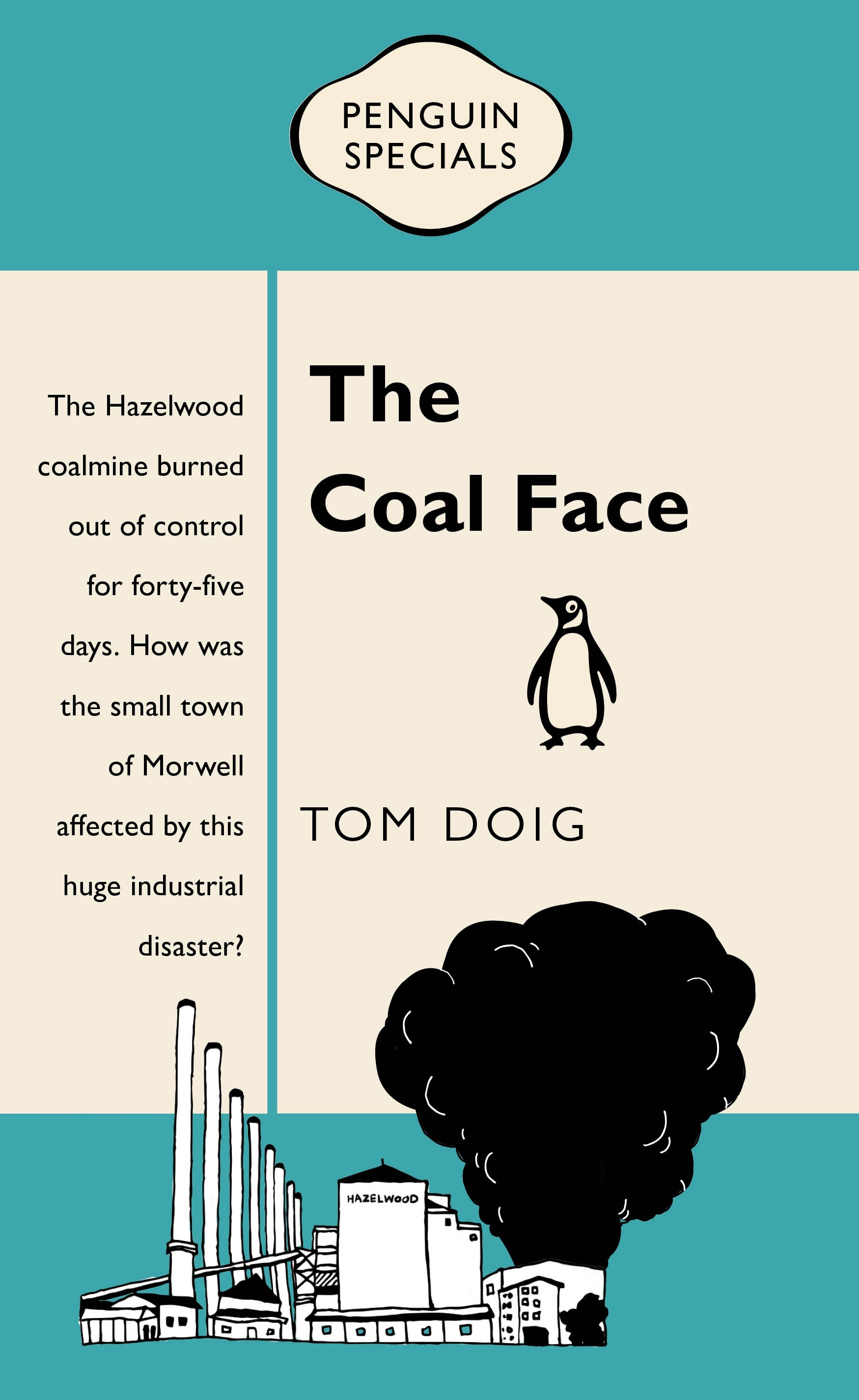
The Hazelwood mine fire has faded from the memory of most Victorians following the Parliamentary inquiry but not so for those who continue to live in the Latrobe Valley and with the health consequences of the fire.  Tom Doig has written a short book on the incident and its consequences that will put pressure on the Andrews (Labor) Government to honour its election promise and reopen the inquiry.

Doig’s book, The Coal Face, summarises many of the issues raised by the inquiry by looking at a selection of personal stories from residents, neighbours and firefighters.  It is a short book of just over 100 pages but it is an important reminder that the consequences of the mine fire are still being felt. Continue reading “OHS and public health at The Coal Face”

OHS issues from over the horizon

seaOn 18 March 2015, the Melbourne office of Herbert Smith Freehills conducted a breakfast seminar that doubled as a launch for the latest edition of the CCH Wolters Kluwer book Australian Master Work Health and Safety Guide (reviewed recently).  The seminar had three of the book’s authors talking about emerging occupational health and safety (OHS) and work health and safety (WHS) issues for Australia.  These included
  • The growth of WHS/OHS “Assurance Programs”
  • The potential implications for the safety management from the Trans-Pacific Partnership and Free Trade Agreements.
  • The OHS trend in the European Union for “Supply Chain Safety“.

The first two of these topics are discussed below.

Subscribe to SafetyAtWorkBlog to continue reading.
Subscribe Help
Already a member? Log in here

OHS professionals should be more politically active

Occupational health and safety (OHS) is inextricably linked to everyday life and everyday politics but it is treated as somehow separate, even by those who are experts in OHS.  This is not the case with industrial relations which is much more grounded in the political realities.

Industrial relations has been pushed by the trade union movement that has always seen workers’ rights as a social issue.  The OHS profession and its associations have been content, largely, to live within the factory fence.  Until recently OHS laws related solely to the workplace and OHS professionals had the luxury of a clear demarcation for its operations.

But new OHS laws acknowledge the responsibility for the effects of work on those other than workers, and those who are neighbours to workplaces.  Australian OHS professionals have been slow to embrace the social role that has been foisted on them.  There seems no excuse for this.

Recently, a

Subscribe to SafetyAtWorkBlog to continue reading.
Subscribe Help
Already a member? Log in here

WorkSafe Victoria heads roll

Victorian Premier Daniel Andrews has spoken publicly about the removal of the CEO and Chair of WorkSafe Victoria describing them as liars and incompetent.  As Jon Faine pointed out in the radio interview, the Premier has established a high level of accountability.  Hopefully this results in an increased diligence on OHS matters by government departments and authorities.

The Industrial Relations Minister in the Andrews Government, Robin Scott, was a

Subscribe to SafetyAtWorkBlog to continue reading.
Subscribe Help
Already a member? Log in here

New analysis of deaths at work

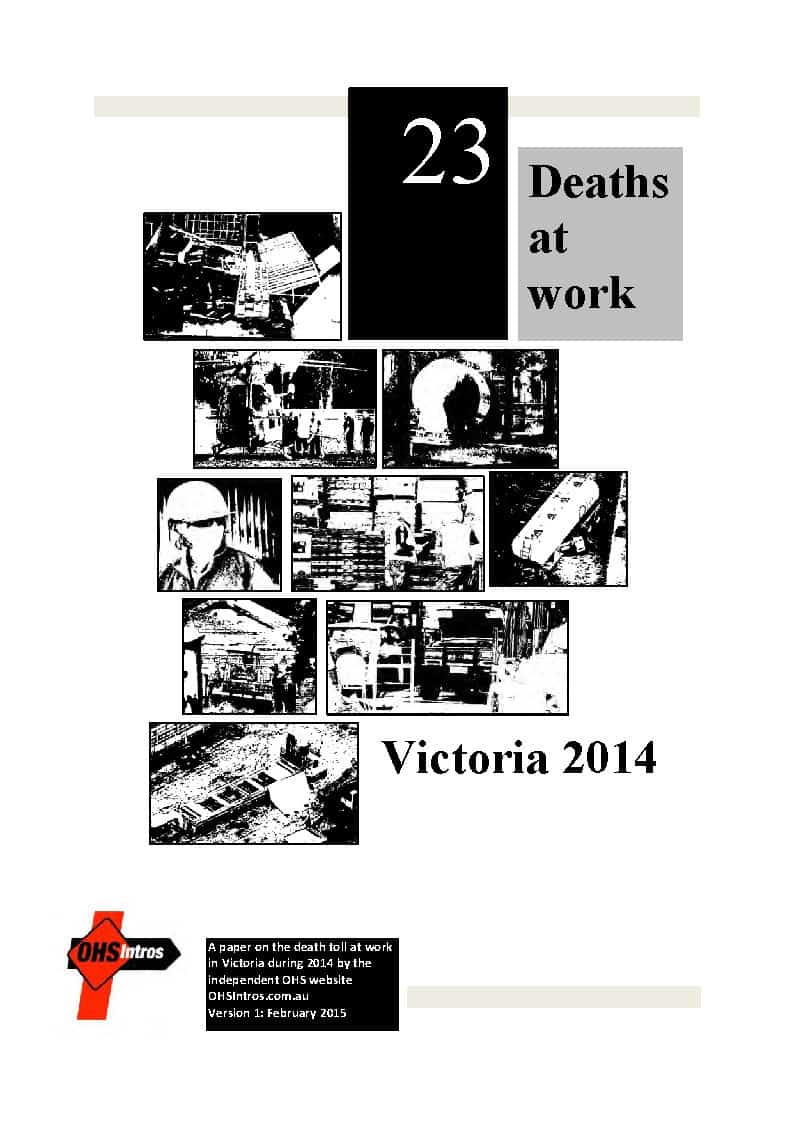
Cover of Deaths at Work 2014Barry Naismith has followed up his first report into WorkSafe with a second that analyses the workplace deaths in Victoria since 1985.

One of the attractions of Naismith’s analyses is that he considers the broader context to the data.  His first report looked at WorkSafe Victoria’s actions and policies in relation to the executive and board complexion.  In this report he looks at the frequency of deaths with WorkSafe campaigns and enforcement response.

The analysis may not have the authority of a fully-funded research program from an academic institution but the level of detail he has collected from official sources is impressive, and in the absence of any other analysis, Naismith’s work deserves serious attention.

Kevin Jones

Master guide or handbook

In 2012, SafetyAtWorkBlog reviewed the first edition of the Australian Master Work Health and Safety Guide. CCH Wolters Kluwer has released its second edition and, sadly, it repeats many of the criticisms in the 2012 review.

The title of Australian Master Work Health and Safety Guide (2nd ed) seems inaccurate if one considers a book with “master ” in its title to be a “masterwork”. This is not a masterwork and the publishers have emphasised to SafetyAtWorkBlog that the book was never intended to be.  The book is intended to be a brief outline of the most important contemporary occupational health and safety (OHS) issues in Australia and to provide practical advice, checklists and templates.  In fact, the word that should be focussed on in the title is “guide”.

The publishers advised that “master” is in the title to indicate it is part of its “Master Series“, a “brilliant” series described as

“Australia’s premium range of professional books, widely accepted as the leaders in their fields.”

SafetyAtWorkBlog looked at a couple of chapters to assess the quality of the content.  As workplace bullying is such a contentious issue. the Bullying and Violence chapter was a focus. There were a surprising number of omissions in this chapter.

Subscribe to SafetyAtWorkBlog to continue reading.
Subscribe Help
Already a member? Log in here

Will workers be safer through an expansion of Comcare?

At a recent breakfast seminar, Steve Bell of Herbert Smith Freehills mentioned that a Bill is with the Australian Senate that will open up the Comcare scheme to Australian businesses through the removal of the national competition test.  This move has been flagged for some time with several lawyers expressing reservations.  Bell mentioned this to the audience of OHS professionals as the law changes could present a substantial change to their operational knowledge base. The Bill is part of a larger debate on OHS.

In a July 2014 article, the Australian Lawyers Alliance (ALA) warned that:

“The proposed changes to Comcare will not only throw state and territory-based workers’ compensation schemes into fiscal chaos, but will also see injured workers left out in the cold,” ALA National President Geraldine Collins said.

“If this legislation is passed, employers may move their workers into the Comcare scheme, thus leaving huge holes of unfunded liability in state schemes which is likely to result in state-based premiums soaring.”

“Opening up the Comcare scheme will be disastrous for workers. Comcare has no meaningful access to common law damages for injuries caused by the negligence of an employer. The scheme is burdensome, paternalistic, and bureaucratic for workers and employers.  Its design means premiums have to go up unless benefits are slashed ,” Ms Collins said.

“Comcare also has no meaningful workplace health and safety regime.  Work environments will develop where lives are lost and permanently damaged with little oversight and enforcement of workplace health and safety.  It is a fundamentally flawed minimalist scheme.  Migration en masse will strike at the heart of the financial stability of state schemes, which are mostly running fairly,” Ms Collins said.”

Continue reading “Will workers be safer through an expansion of Comcare?”

Concatenate Web Development
© Designed and developed by Concatenate Aust Pty Ltd