
Several weeks ago there was a stir in the OHS sector in Victoria, Australia.
Category: government
Lessons from Royal Commission into Home Insulation Program
Australia’s Royal Commission into the Home Insulation Program (HIP) demands the attention of all occupational health and safety (OHS) professionals, primarily, because a job creation and economic stimulus program was so poorly planned at the highest level of government, that it seems to have established a culture that led to workplace deaths. However the Royal Commission is already revealing information that shows how OHS is misunderstood by decision-makers, a situation that still persists in many jurisdictions and will only change by watching the Royal Commission carefully and analysing this information through the perspective of workplace safety.
State of Knowledge
The Royal Commission has been investigating when the workplace deaths in New Zealand from using metal staples with foil insulation were known by the Australian Government. In OHS-speak, it is trying to determine the state of knowledge on this workplace hazard in the decision-making process. The deaths of four young Australian workers prove that the state of knowledge was inadequate however it is well established that Australia and New Zealand operate independently and that, although there are legislative similarities, it is rare for a death in one country to generate regulatory change in another. (One could look to the quad bike safety issues for an additional example.) The recent legislative changes in New Zealand may indicate that they listen to Australia more than vice versa.
Senator Abetz oversteps on workplace bullying claim
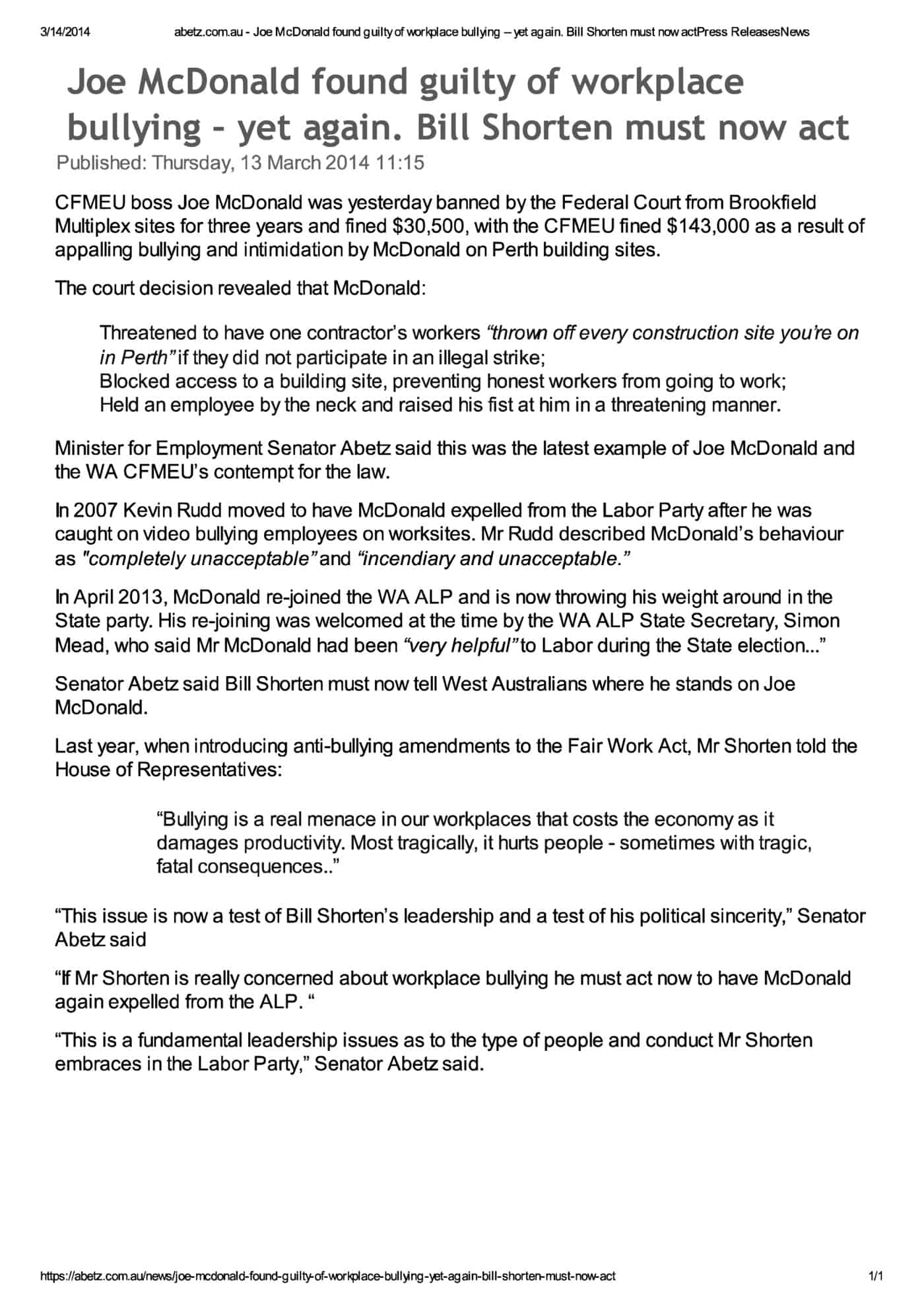 Anyone dealing with occupational health and safety (OHS), or in any profession, knows to be careful with one’s words in public. This is particularly so when one is dealing with mental health issues or claims of workplace bullying. This week Senator Eric Abetz, Australia’s Workplace Relations Minister, seems to have overstepped the mark by misrepresenting some Federal Court Orders as related to workplace bullying, when the Court made no such statement. This could simply be dismissed as political hyperbole in the heat of the moment but this was no off-the-cuff remark. He headlined his media release on 13 March 2014 as:
“Joe McDonald found guilty of workplace bullying – yet again. Bill Shorten must now act”.
According to Safe Work Australia, an organisation within Senator Abetz’s portfolio, workplace bullying is defined in the most recent national guide as
“repeated and unreasonable behaviour directed towards a worker or a group of workers that creates a risk to health and safety.” (page 2)
Nowhere in the Federal Court orders* is workplace bullying, or any other bullying, mentioned and the Federal Court has not found Joe McDonald guilty of workplace bullying. The best that can be said is that Joe McDonald has a history of intimidation on construction sites and that this has created tense relations between the workforce and employers (perhaps a confused safety culture) and generated delays in construction.
Does this all matter? Yes
Important OHS titbits in latest Productivity Commission report
 Productivity and regulation is the rationale behind most of the workplace policies of the current Australian Government. Occupational health and safety (OHS) has a role to play in both of these economic and social elements but it rarely gets considered in a positive light. This is partly an ideological position of the conservative politicians but is also due to a lack of economic argument in favour of OHS and an inability, or an unwillingness, to identify essential regulations.
This week Australia’s Productivity Commission (PC) released a draft paper into the costs of public infrastructure projects that includes some telling OHS information even though most of the media has focused on the political angle or on the taxing of cars?!
A brief review of the draft report reveals OHS dotted throughout both volumes of the report and early on there is some support for Safety in Design in the tender development stage.
Coroner calls for fresh approach to OHS in small business
Ever since the UK Government reduced the occupational health and safety (OHS) obligations on small business, there have been concerns that a similar strategy could occur in Australia. Of all the States in Australia, Victoria is the most likely to mirror the UK actions, particularly as its WorkSafe organisation continues with its restructuring and (ridiculous) rebranding, and Victoria’s conservative government continues to see OHS as a red tape issue for small business. However a recent finding by the Queensland Coroner should be considered very seriously when thinking of OHS in small business.
In 2011 Adam Douglas Forster
” … came close to the rotating ball mill, then accidently (sic) became ensnared by the protruding bolts and was dragged underneath the ball mill which continued to rotate, thereby causing his fatal injuries.”
The inquest found
“There were no guards, barriers or other apparatus restricting access by any persons to the ball mill.” and
Forster “did not know how to turn the ball mill on or off”. Continue reading “Coroner calls for fresh approach to OHS in small business”
One man’s frustration with OHS illustrates larger safety dysfunctions
Terry Reis has written a terrific article about how occupational health and safety (OHS) requirements can impede his work as a fauna ecologist. Instead of whingeing about green or red tape, Terry has provided examples of the annoyance which allows me to build an article in response. This article is in no way a rebuttal as I agree with most of Terry’s grievances, but there can be reasons behind some of the grievances that are likely to be unrelated to OHS or illustrate poor OHS decisions.
Some of the issues Terry raises include:
- Inductions
- PPE
- Working Alone
- OHS arguments
- Drug and Alcohol Testing
- Permits
Inductions
Terry mentions the irrelevance of many OHS inductions and his article seems to indicate a dysfunctional induction program. The intention of inductions is to outline the safety rules of a workplace or task but most are boring, condescending or include information that is unrelated to the task. The reality of many inductions is that they are a mechanism to have workers sign up and indicate they have understood all of their safety obligations on a site so that there is a clearer line of responsibility in the event of an incident. Continue reading “One man’s frustration with OHS illustrates larger safety dysfunctions”
New Zealand trumps Australia on workplace bullying advice
 WorkSafe NZ has released “best practice guidelines” on workplace bullying. Best practice is a nonsense term but this guide is a major step above similar guides in Australia, in particular.
Definitions
Guides always begin with definitions and the definition New Zealand has applied is the same as that in the recently released Australian workplace bullying guide but with a couple of odd semantic differences. These variations should not have any effect on organisational changes required to prevent bullying but the variations are curious. Australia describes “unreasonable behaviour” the actions that generate the bullying as:
“… behaviour that a reasonable person, having considered the circumstances, would see as unreasonable, including behaviour that is victimising, humiliating, intimidating or threatening.”
New Zealand’s definition is:
“…. actions that a reasonable person in the same circumstances would see as unreasonable. It includes victimising, humiliating, intimidating or threatening a person.”
Is there a difference between actions and behaviours?