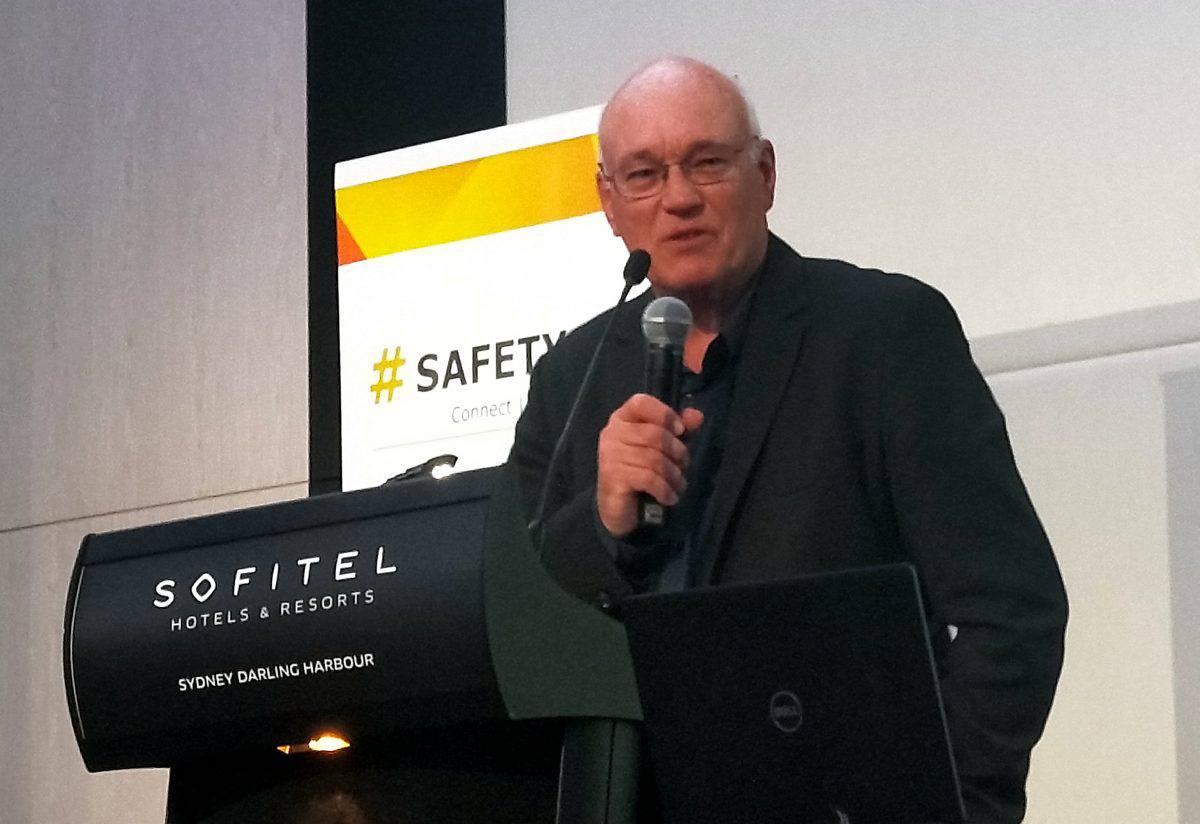
Victorian businesses and occupational health and safety (OHS) people are hungry for advice about managing psychosocial hazards at work if the scenes at today’s Work Health and Safety show were any indication. The sad part of the popularity of the topic is that some of the advice being given is wrong or outdated.
Continue reading ““Human sacrifice, dogs and cats living together… MASS HYSTERIA!””Category: government
Day One – more useful than not
A short report on Day One* of the Australian Institute of Health and Safety’s (AIHS) National Conference in Melbourne. Given a previous blog article asking for new thinking, new approaches etc. Has the Day One satisfied me? Selectively, Yes.
The keynote speaker, Richard De Crespigny had an extraordinary tale to tell about safely landing a heavily damaged passenger aircraft over a decade ago. Some delegates would have been familiar with De Crespigny’s presentation as many of his points had already been made in a recent article in the AIHS’ journal. More on his presentation in a future article.
International Conventions are attractive but largely academic
Last week, Australia’s Parliament released an information paper on a “National Interest Analysis” of International Labour Organization Convention No. 187: Promotional Framework for Occupational Safety and Health Convention adopted in Geneva on 15 June 2006. Does this mean anything to the local occupational health and safety (OHS) profession? Yeah, Nah, Maybe.
We deserve new OHS ideas, research, initiatives, strategies, epiphanies and enlightenment
This week, the Australian Institute of Health and Safety (AIHS, formerly the Safety Institute of Australia) is hosting its national conference in Melbourne, Australia. The heyday of occupational health and safety (OHS) conferences seems to have passed in Australia as, perhaps, was confirmed by the varying responses to last year’s World Congress on Safety and Health at Work. But expectations for this week’s conference are high; at least mine are.
But are those expectations too high? There is a direct competitor for OHS ears and eyes (no matter the arguments) in the same building at the same time, the Workplace Health and Safety Show. The AIHS Conference needs to work hard to retain its prominence and, most importantly, its influence. It is worth reflecting on how this messy situation came about.
Evaluating the effectiveness of OHS interventions and programs
Last month, an extraordinary document appeared – “Evaluating OH&S Interventions: A WorkSafe Victoria Intervention Evaluation Framework 2023 (2nd Ed.).” Its extraordinariness comes from its appearance with no fanfare or promotion; it is a second edition of something published in 2004 (which I cannot recollect), it has authoritative authors, and it is a document many have been asking for.
Different OHS messages to different audiences
Last week, WorkSafe Victoria held its annual Business Leaders’ Breakfast. The keynote speaker was Karen Maher, who spoke about the need for an effective and respectful workplace culture that would foster a healthy psychosocial environment. Her presentation would have been familiar to many of the occupational health and safety (OHS) and WorkSafe personnel in the audience, but it may have been revolutionary for any business leaders. Maher outlined the need for change but not necessarily how to change or the barriers to change.
The event did provide a useful Q&A session and afforded the new WorkSafe Victoria CEO, Joe Calafiore, his second public speaking event in a week.
New data on workplace suicides should change the mental health at work discussion
“No one should die at work” is a common statement at Worker Memorial Services every year. Occupational health and safety (OHS), in particular, uses death as a starting point for reflection and sometimes action. Workplace death is a recognised worst-case scenario and has long been established as a benchmark for measuring OHS progress.
[This article discusses workplace suicides]
There is increased interest in psychosocial hazards at work with the worthy goal of preventing these hazards. However, psychosocial deaths such as those by suicide do not hold the same place or role as “traditional” physical workplace deaths. They are rarely the launching pad for drastic change in our systems of business, but that is starting to change if new data and analysis are any indication.