Statistics are vital to any decisions about occupational health and safety (OHS). Safe Work Australia (SWA) does a great job providing statistical packages based on the data sources it can access. Last week SWA released its 2019 report on “Work-related Traumatic Injury Fatalities” which identified vehicle collisions as, by and large, the most common cause of worker fatalities. This category may be a surprise to many readers but perhaps the most important part of the report is what is omitted.
Category: government
The black sheep of safety leadership
Western Australia’s Industrial Manslaughter (IM) laws are now in effect. The same arguments for and against were posed in Parliament and outside as they were in Queensland and Victoria, and the Australian Capital Territory well before that. The IM laws will face the same institutional hurdles to application and offer the same, nominal, deterrent effect.
But WA also prohibited insurance policies that cover the financial penalties applied by the Courts. Such policies may make good business sense in managing risk, but they also remove the pain and deterrence intended in the design and application of Work Health and Safety laws.
Hospitality survey shows the size of the hurdle to reform

Hospo Voice, a trade union for Australian hospitality workers has released a report on a survey of more than 4000 workers between March and June 2020. #RebuildHospo: A Post-Covid Roadmap For Secure Jobs In Hospitality has all the limitations of other surveys done by members of an organisation rather than independent research but this report offers a framework for safe and decent work that reflects many of the occupational Health and safety (OHS) that SafetyAtWorkBlog has reported on.
The union claims that hospitality workers endorse four important work elements:
- Secure jobs,
- End to wage theft,
- Safe and respectful workplaces, and
- Justice for migrant workers
OHS has a thin presence in this report, mainly discussed in that third bulletpoint but an integrated analysis would show that OHS is involved with more of the elements.

Accusations of cover-up at Senate Estimates
Safe Work Australia also attended Senate Estimates late last month. COVID19 is an unavoidable focus but we learnt that the latest fatality report will be released early this month, obtained more details on the response to the Boland Report, heard more about the gig economy but the climax was accusations of a coverup with Senator Deborah O’Neill (ALP) saying:
“Minister Porter… influenced Safe Work Australia—how independent; running for cover!”
page 65, Hansard

What did we learn in Senate Estimates last week?
Australia has a process of accountability where Ministers and Heads of Government Departments and Authorities are required to answer attend Senate Estimates. Few people outside of the Canberra bureaucracy pay much attention to the occupational health and safety (OHS) information provided. Most media pay attention to disputes and statements that have a more general political appeal, but there is important information about workplace health and safety, such as an update of the progress on Marie Boland’s recommendations or the role and activity of Safe Work Australia (SWA).
Truck driver death is relevant to all
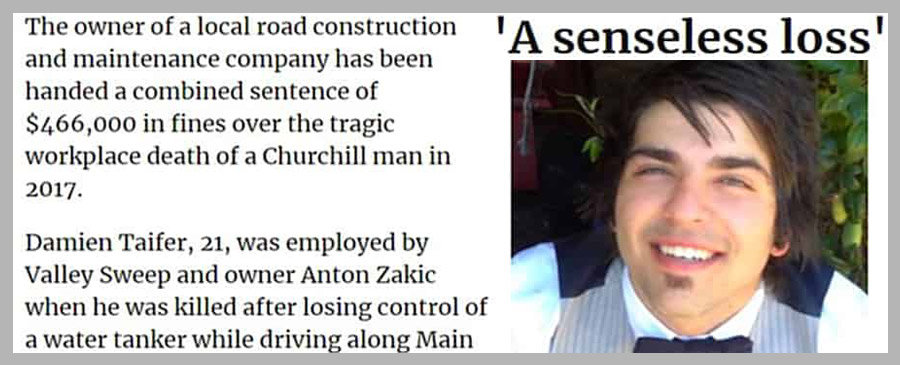
Well before the push for Industrial Manslaughter laws was the occupational health and safety (OHS) offence of “reckless conduct”. A media report from the LaTrobe Valley Express recently showed how one employer’s neglect of basic safety practices and processes resulted in the death on 21-year-old Damien Taifer.
Precarious Work, Pandemics and Australia’s Future – Let’s Not Forget the Link
This is a guest post by Michael Quinlan & Dr Elsa Underhill (links added).
In mid- August 2020 Victorian Premier Daniel Andrews labelled insecure work as toxic and argued a fundamental policy reset was required into the future. He stated:

Insecure work is toxic. There is nothing good about insecure work, and when this is done, when this virus has been beaten, we will need to commit ourselves to do something really significant about it. It is no good for anything, for families, for a sense of security [and] for public health, for any purpose. We have a lot of people who work very hard but have no safety net to fall back on and that is just not something we should settle for .
(Guardian 16 August 2020)
The observation generated little publicity and was soon forgotten as the Victorian COVID outbreak caused deepening concern across the nation. But the first major Australian political leader to call precarious work for what it demonstrably was should start a long overdue public debate.
Continue reading “Precarious Work, Pandemics and Australia’s Future – Let’s Not Forget the Link”