More OHS activists needed

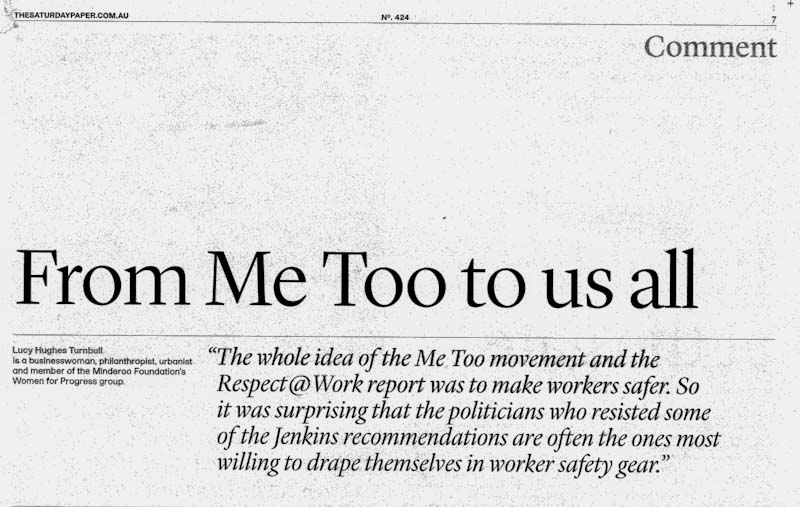
The Australian Government is set to introduce new workplace sexual harassment laws and obligations through Parliament. In The Saturday Paper on November 5 2022 (paywalled), businesswoman Lucy Hughes Turnbull wrote a short article that reminds us of the purpose of the new laws.

“The whole idea of the Me Too movement and the Respect@Work report was to make workers safer. So it was surprising that the politicians who resisted some of the Jenkins recommendations are often the ones most willing to drape themselves in worker safety gear. Protection from abuse and harassment is another key aspect of safety, like guardrails and fire exit signs. Now the legal system recognises it as such.
This latest work safety bill is the best gift the parliament could give to mark the fifth anniversary of the global Me Too movement. Together with more paid parental leave and greater access to more affordable childcare, it has been a great few weeks for women and indeed all Australians.”

links added
Subscribe to SafetyAtWorkBlog to continue reading.
Subscribe Help
Already a member? Log in here

Do we have to work?

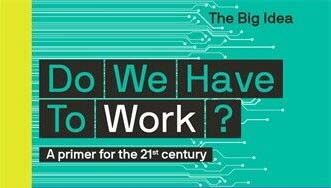
You often learn more about your area of speciality from reading outside of that speciality. Matthew Taylor’s book “Do We Have To Work?” is one of those books though it overlaps with occupational health and safety (OHS), if one thinks of the role and place of OHS in modern business.

The Big Idea series of books by Thanes & Hudson uses a jaunty format that is jarring in some ways but attractive in others. Its pages use fonts of different sizes, lots of colour images and highlighted cross-references that look like a Dummies Guide on acid, but the content is so good the reader works out where to look and what to choose fairly quickly.

Subscribe to SafetyAtWorkBlog to continue reading.
Subscribe Help
Already a member? Log in here

Past findings may offer strategies for the future

Further to the recent article about the 2004 Maxwell Report, it is useful to note the recommendations peppered throughout the report, as collated by K Lee Adams. Although aimed at the Victorian Workcover Authority and WorkSafe Victoria, these are interesting ideas that could be asked of any occupational health and safety (OHS) authority currently. Some have already been addressed; others were posed 18 years ago and have not progressed. The recommendations have been numbered for easier reference.

Subscribe to SafetyAtWorkBlog to continue reading.
Subscribe Help
Already a member? Log in here

Sacking may eliminate a hazard but allow toxic work cultures to persist

A Queensland inquiry into how Police respond to and handle domestic violence incidents has gained an occupational health and safety (OHS) context. According to The Guardian newspaper (paywalled).

“Employment law experts say the weak police discipline system and the ongoing employment of problematic officers have created “clear breaches of duty” under workplace health and safety laws, which require organisations to provide a safe environment for employees.”

Perhaps the article is more telling in the assumption that offending Police are unredeemable, with the only option being to sack them. OHS duties are meant to be supportive, but they also advocate that workplace hazards should be eliminated, as this is the most effective risk control measure.

Subscribe to SafetyAtWorkBlog to continue reading.
Subscribe Help
Already a member? Log in here

Disconnect and Positive Duties

Recently the Australian government released the interim report of the Select Committee on Work and Care. This committee is one to watch for many reasons; the least is that it is chaired by Senator Barabara Pocock, a leading researcher and writer on issues related to work/life balance and workplace equity. The report does not address occupational health and safety (OHS) risks directly;y but discusses many of the flexible work structures that can affect workers’ mental health.

One element of the Committee’s report deals with the Right to Disconnect – the right to turn off from the always-on workplace; a policy that returns the focus of days off to relaxation, hobbies or reconnection with friends and family.

Another is the imposition of another work-related positive duty.

Subscribe to SafetyAtWorkBlog to continue reading.
Subscribe Help
Already a member? Log in here

New trade union psychological safety survey shows how little has changed

Australia’s trade union movement has long been active on the issue of workplace psychological harm. Its 1997 Stress At Work survey of members led directly to the creation of workplace bullying and occupational violence guidance in Victoria and elsewhere. Over 20 years later, the Australian Council of Trade Unions (ACTU) undertook another survey of its members (not publicly available), again on mental health at work.

Subscribe to SafetyAtWorkBlog to continue reading.
Subscribe Help
Already a member? Log in here

Minister could have spoken stronger on OHS at a business event

Recently Australia’s Minister for Resources, Madeleine King, spoke at an event hosted by the Western Australian Chamber of Commerce and Industry. The speech aimed to reassure the State’s mining sector to not feel threatened by the new Australian Labor Party government. However, her words about sexual harassment were a little odd.

According to the publicly released speech, King said this on the issue of the labour shortage in mining and resources:

Subscribe to SafetyAtWorkBlog to continue reading.
Subscribe Help
Already a member? Log in here
Concatenate Web Development
© Designed and developed by Concatenate Aust Pty Ltd