A strong safety conference

The Safety Institute of Australia continues to rebuild its member services, its finances and its reputation. In fact, it is so confident in its future that it has changed its name and brand to reflect this path. From July 2019 it will be known as the Australian Institute of Health and Safety (AIHS). A critical element of the SIA/AIHS strategy is it national conference, the second of which was held in Sydney at the end of May 2019, and it is worth asking whether the conference matched the Institute’s renewed pathway.

Subscribe to SafetyAtWorkBlog to continue reading.
Subscribe Help
Already a member? Log in here

Where’s the harm in bullying?

The West Australian Government has released its the report on its Ministerial Review of the State Industrial Relations System. There are a few interesting bits that relate to occupational health and safety (OHS) and bullying.

The Fair Work Commission has been able to accept applications to stop workplace bullying for a few years now. Western Australia’s State system will soon also allow this, if the Government accepts the recommendations, but workplace bullying is a little different from the OHS approach. The report says:

Subscribe to SafetyAtWorkBlog to continue reading.
Subscribe Help
Already a member? Log in here

Answers and clues on workplace bullying and mental health in a small package

Talking about occupational health and safety (OHS) is a critical element so explaining the concept but also strengthening OHS as more and more people understand its socio-economic and organisational context. Sometime this is done through newsletters from OHS Regulators, sometimes by large and/or expensive conferences. Sometimes all of this still fails to reach the right audience.

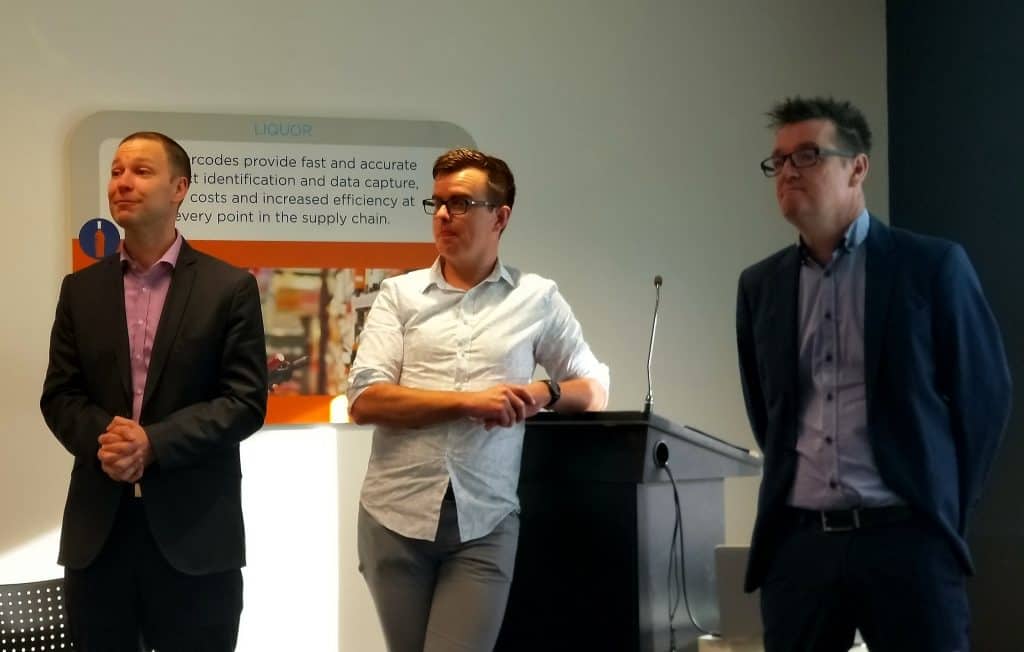
Mark Stipic, Antony Malmo and Michael Plowright

Last week a small seminar was held in the Melbourne suburb of Mulgrave. That seminar was no more than 90 minutes and provided advice from three experts in OHS-related topics related to workplace bullying. These were the psychology of workplace bullying, the management and prevention of it and workers compensation for the resultant mental ill-health.

Subscribe to SafetyAtWorkBlog to continue reading.
Subscribe Help
Already a member? Log in here

Family violence at work, looking at trees instead of forest

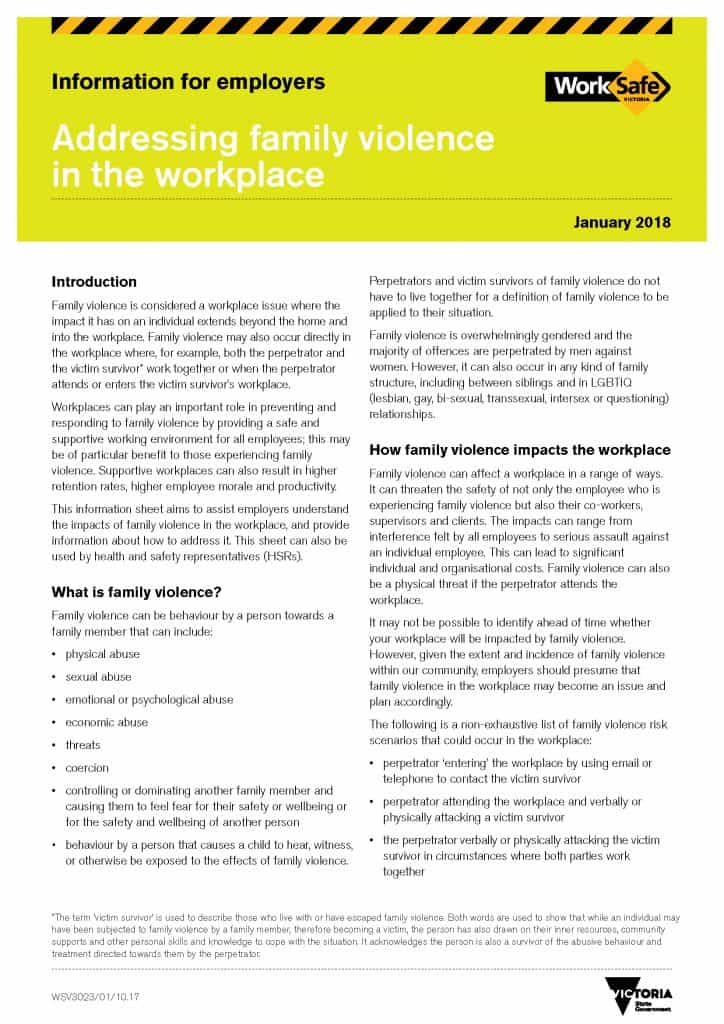
Victoria’s Minister for Workplace Safety, Jill Hennessy, has released a media statement about the occupational health and safety (OHS) context of family violence, referencing a WorkSafe Victoria guidance note from January 2018.

Hennessy is quoted saying:

“Employers have a legal obligation to provide a safe workplace for their employees – and that includes doing whatever they can to support workers experiencing family violence.”

But what level or type of support is expected from employers? Family violence is damaging and insidious but also a crime. It is also a subset, or maybe a special type, of workplace violence as is evident by WorkSafe’s reference to its broader violence publication at the end of the family violence guidance note. The publication, A guide for employers Preventing and responding to work-related violence, outlines the employers duty of care, which includes prevention.

Subscribe to SafetyAtWorkBlog to continue reading.
Subscribe Help
Already a member? Log in here

Steady as she goes in Victoria

The annual Safety Institute of Australia (SIA) breakfast was held at the Melbourne offices of Herbert Smith Freehills (HSF). As has become a tradition, a spokesperson for WorkSafe Victoria was the feature presenter and this year that was the very recently appointed Executive Director of Health and Safety, Julie Nielsen. HSF’s Steve Bell also provided an update on OHS laws and national Work Health and Safety (WHS) changes.

Subscribe to SafetyAtWorkBlog to continue reading.
Subscribe Help
Already a member? Log in here

Business groups miss the target on sexual harassment

Two business associations have released the submissions they provided to Australia’s National Inquiry into Sexual Harassment in Australian Workplaces – the Australian Chamber of Commerce and Industry (ACCI) and the Australian Industry Group (AiG). These submissions have been eagerly anticipated as these two groups are politically influential.

ACCI has based its submission on 13 “principles”:

  • Employers oppose sexual harassment
  • Sexual harassment is not good business
  • More Australians need to be able to recognise sexual harassment
  • We need to improve the attitudes Australians bring to work
  • The law needs to support employers in turning values into action
  • We need to recognise/reward learning and change
  • Individuals must be made more accountable for their own behaviour
  • Greater effectiveness does not demand more law
  • Regulation needs to be smart, simple, clear and balanced to be effective
  • Jurisdictional overlap / repetition detracts from effectiveness
  • Businesses have differing capacities and cultures
  • Sexual harassment can be challenging to manage
  • This is a moving target; new sexual harassment risks are emerging

Each one of these sound positive but can be argued over. For instance “sexual harassment can be challenging to manage”. This is less of a principle than a reason, or even an excuse. Sexual harassment is complex to manage as it is not just about poor relationships, it involves a sexual element which involves power and disrespect; power that is sometimes misinterpreted as leadership or part of a manager’s entitlement.

Subscribe to SafetyAtWorkBlog to continue reading.
Subscribe Help
Already a member? Log in here

Workplace sexual harassment inquiry releases more submissions

The National Inquiry into Sexual Harassment in Australian Workplaces has released another block of public submissions. many of them involve examples of horrible harassment and psychological harm, but several offer research, suggestions for improvement and, a little bit of, prevention.

Those making the recently released submissions seem to be realising that the inquiry’s terms of reference focuses on Australian workplaces.

Non-disclosure agreements and communication barriers

One submission is from Professor Judith Bessant, AM, of RMIT University (Submission 188) in which she addresses the application of Non-Disclosure Agreements (NDAs). NDAs have been in the press lately as some of those who experienced sexual harassment were unable to make submissions to this Inquiry without contravening the NDA they had with their employer. Professor Bessant asserts that

Subscribe to SafetyAtWorkBlog to continue reading.
Subscribe Help
Already a member? Log in here
Concatenate Web Development
© Designed and developed by Concatenate Aust Pty Ltd