Important discussion of moral harm, moral repair and what can be done

Occupational health and safety (OHS) needs to talk more about failure, in a similar way that other business processes are dissected and reported. But the challenge to this, and I think the main reasons failure is not discussed, is that OHS failures result in serious injuries, life-altering conditions and deaths. OHS shares something with the medical profession which “buries its mistakes”. There appears to be something shameful in talking about these failures in public, although the OHS profession is full of chatty anecdotes in private.

One of the ways for OHS to discuss these uncomfortable experiences is to focus on Harm rather than legalities and the chase for compliance.

The first paragraph in Derek Brookes‘ new book, “Beyond Harm“, seems to speak to the OHS profession:

Subscribe to SafetyAtWorkBlog to continue reading.
Subscribe Help
Already a member? Log in here

Make sure you are serious about deeper and better thinking on workplace mental health

In October 2018, the Australian Financial Review (AFR) reported (paywalled) on an occupational health and safety (OHS) investigation into overwork and staff fatigue being conducted by WorkSafe Victoria. The AFR has followed this with a report on June 6 2019 (paywalled) by its Legal Affairs Editor, Michael Pelly. It is a positive article about how the law firm, King, Wood & Mallesons (KWM) has improved its OHS performance since October last year. However there is much between the lines that hints at the OHS approach used and how limited it is.

Subscribe to SafetyAtWorkBlog to continue reading.
Subscribe Help
Already a member? Log in here

A strong safety conference

The Safety Institute of Australia continues to rebuild its member services, its finances and its reputation. In fact, it is so confident in its future that it has changed its name and brand to reflect this path. From July 2019 it will be known as the Australian Institute of Health and Safety (AIHS). A critical element of the SIA/AIHS strategy is it national conference, the second of which was held in Sydney at the end of May 2019, and it is worth asking whether the conference matched the Institute’s renewed pathway.

Subscribe to SafetyAtWorkBlog to continue reading.
Subscribe Help
Already a member? Log in here

Where’s the harm in bullying?

The West Australian Government has released its the report on its Ministerial Review of the State Industrial Relations System. There are a few interesting bits that relate to occupational health and safety (OHS) and bullying.

The Fair Work Commission has been able to accept applications to stop workplace bullying for a few years now. Western Australia’s State system will soon also allow this, if the Government accepts the recommendations, but workplace bullying is a little different from the OHS approach. The report says:

Subscribe to SafetyAtWorkBlog to continue reading.
Subscribe Help
Already a member? Log in here

Answers and clues on workplace bullying and mental health in a small package

Talking about occupational health and safety (OHS) is a critical element so explaining the concept but also strengthening OHS as more and more people understand its socio-economic and organisational context. Sometime this is done through newsletters from OHS Regulators, sometimes by large and/or expensive conferences. Sometimes all of this still fails to reach the right audience.

Mark Stipic, Antony Malmo and Michael Plowright

Last week a small seminar was held in the Melbourne suburb of Mulgrave. That seminar was no more than 90 minutes and provided advice from three experts in OHS-related topics related to workplace bullying. These were the psychology of workplace bullying, the management and prevention of it and workers compensation for the resultant mental ill-health.

Subscribe to SafetyAtWorkBlog to continue reading.
Subscribe Help
Already a member? Log in here

Family violence at work, looking at trees instead of forest

Victoria’s Minister for Workplace Safety, Jill Hennessy, has released a media statement about the occupational health and safety (OHS) context of family violence, referencing a WorkSafe Victoria guidance note from January 2018.

Hennessy is quoted saying:

“Employers have a legal obligation to provide a safe workplace for their employees – and that includes doing whatever they can to support workers experiencing family violence.”

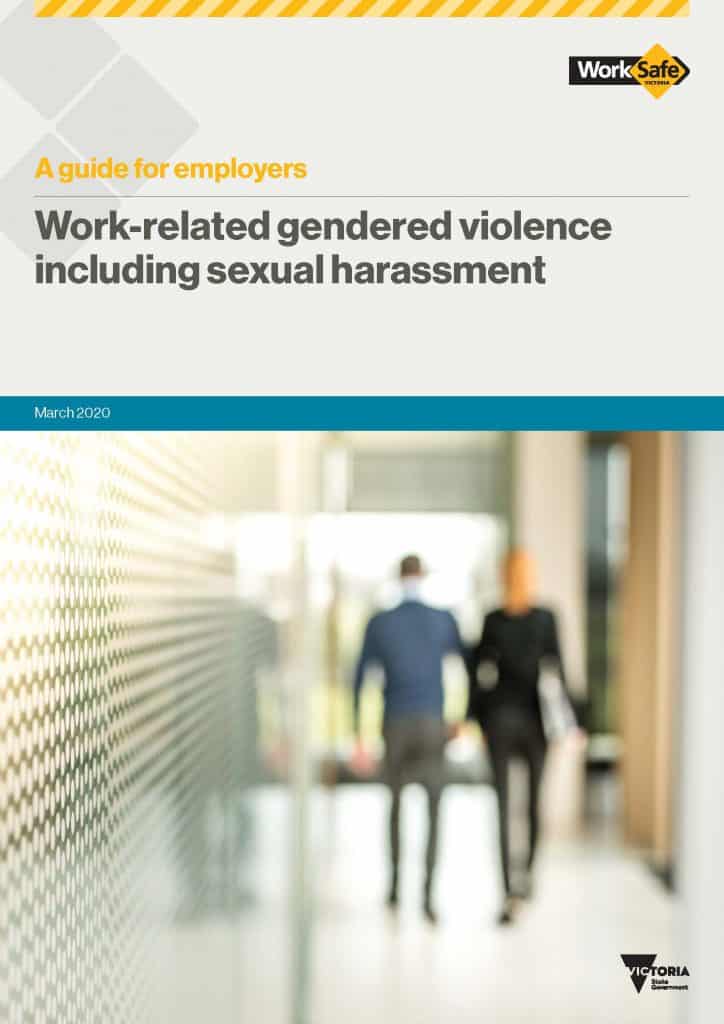
But what level or type of support is expected from employers? Family violence is damaging and insidious but also a crime. It is also a subset, or maybe a special type, of workplace violence as is evident by WorkSafe’s reference to its broader violence publication at the end of the family violence guidance note. The publication, A guide for employers Preventing and responding to work-related violence, outlines the employers duty of care, which includes prevention.

Subscribe to SafetyAtWorkBlog to continue reading.
Subscribe Help
Already a member? Log in here

Steady as she goes in Victoria

The annual Safety Institute of Australia (SIA) breakfast was held at the Melbourne offices of Herbert Smith Freehills (HSF). As has become a tradition, a spokesperson for WorkSafe Victoria was the feature presenter and this year that was the very recently appointed Executive Director of Health and Safety, Julie Nielsen. HSF’s Steve Bell also provided an update on OHS laws and national Work Health and Safety (WHS) changes.

Subscribe to SafetyAtWorkBlog to continue reading.
Subscribe Help
Already a member? Log in here
Concatenate Web Development
© Designed and developed by Concatenate Aust Pty Ltd