New President and new approaches to unionism

ACTU Executive with Michele O’Neil second from left

Day One of the Australian Council of Trade Unions’ Congress was memorable for a couple of reasons.  The appointment of Michele O’Neil, pictured right, as the President was a notable achievement, one made more memorable as she denied any desire to move onto a political appointment. The other memorable event was a string of shopfloor representatives outlining their innovative approaches to the recruitment of members and the creation of (sub)unions for hospitality workers, hairdressers and indigenous workers in the Northern Territory.

Workplace safety was mentioned a couple of times in passing but occupational health and safety (OHS) seems to becoming more a thing that is, rather than a thing that is named.  If we look for it, we find it.

Subscribe to SafetyAtWorkBlog to continue reading.
Subscribe Help
Already a member? Log in here

Trade unions need to look for change beyond legislation

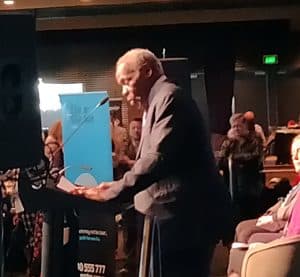
Danny Glover addressing the ACTU Congress on July 16 2018

The 2018 Congress of the Australian Council of Trade Unions (ACT) is happening in the middle of a campaign to “Change the Rules”.  These “Rules” are largely concerning with industrial relations, of which Occupational Health and Safety (OHS) is a subset, or complementary, element. Legislation constantly needs challenging and review; much legislation, like Australian Standards, misses their expiry dates and persists too long,  becoming increasingly seen as irrelevant.

OHS has the “luxury” of having been reviewed nationally within the last decade.  For some Australian States this change was progressive but for most it was a catch up to contemporary standards and expectations.  OHS laws have not progressed since and a lot of hope is placed on the current Independent Review of Work Health and Safety (WHS) laws to enliven the discussions, yet that report is not due until 2019.

Trade unions have a great deal of faith in legislation to achieve change.  

Subscribe to SafetyAtWorkBlog to continue reading.
Subscribe Help
Already a member? Log in here

Exclusive reports from the 2018 ACTU Congress

SafetyAtWorkBlog will be reporting from the biennial Congress of the Australian Council of Trade Unions. For the first time   Trade unions have been pivotal for the creation and enforcement of occupational health and safety (OHS) around the world.

Most of the past reporting on these events in mainstream media has focused on politics and industrial relations.  OHS tends to get overlooked so SafetyAtWorkBlog’s attendance will be important.

Articles from the Congress will be available only to Subscribers. Continue reading “Exclusive reports from the 2018 ACTU Congress”

New inquiry into sexual harassment – an OHS opportunity and challenge

On June 20 2018, the Australian government announced a National Inquiry into Sexual Harassment in the Workplace, claiming it to be a world-first. Sexual harassment is not an occupational health and safety (OHS) hazard in many ways BUT the psychological harm it can create is. The job of an OHS person is to encourage employers to reduce work-related harm through prevention, so we need to prevent sexual harassment, just as we do for all the work activities that contribute to poor psychological health and safety.

The macroeconomic costs of sexual harassment in the workplace may be of interest to politicians and business lobbyists but this can be a significant distraction from identifying ways to prevent psychological harm, which should be the most important legacy of this type of inquiry.

Addressing the OHS impacts of

Subscribe to SafetyAtWorkBlog to continue reading.
Subscribe Help
Already a member? Log in here

A strong attack on work-related psychological health and safety

The guidance on workplace psychological health and safety forecast by Safe Work Australia’s Peta Miller was released on June 14 2018.  There is potential for this guidance to change how mental health is managed and, most importantly, prevented in Australian workplaces.

It is important to note that “Work-related psychological health and safety – a systematic approach to meeting your duties” has been developed with the involvement and approval of all of Australia’s occupational health and safety (OHS) or work health and safety (WHS) regulatory bodies.  Workplace mental health promoters and resilience peddlers are unlikely to find much support in this document as the prevention of harm is the benchmark.

The guidance is also intended to operate in support

Subscribe to SafetyAtWorkBlog to continue reading.
Subscribe Help
Already a member? Log in here

Factbook, short on OHS facts

The Australia Institute has released a “factbook” about The Dimensions of Insecure Work.  It is little more than a snapshot of some of the labour situations in Australia centring on the fact that

“Less than half of employed Australians now hold a “standard” job: that is, a permanent full-time paid job with leave entitlements”

This changed demographic is significant whenever the Government or its departments and agencies take about job and employment figures.  The reliance on full time employment as the core metric should be reviewed and revised but this is likely to change our view of the world through official reports . 

Subscribe to SafetyAtWorkBlog to continue reading.
Subscribe Help
Already a member? Log in here

Preview of Australia’s new work-related psychological injuries guidance

Peta Miller has worked at Safe Work Australia (SWA) for around 17 years.  She leaves there at the end of June.  One of her last public appearances for SWA was the National Health and Safety Conference in Melbourne in May 2018 at which she provided an outline of the new work-related psychological injuries guidance that has been signed-off by SWA but not yet released to the public.

This guide is said to be a large one but not one that requires a re-education on safety and psychological terms.  There is discussion about applying the risk management Hierarchy of Controls to psychosocial hazard identification, the prevention of psychological harm through the design of good work and the identification of psychological hazards without the need to diagnose a medical condition.

Subscribe to SafetyAtWorkBlog to continue reading.
Subscribe Help
Already a member? Log in here
Concatenate Web Development
© Designed and developed by Concatenate Aust Pty Ltd