Consumer Product Safety System review should be on the OHS radar

Following on from the product safety theme in yesterday’s article, it is noted that the Australian Treasury has opened a consultation phase on improving the effectiveness of the Consumer Product Safety System. The report makes specific reference to workplace health and safety laws.

This consultation is a direct result of the recent review of Australian Consumer Law:

“The Australian Consumer Law Review final report recommended the introduction of a General Safety Provision (GSP) into the Australian Consumer Law (ACL) requiring traders to take reasonable steps to ensure the safety of a product before selling it onto the market.”

page 7

The GSP has similarities to the duties of the PCBU (person conducting a business or undertaking) under the model Work Health and Safety (WHS) laws.

Subscribe to SafetyAtWorkBlog to continue reading.
Subscribe Help
Already a member? Log in here

Arts Wellbeing Collective shows how it’s done

From an occupational health and safety (OHS) perspective, part of the reason that the Arts Wellbeing Collective (AWC) is being so successful and admired is that it originated outside of the traditional OHS and Health funding models. Existing in the performing arts meant the Collective drew firstly on their modern version of patronage by approaching their sponsors.

Recently the CEO of the AWC, Claire Spencer, spoke at the launch of Victoria’s Health and Safety Month and reminded the audience of the dire straits the performance arts were in with relation to mental health. She referenced the research commissioned by Entertainment Assist and conducted by Victoria University

Subscribe to SafetyAtWorkBlog to continue reading.
Subscribe Help
Already a member? Log in here

Australian silicosis research mirrored in the US

At the end of October 2019 the Australia New Zealand Society of Occupational Medicine (ANZSOM) will be conducting its annual scientific meeting in Adelaide. There are many issues on the agenda but silicosis is likely to figure prominently as it did last year, and as it should. The politics, knowledge and regulatory action has changed in the intervening twelve months.

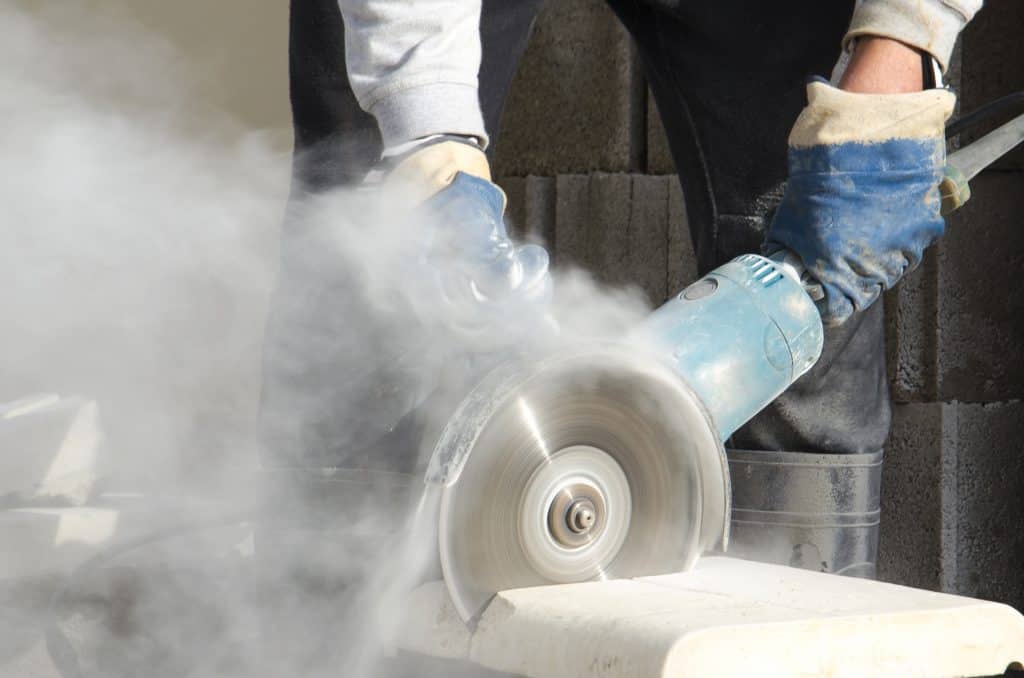
Australia has new guidances from several occupational health and safety (OHS) regulators and agencies which restrict or ban dry-cutting of engineered stone and change other safety-related practices. There is also at least one political move to ban the use of engineered stone. But perhaps more important is that new research on silicosis risks is appearing and not just from Australia. The United States’ Centers for Disease Control and Prevention published new research on 27 September 2019 based on medical assessments and several silicosis-related deaths.

Subscribe to SafetyAtWorkBlog to continue reading.
Subscribe Help
Already a member? Log in here

Time to ban synthetic stone

Professor Malcolm Sim of Monash University spoke at the 2019 National Work Health and Safety Colloquium on an issue that he never imagined he would be speaking of, at his age, silicosis.

As it is in several countries, the emergence of silicosis related to synthetic stone is gradually getting the attention of governments as more, and younger, workers are starting to die from this aggressive occupational disease. Professor Sim outlined the risk of handling this new type of stone by asking:

Subscribe to SafetyAtWorkBlog to continue reading.
Subscribe Help
Already a member? Log in here

Podcast on WHS colloquium

Yesterday the Centre for Work Heath and Safety held its first colloquium of occupational health and safety researchers. It comprised of 15 research presentations, a keynote speaker and a workshop about the 2023 World Congress for Safety and Health at Work to be held in Sydney, Australia.

SafetyAtWorkBlog was lucky to attend and will be writing at least one article about the event for subscribers soon, but I was also able to speak with the Centre’s Director, Skye Buatava, about the event. The audio is available through the links below

https://www.podbean.com/eu/pb-52min-bb8123

https://soundcloud.com/safetyatworkblog/safety-at-work-talks-episode-15

Kevin Jones

What’s the fuss? Stay focused on safety

The debate about quad bike safety has gone global with the United States telling the World Trade Organisation that the imposition of operator protection devices (OPDs) on general quad bikes (those not used for recreation or sport) may be a trade barrier. To some this would appear silly, and the argument has little to do with worker safety, but this action by the US impedes progress on safety.

Recently the Victorian Coroner made findings into the quad bike-related death of 69-year-old farmer Gustaav Walta in September 2017. The finding is not yet publicly available but the story of Walta’s death sounds very familiar.

One evening around 6pm Walta advised his friend that he was putting the sheep away. His friend did not receive the regular phone call the next morning and drove to the property finding a quad bike that had rolled over and Walta’s body in an adjacent paddock. It was determined that Walta had died from severe chest injuries caused by the quad bike incident, that he had been ejected from the bike, the bike rolled over him and he then had tried walking to a neighbour’s property before he collapsed and died.

The chronology in the Findings is not very clear on Walta received his chest injuries but what is clear is that, like so many before, the quad bike had not been fitted with an OPD and that Walta had not been wearing a helmet.

Subscribe to SafetyAtWorkBlog to continue reading.
Subscribe Help
Already a member? Log in here

Burnout – OHS regulators clarify their positions

The prominence of Burnout as an occupational health and safety (OHS) matter has gained renewed prominence since the World Health Organisation (WHO) recognised it as an “occupational phenomenon“. But WHO equally stressed that Burnout

“… is not classified as a medical condition.”

SafetyAtWorkBlog asked several OHS and workplace experts in Australia and overseas about how to prevent Burnout. Below is the first of a series of articles in which Australian OHS Regulators provide their take on the issue. The next part will look at some overseas and non-regulatory perspectives.

Subscribe to SafetyAtWorkBlog to continue reading.
Subscribe Help
Already a member? Log in here
Concatenate Web Development
© Designed and developed by Concatenate Aust Pty Ltd