Acts of God, the morality of safety – interview with Sidney Dekker

The latest episode of Safety At Work Talks is a return to the sequence of interviews with Professor Sidney Dekker.  In April 2017, Dekker published a book called The End of Heaven which discusses suffering.  This book has a very different tone from his previous books and is intriguing.

The breadth of the discussion was also surprising with concepts and references rarely talked about in relation to occupational health and safety, such as morality, Acts of God, train disasters and the Bible.  If this sounds heavy, it is useful to follow the discussion that leads to this statement from Dekker:

“Safety Culture is the new Human Error”.

This latest episode is available at

Soundcloud: https://soundcloud.com/safetyatworkblog/safety-at-works-talks-episode-03 

Podbean: https://safetyoz.podbean.com/

Kevin Jones

Safety Awards nights are important but need constant maintenance

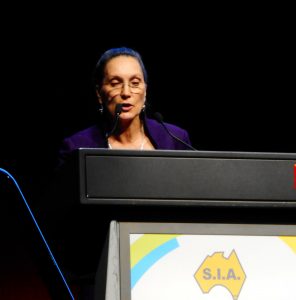
As October is Australia’s Safe Work Month there are several awards evenings. On 19 October 2017, Victoria’s WorkSafe conducted theirs.  It was a sedate evening in comparison to previous events.  Very few tables whoop-ed their nominations,  the MC did not leer at the female waiters and none of the winners danced across the stage.  But there were a couple of notable moments.

Richard Wallace

The most obvious was the standing ovation one winner received from the entire audience.

Subscribe to SafetyAtWorkBlog to continue reading.
Subscribe Help
Already a member? Log in here

New laws help in the prevention of occupational asthma

Recently a public relations firm has been promoting a statement about workers’ compensation and occupational asthma in support of the Australasian Asthma Conference.  The statement was a timely reminder of the 2015 report – The Hidden Costs of Asthma.  These documents are aimed at the management of asthma rather than the prevention but, coincidentally, the Australian Government entered some legislative amendments in Parliament that will help with the prevention of this important condition.

The 

Subscribe to SafetyAtWorkBlog to continue reading.
Subscribe Help
Already a member? Log in here

Measure the old, plan for the new

“What gets measured, gets done” is a common phrase in corporate-speak but needs to be treated with caution in terms of occupational health and safety (OHS).

In The Australian newspaper of October 5 2017 (paywalled) an article about remuneration and innovation includes a brief but telling discussion of the perception of OHS.

Sylvia Falzon is a director of the companies Perpetual and Regis Healthcare.  The article states that Falzon is a

“great believer that ‘what gets measured gets done”.

However, this belief has important limitations. 

Subscribe to SafetyAtWorkBlog to continue reading.
Subscribe Help
Already a member? Log in here

Workplace mental health and wellbeing strategies must consider suicide

There is an increased blurring between the workplace, work and mental health.  In the past, work and life were often split implying that one had little to do with the other except for a salary in return for effort and wellness in preparation for productiveness.  This split was always shaky but was convenient for lots of reasons, one of which was the management of occupational health and safety (OHS).  However that perceptual split is over, now that mental health has come to the fore in many OHS considerations.

Recently

Subscribe to SafetyAtWorkBlog to continue reading.
Subscribe Help
Already a member? Log in here

Singapore’s Prime Minister shows mature approach to OHS

Lee Hsien Loong centre)

It has been noted that the recent World Congress on Safety And Health at Work had “Vision Zero” as one of its three themes.  It was curious that the opening remarks of Singapore’s Prime Minister, Lee Hsien Loong (pictured right), did not mention Vision Zero at all.  In fact he was quite measured in his speech which placed him in a better position to argue for real safety targets and initiatives.

In contrast to many business leaders, and some of the speakers at the World Congress, the Prime Minister stated that

“workplace accidents and injuries are almost always preventable.”

Subscribe to SafetyAtWorkBlog to continue reading.
Subscribe Help
Already a member? Log in here

Exclusive interview with Hans-Horst Konkolewsky on Vision Zero

A major theme of the World Congress of Safety and Health 2017 is the extension and strengthening of the Vision Zero concept.  One of major advocates of this is Hans-Horst Konkolewsky, of the International Social Security Association. Konkolewsky sees Vision Zero as a “life changer”.

Any safety concept that includes the word “zero” is inflammatory to some sectors of the Australian occupational health and safety (OHS) profession as is evident by some of the tweets received by @SafetyOz over the last few hours. Late on Day One a question from the audience also expressed wariness over the use of the concept. However SafetyAtWorkBlog was able to interview Konkolewsky at the congress over a decade after our first interview, when he was head of EU-OSHA.  We outlined the Australian perspective – “Zero Harm” – and his clarification of Vision Zero is important.

Below is audio of the exclusive seven minute interview.

Subscribe to SafetyAtWorkBlog to continue reading.
Subscribe Help
Already a member? Log in here
Concatenate Web Development
© Designed and developed by Concatenate Aust Pty Ltd