
An OHS look at the Fair Work book

On 9 July 2009 I wrote in SafetyAtWorkBlog

“The  Fair Work Act has no relevance to occupational health and safety, so why mention this on SafetyAtWorkBlog?”

The Fair Work Act changes the negotiating and consultative structure of Australian workplaces stemming from changes in industrial relations law.
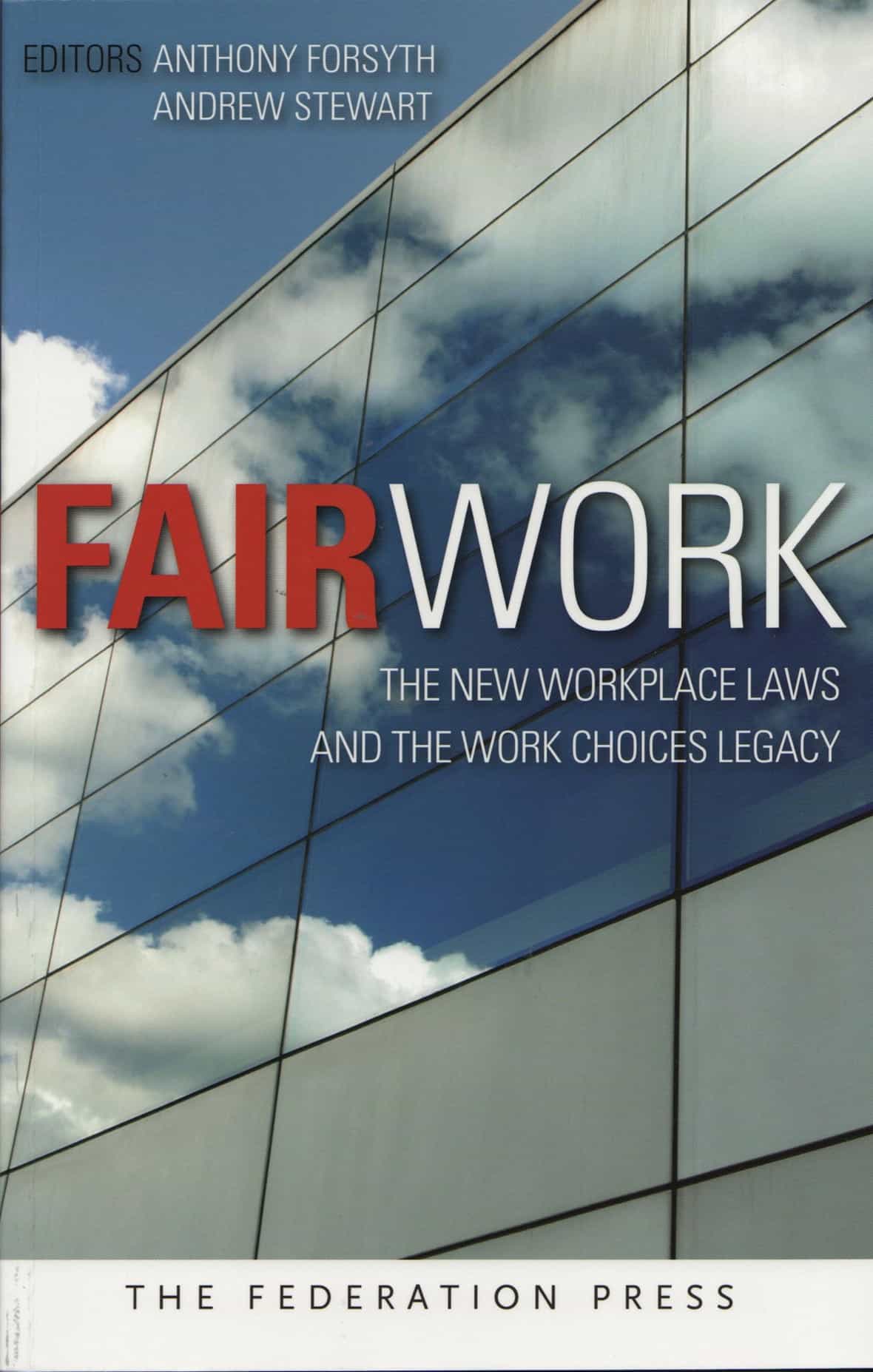
Fair Work Book cover 002A book that came across my desk this morning suggests several other overlaps of OHS and IR in the new regime.  Federation Press sent a copy of  “Fair Work – The New Workplace Laws and the Work Choices Legacy“, a book edited by Anthony Forsyth and Andrew Stewart.

In Andrew Stewart’s chapter he talks of how the New South Wales Industrial Relations Commission made several extreme rulings on the application of State OHS laws to federal employees.  He states that the government of Kevin Rudd has progressed OHS legislative reforms considerably by the government has “not indicated any interest in taking over the field itself”.  The reticence has seemed strange and I was one of those who tipped a greater role for Comcare as a  body for national OHS oversight.

Stewart has interpreted the government’s suspension of Comcare licences for national workers compensation coverage as  illustrating the government’s interest lies

“in streamlining workers compensation for multi-State employers, rather than imposing a national regime”.

Ron McCallum is an Australia labour academic who always demands attention. Stewart includes a particularly salient reference

“Ron McCallum, for example, has argued that labour laws that are centred around corporations are unlikely to retain a ‘wholesome’ balance between employers and employees.  Ultimately, he suggests, such laws are likely to become ‘little more that a sub-set of corporations law because inevitably they will fasten upon the economic needs of corporations and their employees will be viewed as but one aspect of the productive process in our globalized economy.”

The path to fairness is likely to continue to be rocky even during the terms of a government that originated from the labour movement.

NES

Jill Murray and Rosemary Owens write a chapter focusing on the Safety Net, a set of legislated minimum standards – National Employment Standards (NES).  These standards are not “lines in the sand” and have purposely been given inherently flexibility.  One of the issues discussed by Murray & Owens is maximum working hours.

This is particularly important to those of us who are trying to manage the issues of fatigue and impairment in workplaces.  The authors state that it remains between the employer and employee to determine what hours, additional to the 38-hour working week, are “reasonable”.  Some of the relevant safety factors in determining reasonableness are listed as

  • “Occupational health and safety risks”
  • “Personal circumstances, including family responsibilities”, as well as
  • “Needs of the workplace or enterprise” and
  • “any other relevant matter.”

Murray & Owens say that to determine reasonableness is almost impossible to negotiate between individuals because there is no priority allocated to each of the eleven criteria.    The authors say

“… this kind of conflict is exactly what the provision must confront: a business might have urgent demands on production, yet an individual worker has to get home to cook tea for the family.”

Murray & Owens go on

“By placing the potential to expand working hours in the hands of the parties at the workplace, the NES, like WorkChoices, really mean that whoever holds the greater power (and, perhaps, knowledge of their rights) is likley to prevail, notwithstanding any calculation of reasonableness.”

Here is the opportunity for the union movement to generate additional members and in an industrial relations climate that allows fro greater access to employees.  It is rare to find any individual who understands their own employment rights sufficiently to negotiate by and for themselves.  The union movement could again become the “Friend of the Workers” by actually being the friend of workers and doing some solid footwork.

The Fair Work book is far more than this short article indicates.  I only received the book this morning but am promising myself that I will read the rest.

As safety management broadens itself to cover psychosocial risks, it increasingly overlaps industrial relations, a workplace element that, with luck and a bit of work, could have been avoided by OHS professionals in the past.  That is no longer the case and OHS professionals must understand how industrial relations changes will affect their own workplace and how they do their jobs.  The Fair Work book is a great place to start.

Kevin Jones

Maintain instead of repair

Every country has its share of high-fliers who “burn out”.  Many fade away from the public eye with their careers over.  Frequently this path to wealth and prominence is not perceived as a workplace health or safety matter.  Some people decide that the health trade-off of multi-million dollar salaries is worth it.

Sadly the psychological reality of this personal decision is often masked by clichés.  Frequently, executives say that a major motivation for their decision is “to spend more time with my family”.  Many executives may believe this to be a major part of their decision, but regrettably, this worthy sentiment has become a cliché – the equivalent of a beauty pageant winner working toward “world peace”.

The family-time phrase/reason/excuse signifies an important element of the executive’s personality.  They were willing to sacrifice decades of their relationship with their partner and to be absent from the development of their children for money.

If any of these departing executives use the family-time phrase in the same departure speech or media exit-interview  as regaining “control of their lives” to “re-engage with the most important people in my life”, ask the executives, or politicians, “how do you justify ignoring your family over your career?”.

In some cases one could be more specific.  “Do you think that your multi-million career was related to your daughter’s persistent attempts to kill herself?”  “After being absent so frequently and for so long, are you still justified in describing your marriage as a loving relationship, or your partner as your ‘soulmate’?”  “Was your million-dollar salary really worth it?”

Int he wake of the self-generated corporate financial crisis, some corporate executives are re-examining their ethics and morality.  Not enough are going through this but it’s a start.  Most say they operate for the benefit of shareholders but they cannot deny the reality of massive remuneration for their efforts.  What they are ignoring is the individual cost to their loved ones of these efforts.

Should we look up to the billionaires who sacrifice the wellbeing of others they say they love to chase the dollar?  Are these the paragons of our society?

People are trying to maintain or establish a work/life balance.  (There are several articles at SafetyAtWorkBlog that report on this movement.)  But the reality is that to achieve a work/life balance, one must be prepared to sacrifice income.  This may involve the necessity of achieving a certain stage in one’s career that is not the top, but still a position of value in the company and, equally important, of value to one’s family and even one’s own psychological well-being.  If one’s colleagues fail to understand this decision, the workplace culture is faulty, and probably irreparable.

If the ultimate ideal is to have a happy, functional, and sustainable community, one must examine one’s own motivations, and one’s own personal priorities.  Everyone must consider whether we want to emulate those who sacrifice their family’s welfare for money or whether we support those who rebut the “glory of the high-achiever” and emulate those who love their family enough to spend time with them through their career.  Maintenance is easier than repair in life as in safety management.

Kevin Jones

What the next generation of graduates wants

A survey of graduates by GradConnection released on 15 July 2009 has important information for Australian companies and provides some optimism for the OHS profession and regulators.

A dominant element of modern employment is work/life balance. In some disciplines this is taken as workplace flexibility. In terms of workplace safety, work/life balance is a euphemism for psychosocial hazards of stress, bullying, fatigue, and workload amongst others. From this position, the survey findings showed that, when asked “What are the most important extra benefits?”, work/life balance scored the most support at almost 39%.

Companies that want to recruit graduates, often those companies which are looking to refresh their staff and workplace culture but also need to build sustainability and longevity, need to review their existing working conditions to match the desires of job seekers. This could be an enormous task for corporations that will take years but smaller companies can afford to be more reactive and flexible and may get the edge on attracting graduates.

It must be acknowledged that over 60% identified high salaries as the most important element in their salary packages. But the work/life balance indicates a growing reality that graduates are less likely to trade off wellbeing for dollars.

This is supported in terms of extra benefits where flexitime and flexible working arrangements gained around 24% and 22% support, respectively. Companies must operate within the time constraints of their industry, suppliers and customers but they should also identify those work processes that allow for flexibility. It may be useful to formalize start and finish times so that there remains a core set of hours within the working day where interaction of staff and clients can be maximised. Some of the social structures are already pushing in this direction with issues of public transport, schooling and childcare already accommodating this flexibility.

David Jenkins, the director of GradConnection, told SafetyAtWorkBlog that

The data we have extracted is drawn from contributions by about 10,500 graduates currently looking at their career options. It gives employers clear indicators as to what grads are looking for in their careers and helps potential employers adjust or increase their messaging about careers on offer at their companies.

Hope for OHS professionals and regulators comes from the fact that of the values that graduates wanted an employer to embrace, health and safety ranked third, behind equal opportunities and environmental sustainability.

This survey is the first generated through the website of GradConnections so the next survey should be able to provide some trend data.

Kevin Jones

More workplace stressors, email and upwards bullying

According to a paper presented at the latest Industrial & Organisational Psychology Conference organised by the Australian Psychological Society, poor quality emails are causing almost as much stress in the workplace as the number received.

New Zealand provisional (?) psychologist, Rowena Brown, was presenting findings from her PhD studies and said

“Email is a double-edged sword. We know that email can help employees to feel engaged with and connected to their work colleagues, however the impact of a poor quality email, combined with the expectation to respond immediately, can create unnecessary stress.  Our research raises important issues for employers, who have a responsibility to train their staff in appropriate email etiquette.”

This type of research really doesn’t help business and managers to deal with the stress of their employees because it doesn’t  provide any useful control measures.  There are more significant causes of stress that demand the attention of OHS professionals and managers.

The same conference illustrates one of those other stressors.  Sara Branch, a psychologist Griffith University was quoted on the matter of employees bullying their bosses.

“Upwards bullying, like other forms of workplace bullying, is often more subtle and less obvious to other staff. However, it can also include more aggressive behaviours such as yelling, verbal threats, and confrontational phone conversations.”

“Workplaces need to understand that bullying can occur at any level in an organisation. Although managers clearly have formal authority, they can also be victims of bullying and need just as much support as other staff.”

The study also found, according to a media release about the conference, that one of the main triggers for upwards bullying is organisational change.

“If an employee is disgruntled by change, such as new working conditions, management, or processes, they may blame their manager and respond by bullying them.”

With the increased attention to psychosocial hazards in the occupational health and safety profession, it is necessary to pay attention to these sorts of studies but they are simply new perspectives on established issues that should already be monitored and changed.

These studies may illustrate the issue that OHS professionals can use to gain that managerial or client attention but they should be handled carefully so that these specific issues do not dominate the understanding on the manager or client.

SafetyAtWorkBlog advocates looking outside the OHS discipline for new evidence and understandings of workplace issues be it sociology or psychology but one must avoid reacting to hype.

Kevin Jones

When employees are their worst enemy.

A recent article in a rehabilitation newsletter reminded me of a client from several years ago.

Several employees in a small item packaging line were reporting wrist and forearm soreness toward the end of their shift.  They believed that the line speed was too fast for them to comfortably work their full shift.

In consultation with the workers and the operations manager we went through various possible control options – line speed, automation, seating, posture, warm-up exercise, footwear, length of shift…..

A couple of days later, I was at the workplace at the end of the shift.  The employees said they were sore but they did not go home.  They stayed on for several hours of overtime.  When I asked them about this they said they always do the overtime.

So the assessment of working environment had incomplete data.

My advice was that if the employees were putting themselves at harm of the potential for harm, undertaking overtime while not fit-for-work contravenes their own OHS obligations.  If the employer offered these employees overtime knowing the employees were in pain, the employer is breaching the OHS obligation.

That is the straight OHS position.  But life is more complex than OHS.  The right OHS decision deprives the employees of additional income.  The right OHS decision could encourage employees to not report their pain or discomfort, for if they do, the offer of overtime would be withdrawn.  Non-reporting of injuries is a common short-term decision that many employees make.

It is in this context that consultation is required between employees, production manager, supervisor, human resources officer, and the health & safety rep, if one is on site.  This consultative group can then make a decision that everyone understands the justification for, even if some participants do not like it.

A question to ponder from the scenario above – if one of the workers developed pain during the normal work shift, undertook overtime without the employer being informed of the pain and put in a worker’s compensation claim for the pain, would the employer feel justified in contesting the claim?

Kevin Jones

Resilience, stress and safety management

The July 25 2007 SafetyAtWork podcast is now available for download.  It includes an interview with Michael Licenblat where we discuss the psychological approach to individuals taking control of their own safety, the benefits of wellbeing programs and the changing workplace.

On listening back to the podcast today, I was struck by several issues he raises:

  • Michael is one of the few wellbeing gurus who directly link the management of stress to the productivity of the worker.  He displays more awareness than many others of the “proactive” OHS context of this approach to human capital.
  • He discusses why it is difficult for all of us to say no to some work tasks, even if  the task is high risk and may injure ourselves and others.
  • He states two core elements of workplace cultures that seem to revolve around the established OHS obligation of consultation.  Perhaps OHS managers can become real agents of change by cranking up consultation.

Kevin Jones

Harmonising workers compensation

Gabrielle Lis raised an issue in an article for Return To Work Matters that deserves to be seriously considered.  The Australian Government is set on a path of harmonising OHS laws through the coordination role of Safe Work Australia.  One of the key policies  for Safe Work Australia is also to 

“develop proposals relating to… harmonising workers’ compensation arrangements across the Commonwealth, States and Territories…”

Wow, this is more of a challenge than harmonising OHS laws.  As Gabrielle writes

“Workers and employers don’t always see eye to eye on the issue, not to mention the differing interests of big businesses and small and medium enterprises, and the entrenched positions of the states and territories, who all tend to prefer “how we do things” to how things might best be done.”

Safe Work Australia is going to be dealing with over a dozen worker’s compensation insurers, around half a dozen workers’ compensation bureaucracies and thousands of stakeholders in the compensation, insurance, healthcare and return-to-work sectors.

This challenge is phenomenal and will not fit into any short-term schedule.  This challenge differs from OHS in that it directly involves money, millions of it.  The negotiations on OHS between government, unions and employer groups will be nothing compared to when the insurance companies move in on workers compensation.

Kevin Jones

(Disclaimer: Kevin Jones is a regular columnist for www.rtwmatters.org)

Concatenate Web Development
© Designed and developed by Concatenate Aust Pty Ltd